What you'll learn
Key ideas from Four Thousand Weeks
These ideas compress the book's argument without treating the author's view as settled fact. Use them as an orientation before reading the full work or listening in Wiseley.
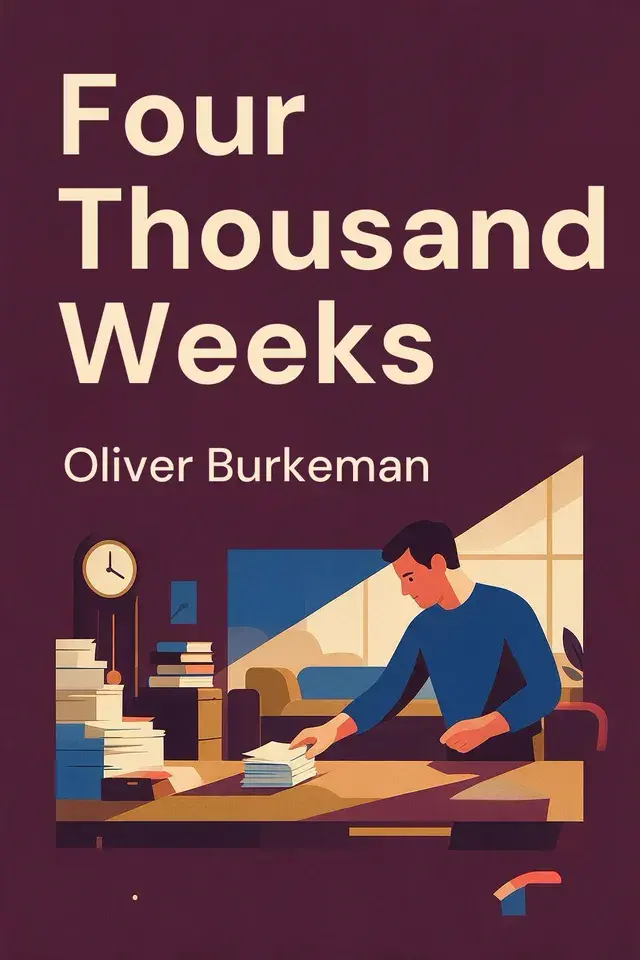
An eighty-year life contains roughly four thousand weeks, making limitless human ambition collide with a strictly finite capacity for living.
Finite time makes every meaningful commitment a refusal of alternatives, so sacrifice is part of choosing rather than evidence of failure.
Limiting work in progress and accepting selective neglect prevent attractive alternatives from scattering commitment.
Leisure becomes genuine when some time is enjoyed without productivity, recovery, or self-improvement as its justification.
Patience is active endurance: accepting limited control makes room for prolonged attention, clearer perception, and engagement with difficult work.
Synchronized rest and ordinary shared pauses can support mental health, belonging, and informal equality.
A project can matter through present participation even when its completion lies beyond one lifespan.
Relinquishing rescue and certainty returns attention to the next necessary action within finite personal and historical limits.
How Four Thousand Weeks builds its case
Follow how the book develops its argument. Each note is a brief orientation, not a replacement for the chapter.
Finite Time, Endless Demands
Imagine trying to picture a normal human lifespan not in years but in weeks. An eighty-year life contains roughly four thousand of them.
Choose, Then Let Go
Once we stop expecting a better system to make room for everything, the problem of time changes shape. It is no longer about squeezing more into the day.
Commitment Over Infinite Possibility
Commitment becomes livable when you stop treating every neglected possibility as a problem to solve. Finite time means that protecting one valuable activity leaves other legitimate demands unattended.
Stop Living for Later
The argument now turns from choosing where to spend finite time to a more unsettling problem: even after we choose, we may still treat the present as something to get through. The question is not whether to plan, but what we ask planning to provide.
Patience Against Compulsive Speed
The case for rest raises an unsettling question: why does stopping feel like a problem? Burkeman argues that people are not merely denied rest by economic pressure; many have learned to distrust idleness.
Time Exists Between People
Time is often treated as a private resource: the more of it you control, the better your life should be. Productivity advice imagines an ideal of choosing your own hours, location, vacations, and commitments.
Meaning Without Completion
The Great Pause created a strange opening in the book’s argument. When lockdown halted commuting, consumption, and ordinary office rituals, many people briefly saw that familiar arrangements were not inevitable.
Act Without Guarantees
The book’s final move is practical. Once finitude has been faced, the question is no longer how to secure every possible outcome.