What you'll learn
Key ideas from The Rational Optimist
These ideas compress the book's argument without treating the author's view as settled fact. Use them as an orientation before reading the full work or listening in Wiseley.
The chapter defines progress through lived welfare: safer lives, longer lives, better health, greater choice, and more goods and services with less work.
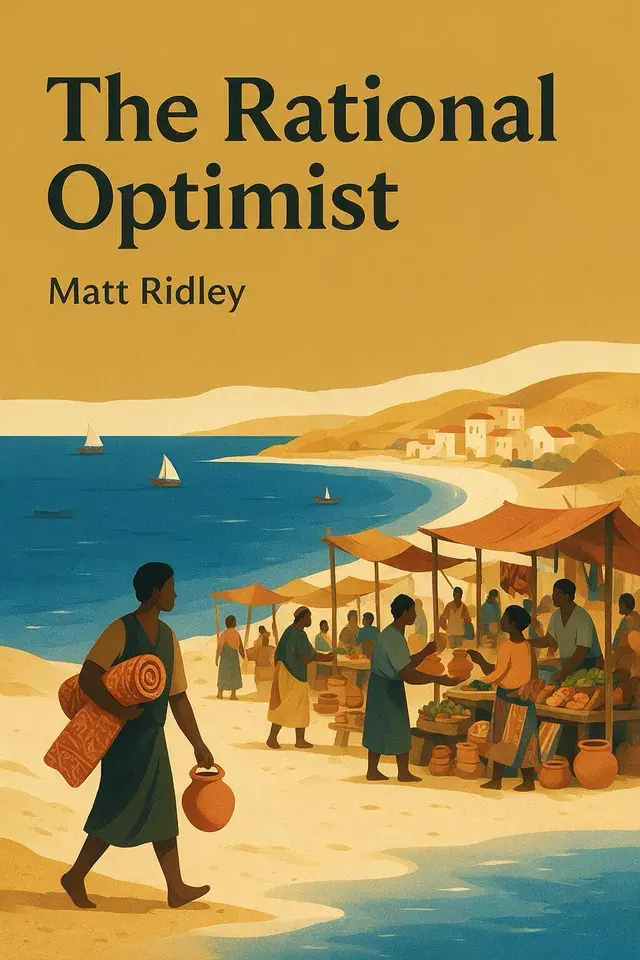
Exchange and comparative advantage let unrelated people specialize, recombine knowledge, and build a collective brain.
Merchant customs can become formal law, while courts and rules make strangers' exchange safer without eliminating fraud or failure.
Borlaug’s short-straw wheat shows how a targeted plant trait, fertilizer, research, and institutions can turn a famine warning into higher yields.
Innovation is bottom-up, mobile, and uneven, with specialization, diffusion, users, and outsiders often driving progress beyond centralized direction.
Static forecasts fail when prices, technology, institutions, and behavior adapt to scarcity and changing conditions.
Optimism remains conditional because suffering, political capture, predation, and uncertainty can interrupt innovation.
How The Rational Optimist builds its case
Follow how the book develops its argument. Each note is a brief orientation, not a replacement for the chapter.
The Evidence for a Better Present
The book begins with a puzzle. Human motives have changed little: people still seek food, sex, status, safety, and care for children.
The Collective Brain Takes Shape
Modern humans did not simply become intelligent and then begin to progress. For more than a million years, hominids across Africa and western Eurasia made broadly similar Acheulean hand axes.
Trust, Reputation, and Rules
Exchange with strangers begins with a problem: why trust anyone you do not know? Ridley opens with money as recorded trust.
The Neolithic Bargain
Agriculture did not begin as a clean break with hunting and gathering. It grew out of specialization and exchange, which let societies combine many kinds of knowledge.
Feeding More People, Sparing More Land
Modern agriculture’s central achievement is not simply more food. It changes the land equation.
Cities, Trade, and the Limits of Power
Cities, in this account, are exchange systems, not merely large settlements built around farm surpluses. When people specialize, each can produce more of one thing and obtain other goods through trade.
Escaping the Malthusian Cycle
The Malthusian cycle begins with a simple pattern: more food allows a population to grow until starvation, disease, or other checks bring it down. Humans partly escape this pattern because we exchange, specialize, accumulate capital, use nonhuman energy, draw on overseas resources, and migrate.
Energy as Substituted Labor
Read as a history of substituted labor, economic development begins with muscle. Rome relied mainly on enslaved human effort.
The Increasing Returns of Knowledge
Why do physical resources tend to run out while prosperity keeps finding new room? Ridley starts with a contrast.
Why Pessimism Persists
Why do gloomy predictions return even when health, wealth, safety, and choice are improving? Ridley begins with an asymmetry.
Testing Catastrophe Forecasts
The right way to test a catastrophe forecast is to ask what it assumes will remain unchanged. If oil vanished while transport depended on it, transport would stop; if irrigation exhausted aquifers, harvests could fail.
Africa's Bottom-Up Development
Africa presents the book’s hardest test of optimism. Much of the world’s remaining extreme poverty is concentrated there, after war, disease, dictatorship, trade barriers, and weak institutions slowed progress.
Climate, Adaptation, and Energy Choice
The chapter treats climate change as a serious test of rational optimism. The author accepts that warming is occurring, that natural shifts have disrupted civilizations, and that future changes can cause real harm.
The Coming Age of Catallaxy
Ridley’s final argument is not that history has entered a trouble-free age. It is that prosperity can be understood as a self-reinforcing cultural process.