What you'll learn
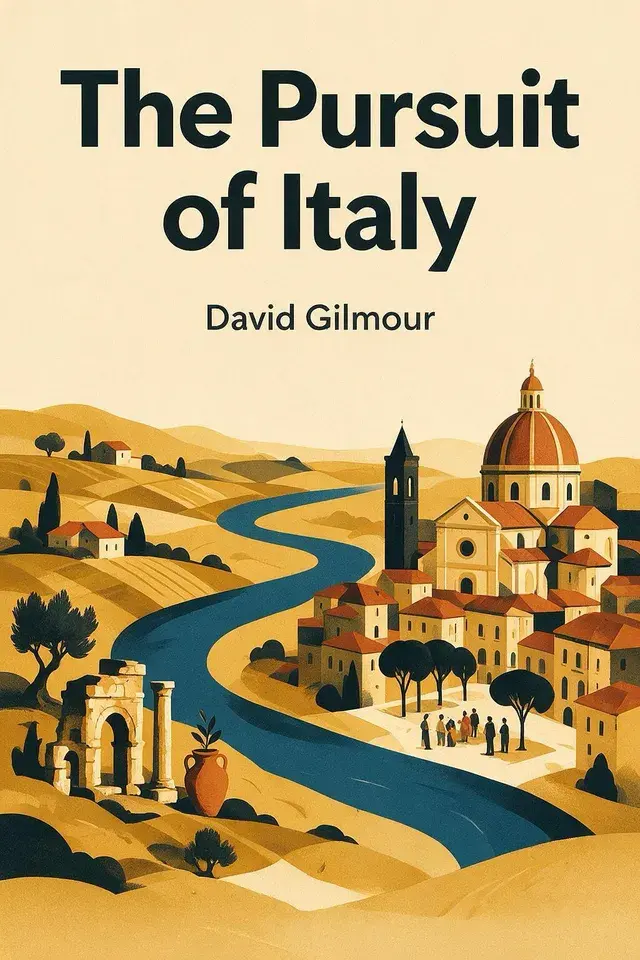
Key ideas from The Pursuit of Italy
These ideas compress the book's argument without treating the author's view as settled fact. Use them as an orientation before reading the full work or listening in Wiseley.
Italy’s unity appears as a contingent political project, not an inevitable expression of geography.
Romantic patriots turned humiliation, selective history, and literature into an imagined Italian community.
Venice and Rome entered Italy through foreign wars and withdrawals, not through a self-generated national uprising.
Revisionists recast the Risorgimento as a rapid, elite-led process with limited popular participation and elements of civil war, challenging romantic national memory.
Southern resistance was a mixed-motive civil war, and state repression plus official concealment turned military victory into a lasting legitimacy problem.
Mass organizations, spectacle, selective cultural freedom, and coercion produced genuine but uneven nationalization rather than shared citizenship.
The economic miracle created consumer prosperity through industry and family firms while intensifying environmental damage, migration, and regional inequality.
Families, voluntary associations, food traditions, and municipalities sustain communal life when national institutions lose credibility.
How The Pursuit of Italy builds its case
Follow how the book develops its argument. Each note is a brief orientation, not a replacement for the chapter.
The Geography of an Unmade Nation
The book opens with a provocation. Paolo Rossi argued that Garibaldi harmed Italy by incorporating Sicily and Naples into the northern kingdom; without that union, the north might have become Europe’s richest state, while the south remained separate.
Rome’s Unity, Empire’s Fracture
To see how Italy became united without becoming a nation, start with the peninsula Rome encountered: a land of distinct peoples, customs, and local identities. Rome did not dissolve that diversity.
Communes, Courts, and Civic Power
Once imperial authority became distant, cities in Lombardy and Tuscany began governing themselves. Communes replaced imperial delegates with elected consuls, councils, courts, and militias.
Venice’s Maritime Exception
Venice poses the book’s clearest challenge to the idea that political division always produced failure. It was not a nation-state, yet it maintained an independent republic, a commercial empire, and a civic identity for centuries.
Foreign Rule, Reform, and Napoleon
Foreign rule in Italy was not one continuous condition. It was a succession of dynastic settlements, occupations, and reforms.
Romanticism Before the Nation
After the Restoration, humiliation became cultural material. Italy remained a peninsula of rival states and regional loyalties, but writers tried to make a shared country imaginable.
Piedmont’s Calculated Path to Unity
Why did Italy become a Piedmontese kingdom rather than a federation or republic? Austria’s victory over the revolutions of eighteen forty-eight and eighteen forty-nine discredited federalism and conspiratorial insurrection.
Garibaldi and the Contested Kingdom
The kingdom was completed by conquest, but conquest did not prove that Italians had become one political people. In Sicily, the revolt that opened Garibaldi’s path began as resistance to Bourbon administration.
Heroes, Armies, and National Myth
Once the kingdom existed, public memory compressed a complicated conquest into a heroic story. Foreign admirers, Italian liberals, governments, statues, streets, and patriotic writing presented Victor Emanuel, Cavour, Garibaldi, and Mazzini as a complementary quartet: king, statesman, soldier, and revolutionary.
The Price of Piedmontization
After annexation, the new kingdom discovered that sharing a map did not mean sharing a country. The journey from northern Italy to Naples could feel like crossing a frontier.
Glory, Liberalism, and Empire
After unification, Italy faced a choice: build practical national institutions, or compensate for weakness with the theatre of power. The kingdom repeatedly chose oversized armies and imperial projects.
War, Fascism, and the Ruptured State
Italy entered the First World War through a choice that was neither inevitable nor as national as later memory suggested. Its alliance with Austria-Hungary and Germany sat uneasily beside dependence on Britain and France.
Fascism’s Roman Empire and Collapse
Once Mussolini reached office, fascism claimed to complete Italian nation-making while breaking with liberal Italy. Its strength lay in a flexible fusion, not a coherent doctrine.
Republic, Communism, and Prosperity
After fascism, Italy needed more than a new government. It needed a new reason to believe in the state.
Regionalism, Berlusconi, and Resilience
After Clean Hands and the collapse of the old parties, Italy did not recover a stable national centre. The postwar constitution had already asked whether a centralized state suited such a varied peninsula.