What you'll learn
Key ideas from Postwar
These ideas compress the book's argument without treating the author's view as settled fact. Use them as an orientation before reading the full work or listening in Wiseley.
The war left Europe’s civilians, populations, and institutions devastated, making 1945 a rupture rather than a return to normality.
Germany became the hinge between Western reconstruction and Soviet consolidation, turning an unsettled occupation into partition.
Sovietization fused Party monopoly, state ownership, collectivization, and distorted industrialization into a durable system of political dependence.
Welfare states turned growth into security and mobility, but their models ranged from Scandinavian universalism to Austrian patronage and British fairness.
Oil shocks, stagflation, and deindustrialization ended postwar confidence without amounting to an absolute historical depression.
State collapse did not guarantee democracy: successor elites preserved power, nationalism divided federations, and Yugoslavia turned political choices into war.
EU institutions delivered markets, legal coordination, redistribution, and peace, but their democratic authority remained indirect and difficult to own.
Holocaust remembrance moved from national silence toward institutional recognition, without erasing collaboration, indifference, or historical complexity.
How Postwar builds its case
Follow how the book develops its argument. Each note is a brief orientation, not a replacement for the chapter.
Europe After Total War
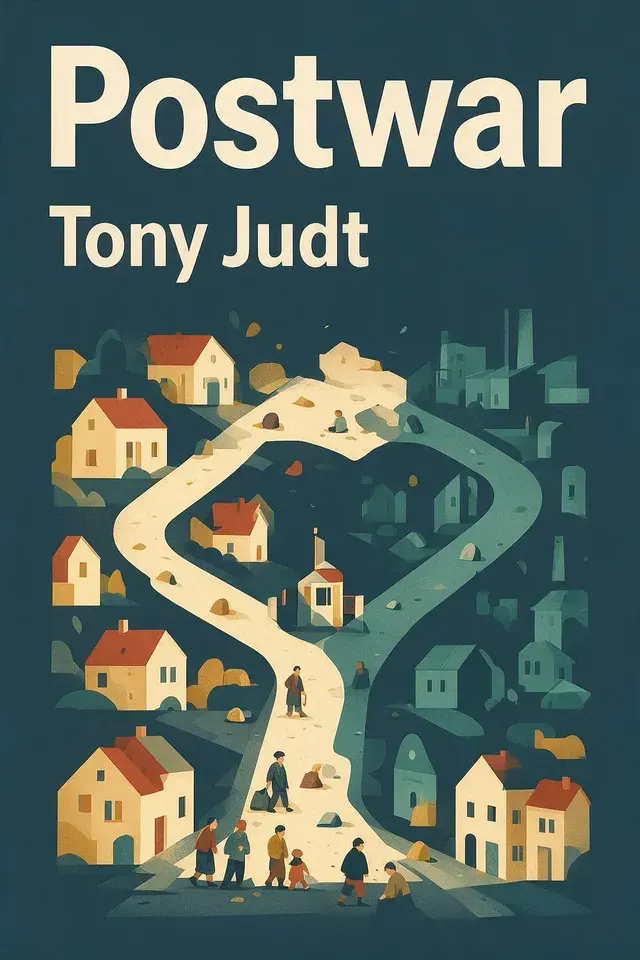
Europe in 1945 was not liberated into an intact past. Tony Judt presents it as a violent rupture: war had destroyed populations, institutions, and confidence in law, leaving a question of what could replace the old order.
Retribution and Reconstruction
After 1945, European governments faced more than repair. Occupation and collaboration had discredited institutions, while people carried humiliation, compromise, and loss.
The German Settlement and Division
Europe’s postwar division did not emerge from a single blueprint. It grew from occupying armies, fear of German revival, and aims the wartime alliance had concealed.
The Soviet Empire and Its Culture
The Soviet victory over Nazi Germany gave Stalinism new legitimacy. Military success made the Bolshevik project appear effective and pushed Stalin’s earlier crimes into the background.
Stability, Empire, and Its Limits
The apparent calm of Western Europe in the 1950s was a managed settlement, not a spontaneous return to political wisdom. After Stalin’s death and the Korean War, superpower negotiations contained disputes, while Europeans surrendered control over their resolution.
Affluence and the Social Contract
In Judt’s account, Western Europe’s postwar prosperity was not a miracle from nowhere. It was catch-up growth shaped by policy.
1968 and the Limits of Revolution
The Sixties transformed European social life more deeply than they transformed European governments. A large postwar generation came of age in prosperity, making education the central challenge.
Crisis and Democratic Adaptation
The 1970s did not simply interrupt the postwar story; they ended its confidence. The boom rested on cheap energy, rising productivity, stable money, and the expectation that governments could sustain growth and employment.
Dissidence and the Market Turn
By the 1980s, Europe was contesting more than budgets and ownership. The postwar story linked memories of Depression and Fascism to welfare, public authority, and faith in social progress.
1989 and the Uneven Transition
1989 was not one revolution. It was a rapid chain of collapses whose timing depended on Moscow.
Integration and Unequal Europe
After 1989, Europe did not become a post-national society. It became a layered system in which states, regions, and European institutions shared authority.
Social Model and Historical Memory
At the end of Europe’s postwar story, the central achievement is easy to misstate. Europe did not become a single nation, and its states did not disappear.