What you'll learn
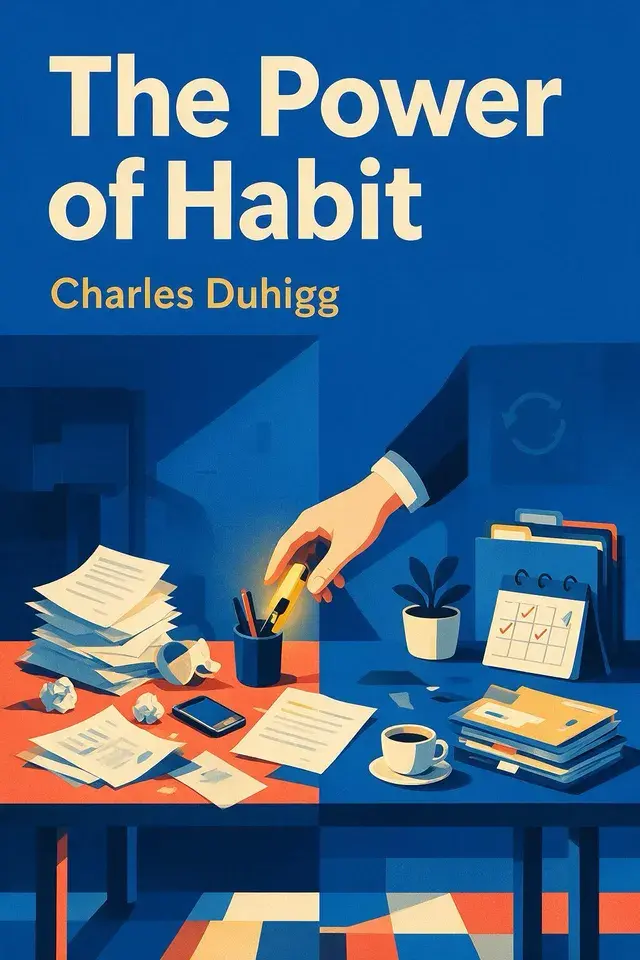
Key ideas from The Power of Habit
These ideas compress the book's argument without treating the author's view as settled fact. Use them as an orientation before reading the full work or listening in Wiseley.
Cues initiate routines, while rewards reinforce and preserve the learned sequence.
Durable habit change usually keeps the cue and reward while replacing the routine with a response that meets the underlying craving.
Keystone habits create small wins and structures that help other routines and shared values take hold.
Autonomy, implementation plans, and rehearsed responses make self-control more dependable at stressful inflection points.
Organizational routines preserve memory, coordinate complex work, and contain rivalry, but they can conceal unequal authority and unowned risks.
Leaders sustain movements by teaching routines that reshape identity, distribute ownership, and let participants act without constant direction.
The appendix connects routine identification, reward testing, cue isolation, planned replacement, and repetition without promising quick or complete change.
How The Power of Habit builds its case
Follow how the book develops its argument. Each note is a brief orientation, not a replacement for the chapter.
Automatic Loops and Craving
Much of daily life feels like a stream of choices. Duhigg begins by arguing that many choices are actually habits: decisions made deliberately at some point, then repeated without much conscious thought.
Replacing Routines Under Pressure
Recognizing a habit loop explains why behavior repeats, but it does not by itself show how to change it. The chapter’s central strategy is the Golden Rule of habit change: preserve the existing cue and reward, then insert a different routine that satisfies the same craving.
Keystone Habits and Willpower
The chapter’s central idea is that change does not always begin with the behavior that looks most urgent. A keystone habit is a routine chosen for its leverage: changing it can create structures, expectations, and small wins that make other changes easier.
Organizations, Failure, and Crisis
Organizations need habits because complex work cannot be reinvented at every turn. Repeated routines preserve knowledge, coordinate people, and reduce uncertainty when staff change.
Consumers, Prediction, and Familiarity
Once the habit loop is in view, commerce asks a second question: can prediction make someone adopt a behavior? Consumer habits are individual.
How Movements Become Habits
The book’s habit logic does not stop at individuals. Groups also develop patterns that make action easier to begin, repeat, and pass on.
Agency, Compulsion, and Practice
The book closes by testing its own thesis against cases in which automatic behavior appears to take over. If a routine can run before deliberation, what remains of responsibility?