What you'll learn
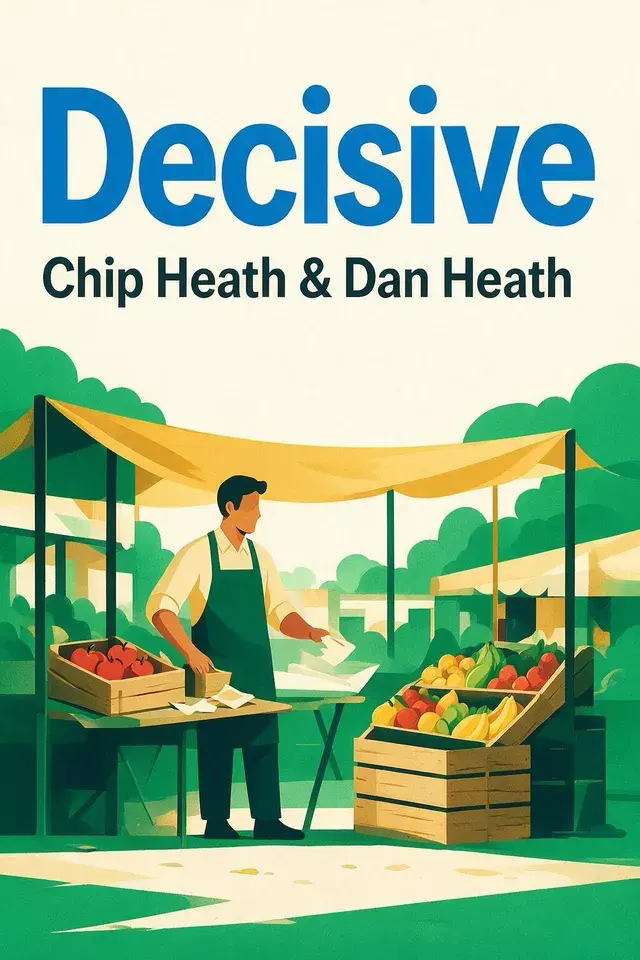
Key ideas from Decisive
These ideas compress the book's argument without treating the author's view as settled fact. Use them as an orientation before reading the full work or listening in Wiseley.
WRAP links four corrections: widening options, reality-testing assumptions, gaining distance, and preparing for error.
Multitracking keeps distinct options alive together, making tradeoffs and strong features easier to compare while reducing attachment to a single idea.
The outside view contributes base rates, while close-up evidence reveals the practical texture and context that averages cannot capture.
A small, realistic trial can replace a forecast with direct evidence before a costly commitment.
Distance through time and perspective gives fleeting emotion less control over a difficult choice.
Guardrails, mission rules, and stop-doing lists translate priorities into repeated behavior and explicit tradeoffs.
Bookending the future replaces a single forecast with plausible lower and upper outcomes, revealing where protection or capacity may be needed.
Procedural justice separates a fair decision process from a favorable outcome and shapes how disappointed people respond.
How Decisive builds its case
Follow how the book develops its argument. Each note is a brief orientation, not a replacement for the chapter.
Why Good Decisions Go Wrong
Good decisions often go wrong before the final choice is made. They go wrong when attention settles too quickly on a partial view of the situation.
Build a Real Choice Set
Many decisions arrive as simple questions: Should I stay or leave? Should we buy this company or not?
Borrow Better Possibilities
Direct brainstorming often stalls because the mind keeps circling the first frame. A better source of alternatives is often outside the decision maker’s own imagination.
Make the Evidence Argue Back
Once a decision has several options, the hardest question is often not what could work but whether the evidence supporting a favorite option deserves trust. People naturally notice, seek, and interpret information that confirms what they already believe.
Test Before You Leap
Forecasting is tempting because it appears to turn uncertainty into a question we can answer before acting. But when action can reveal the missing information, a small experiment may teach more than a confident prediction.
Create Distance, Choose Priorities
Once a decision maker has widened the choice and tested its assumptions, choosing can seem like the easy final step. The authors argue that it is often where temporary emotion, familiarity, and fear of loss regain control.
Prepare for the Full Range
Choosing an option does not make the future predictable; it makes preparation possible. The authors describe the P in WRAP as prepare to be wrong.
Trust the Process in Practice
Decisiveness, the authors argue in the final synthesis, is not certainty or a fixed personality trait. It is a way of behaving when the future remains unclear.