What you'll learn
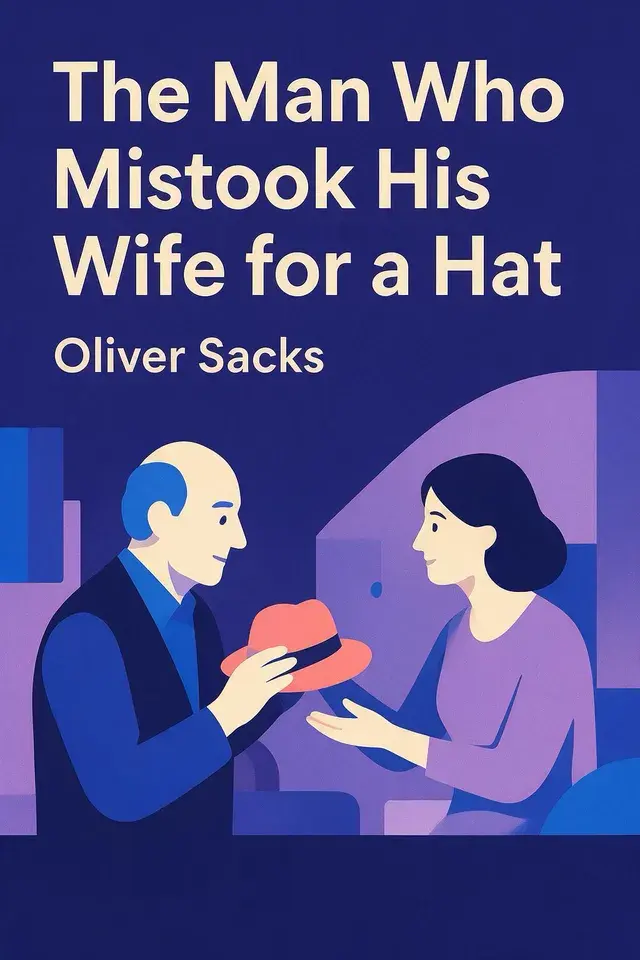
Key ideas from The Man Who Mistook His Wife for a Hat
These ideas compress the book's argument without treating the author's view as settled fact. Use them as an orientation before reading the full work or listening in Wiseley.
Sacks argues that clinical neurology must join brain mechanisms to biography, because a diagnosis can describe disease without describing the person living through it.
Jimmie’s recent-memory loss breaks personal continuity while leaving intelligence, older knowledge, skills, and feeling partly intact.
Proprioception quietly supplies position, tone, and movement signals that help the body feel coordinated and owned.
Perception becomes usable through active exploration, not sensation alone, as Madeleine’s hands developed function through reaching, handling, and sustained use.
Ray’s Haldol regimen reduced disabling tics while also narrowing spontaneity, timing, wit, sexuality, and musical vitality.
Evaluation becomes fuller when it observes spontaneous meaning and participation alongside formal scores.
The chapter’s final synthesis is that care can make surviving forms of personhood visible without promising a complete cure.
How The Man Who Mistook His Wife for a Hat builds its case
Follow how the book develops its argument. Each note is a brief orientation, not a replacement for the chapter.
From Deficit to Personhood
In his preface, Oliver Sacks presents himself as both naturalist and physician, drawn to theory and drama, science and romance. That tension becomes the book’s method.
Memory and Personal Continuity
Memory is more than a storehouse of facts. For Sacks, it gives life coherence by linking perception to feeling, action to purpose, and the present to a past and future.
The Body as Self
Most of the time, the body tells us where it is without asking for attention. Proprioception is a quiet sense arising from muscles, tendons, and joints.
Relearning Perception Through Action
Chapter 3 showed how losing proprioception can unsettle the felt body. The cases here broaden that lesson.
When Neurology Overflows
After examining what neurological disease can remove, Sacks turns to what it can add. Traditional neurology is comfortable with deficits: a function works, or it fails.
Involuntary Worlds and Meaning
Neurology in these cases does more than remove a faculty or add an impulse. It can loosen the structure that makes experience personal, or open a world that arrives without permission.
Intelligence Beyond Formal Tests
One of the book’s most important challenges to conventional neurology begins with people historically called “simple.” Sacks uses that language critically.
Savant Minds and Social Cost
The twins are introduced as a problem of interpretation. Earlier investigators and television programs had made their calendar calculation and visual memory seem almost solved.
Art, Recovery, and Recognition
Jose’s history begins with uncertainty. After a high fever at age eight, he developed incessant seizures and lost speech, schooling, and social contact.