What you'll learn
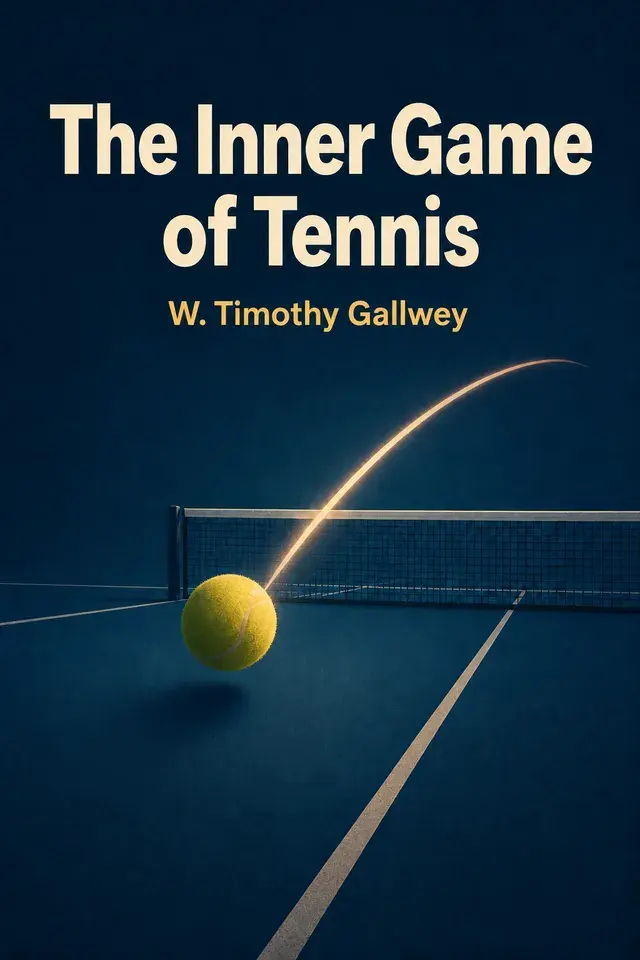
Key ideas from The Inner Game of Tennis
These ideas compress the book's argument without treating the author's view as settled fact. Use them as an orientation before reading the full work or listening in Wiseley.
The outer game concerns opponents, obstacles, technique, and goals; the inner game concerns mental habits that interfere with performance.
Sally’s forehand shows result programming: a clear deep-ball image lets the body reorganize mechanics, balance, force, and confidence without commands.
Concentration is relaxed fascination with present sensory details, including seams, trajectory, sound, racket feel, rhythm, and bodily sensation.
The most durable measure of success is wholehearted, controllable effort rather than an uncontrollable match result.
Unfreakability separates present reality from regret, anxiety, and resistance, supporting calm perception and sensible action.
Letting go releases attachment and control without abandoning care, practice, practical change, or movement toward life.
How The Inner Game of Tennis builds its case
Follow how the book develops its argument. Each note is a brief orientation, not a replacement for the chapter.
The Two Selves and the First Practice
Gallwey begins with a distinction between two games contained in every game of tennis. The outer game is played against an opponent and other external obstacles, toward an external goal.
Trusting the Body to Learn
Having distinguished Self 1 from Self 2, Gallwey turns the idea into a learning method. Self 1 is not asked to vanish.
Replacing Grooves, Training Attention
Once a player has acquired a useful stroke, the challenge changes. The task is to replace a groove that has become automatic.
Competition Without the Verdict
The visible score in a tennis match is only one layer of the game. Gallwey argues that players bring private motives to the court, and those motives can matter as much as their strokes.
Inner Freedom in the Present
The Inner Game begins with tennis, but its final subject is not a better stroke. It is the freedom to meet experience without being pulled backward by regret, forward by anxiety, or sideways by resistance.