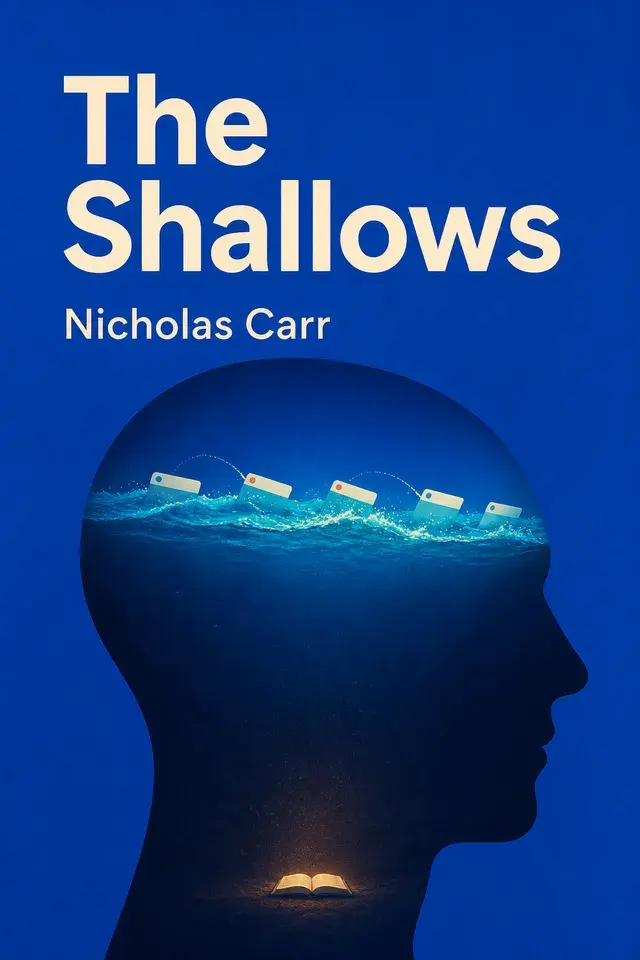
What you'll learn
Key ideas from The Shallows
These ideas compress the book's argument without treating the author's view as settled fact. Use them as an orientation before reading the full work or listening in Wiseley.
McLuhan’s medium-centered lens shifts attention from content to the ways technologies organize perception, behavior, and the nervous system.
Adult brains remain plastic, so repeated experiences strengthen some neural pathways, weaken neglected ones, and turn recurring media use into cognitive habit.
Deep reading linked textual decoding with imagination, reflection, sensory awareness, and the development of complex thought.
Links, search, multimedia, and notifications expand access while making digital reading modular and interruptible.
Working memory can be overloaded by links, alerts, and simultaneous media, reducing retention, comprehension, and connections among ideas.
The chapter treats intellectual balance as the combination of efficient retrieval and the slower work of reflection.
Because memory’s connections help form intellect, identity, and culture, outsourcing them threatens more than recall.
How The Shallows builds its case
Follow how the book develops its argument. Each note is a brief orientation, not a replacement for the chapter.
The Medium Shapes the Mind
Carr opens with a change he can feel while reading. He once disappeared into long books and sustained arguments.
Plasticity and Intellectual Tools
To explain why tools can change thought, Carr turns to the brain’s ability to change itself. He uses Nietzsche’s typewriter as a compact example.
How Books Made Depth
Carr presents the book as an intellectual technology, not simply a container for ideas. Books made depth because their materials and conventions gradually made sustained, private attention practical.
The Universal Medium Arrives
Print had long been the dominant container for sustained written thought. Radio, cinema, the phonograph, and television could compete with books, but they could not carry the written word in the same way.
The Juggler’s Brain
Carr presents the Internet as the newest in a long line of intellectual technologies that mold the mind. The question is not whether people can think deeply online; they can, just as people can think shallowly with a book.
Efficiency as an Intellectual Ethic
The chapter opens with a qualification to any claim that modern media have made people cognitively worse. James Flynn found that IQ scores rose through much of the twentieth century, and later studies confirmed this Flynn effect.
Search, Memory, and Self
The issue is deeper than distraction. It concerns what happens to intelligence and selfhood when a network stores, retrieves, and connects what a person once had to remember.
What We Become Through Tools
Earlier chapters showed how intellectual technologies alter attention, memory, and thought. The final question is what happens to users when tools become part of ordinary life.