What you'll learn
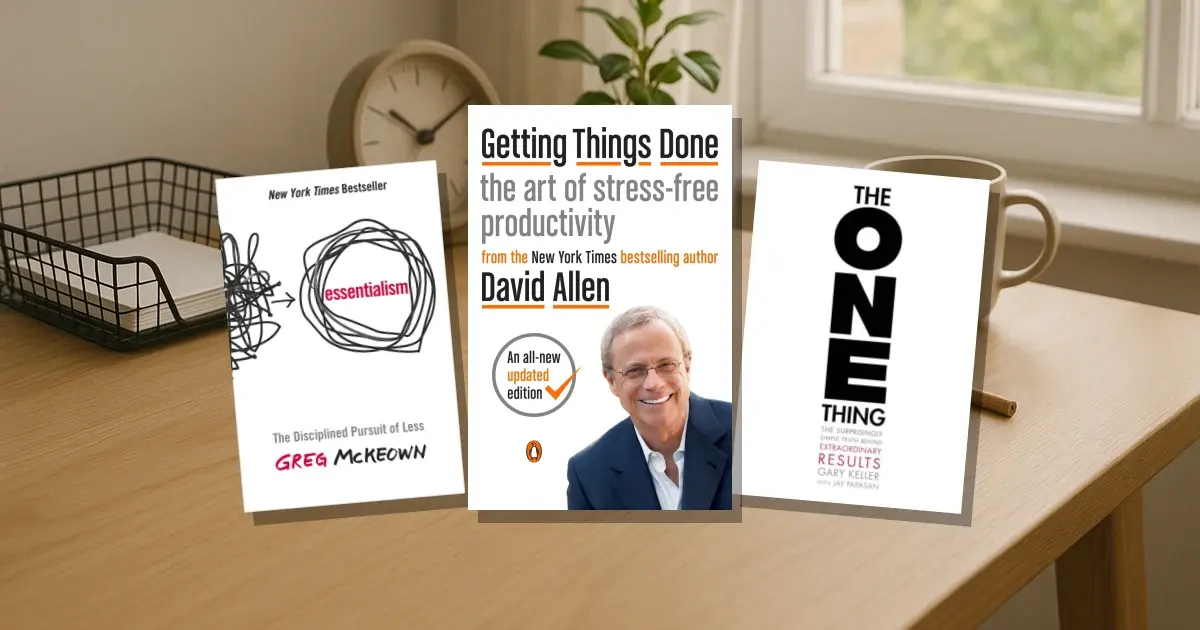
Key ideas from The One Thing
These ideas compress the book's argument without treating the author's view as settled fact. Use them as an orientation before reading the full work or listening in Wiseley.
The ONE Thing is the priority whose next action makes other actions easier or unnecessary.
Multitasking is usually task switching, and competing demands impose reorientation costs that reduce accuracy, decisions, and available work capacity.
Extraordinary results may require focused imbalance, but wisdom lies in knowing when to return before health, relationships, or integrity are neglected.
The Focusing Question identifies an available action whose completion makes other work easier or unnecessary.
Goal Setting to the Now connects a someday objective to the present action through nested time horizons.
The calendar becomes productive when it gives the priority protected time rather than merely recording activity.
Accountability turns outcomes into feedback and adds the honest challenge, expectations, and expertise that sustained improvement often needs.
How The One Thing builds its case
Follow how the book develops its argument. Each note is a brief orientation, not a replacement for the chapter.
The Leverage of One Thing
The ONE Thing is the priority that matters most at a particular moment: the action that makes other actions easier or unnecessary. The authors present it as an answer to a basic problem.
Why Everything Cannot Matter
One of the chapter’s misleading beliefs is that everything matters equally. The idea feels true when a crowded day presents every request as urgent.
Protect Focus and Energy
Focusing on one priority is not merely a matter of preference. It responds to a limit in human attention.
Counterbalance Work, Think Bigger
Once a meaningful priority claims your attention, life cannot remain perfectly even. The authors argue that absolute balance is a myth: what looks balanced is really continual balancing.
From Focusing Question to Great Answers
Ambition becomes useful when turned into a question that governs the next decision. The authors call it the Focusing Question: What’s the ONE Thing I can do such that by doing it everything else will be easier or unnecessary?
Purpose Becomes Present Priority
Once a worthwhile answer has been chosen, another question remains: why does it deserve your life? The authors place purpose above priority and productivity.
Turn Priority Into Productivity
Once a priority has been chosen, the problem is execution: how to ensure the ONE Thing receives enough uninterrupted time to become real. The authors define productivity by results, not busyness or a crowded calendar.
Commit and Defend the System
Once a priority is chosen, the challenge is keeping the system effective when progress slows or demands multiply. The authors say extraordinary results require three commitments: a mastery mindset, a continual search for better ways to work, and accountability for doing everything possible to achieve the ONE Thing.
Live the Focused Journey
The book closes by turning the ONE Thing into a way of living. It is not permanent: the priority most aligned with purpose changes as circumstances change.