What you'll learn
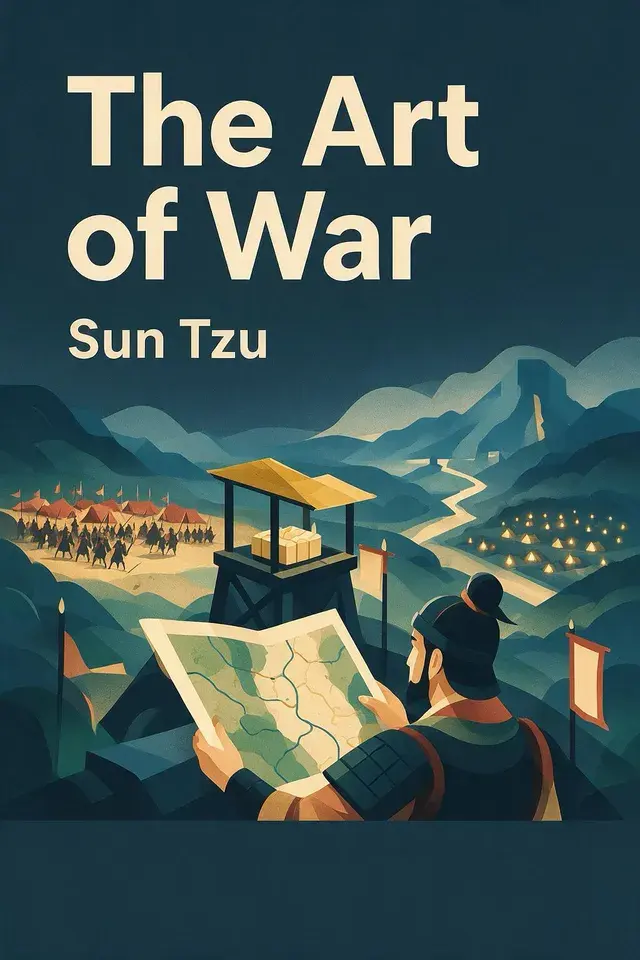
Key ideas from The Art of War
These ideas compress the book's argument without treating the author's view as settled fact. Use them as an orientation before reading the full work or listening in Wiseley.
Comparing both sides turns leadership, conditions, strength, training, and discipline into a forecast of likely victory or defeat.
Speed is valuable because delay compounds costs, but it does not mean reckless haste.
Strategic excellence ranks preserving the enemy’s state and forces above destroying them.
Concealed dispositions and comprehensive preparation establish security before an opportunity for attack appears.
The method has one principle but many forms: avoid strength, strike weakness, and adapt to the opponent’s disposition.
Nine grounds are operational situations whose demands change with position, access, vulnerability, and available choices.
Foreknowledge comes from coordinated human spies, not spirits, analogy, induction, deduction, or mathematical calculation.
How The Art of War builds its case
Follow how the book develops its argument. Each note is a brief orientation, not a replacement for the chapter.
Calculate the Stakes
Sun Tzu opens by treating war as a decision about whether a state survives or falls. The stakes make it too serious for improvisation or confidence based on courage alone.
Economy Sets the Tempo
Sun Tzu treats time as a military resource. Once war begins, the clock works against the state.
Win Without Destruction
Once war is unavoidable, Sun Tzu changes the question from how to destroy an opponent to how to secure victory with the least damage. The superior achievement is to take the enemy’s country intact.
Prepare the Decisive Moment
For Sun Tzu, the battle is largely decided before the armies collide. A force first protects itself from defeat by concealing its dispositions and making precautions that keep its condition unreadable.
Make the Enemy Disperse
Sun Tzu’s question in this chapter is not simply who has more strength. It is who can decide where strength will matter.
Maneuver With Judgment
Once forces approach one another, maneuver is more than getting from one place to another. It converts distance, delay, and obstruction into advantage without exhausting the army that must exploit it.
Read Ground and Signs
Sun Tzu treats ground as an ally, never a substitute for judgment. Mountains, rivers, marshes, and plains shape movement, health, supply, and battle, but their value depends on reading the enemy, one's own troops, dangers, distances, and routes.
Nine Grounds, Different Orders
Sun Tzu's nine grounds are not simply nine kinds of landscape. They are nine operational situations, defined by what an army can do, what the enemy can deny, and what mistake becomes costly.
Cohesion Under Extreme Pressure
Sun Tzu’s treatment of dangerous ground is also a study of collective psychology. Geography changes an army’s options, but it changes its expectations too.
Fire and Human Foreknowledge
After tying action to changing conditions, Sun Tzu closes with two ways of turning knowledge into advantage. Fire can destroy quickly; espionage can reveal what the enemy intends.