What you'll learn
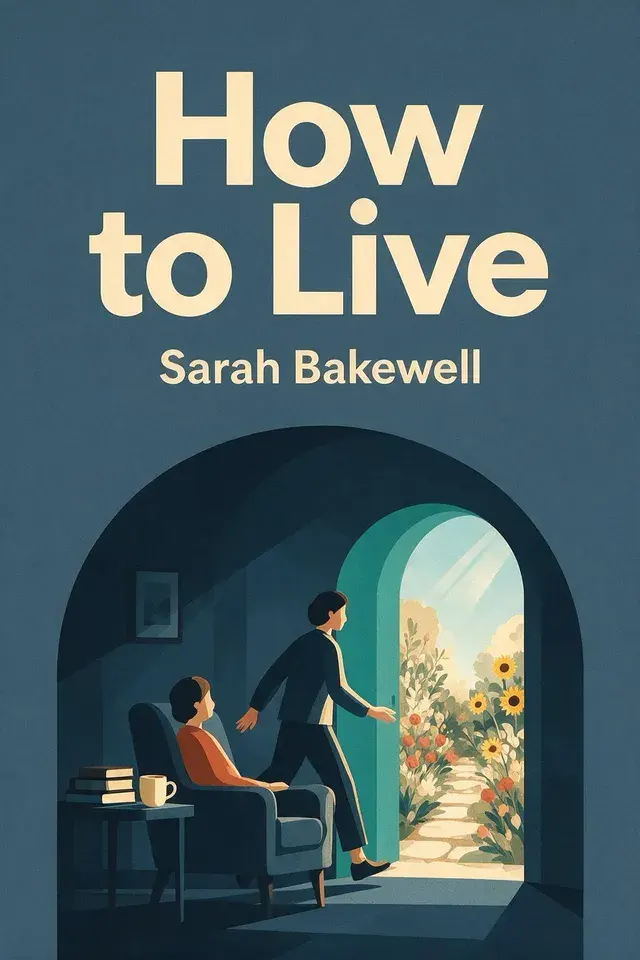
Key ideas from How to Live
These ideas compress the book's argument without treating the author's view as settled fact. Use them as an orientation before reading the full work or listening in Wiseley.
Montaigne makes “How to live?” a practical question about embodied, ordinary experience rather than a doctrine.
Moderation emerges as a civic survival skill because institutions remain necessary while no faction or judgment possesses the whole truth.
Montaigne combines Stoic rehearsal, Epicurean diversion, and Pyrrhonian suspension as practical responses to suffering and uncertainty.
Montaigne’s freedom depends on an inner reserve that limits dependence without requiring him to abandon marriage or family.
Fellow-feeling expands beyond humans, and changed viewpoints expose how habit disguises cruelty and cultural self-superiority.
His mayoralty defines duty as useful, moderate service: plain speech, mediation, and restraint can govern a factional city without theatrical zeal.
The Essays survive through remixing and rereading, while ordinary, imperfect embodied life remains their practical measure.
How How to Live builds its case
Follow how the book develops its argument. Each note is a brief orientation, not a replacement for the chapter.
A Question Turned Into a Life
How do you live well? For Montaigne, this is less a request for a moral formula than an inquiry into life as it is actually experienced.
The Mind He Made
Montaigne’s mind did not come from a smooth or ordinary education. It was formed by a family’s social ascent, a father’s elaborate experiments, books chosen for pleasure, and weaknesses he converted into ways of judging.
Learning Skepticism in Civil War
Before Montaigne became the calm observer of the Essays, he was a young man learning how public life worked—and how badly it could work. After an uncertain interval following his studies, he entered law and spent thirteen years in legal and political service.
Friendship, Voluntary Servitude, and Working Philosophy
How can freedom survive habit, and how can a person live with loss? For Montaigne, these questions became inseparable from his friendship with La Boétie.
When Human Certainty Breaks
Montaigne’s skepticism becomes most unsettling when he asks not only whether human judgments are reliable, but whether humans deserve their privileged place in the world. Doubt now turns toward animals and toward the limits of perception.
An Inner Room, An Open World
How can a person remain free while living among other people? For Montaigne, the answer is neither heroic self-sufficiency nor sealed-off solitude.
Mercy Against Habit and Terror
Montaigne’s humane ethics begins where certainty is least available: in confrontation. He keeps his estate open because defenses can imprison their owner, advertise possessions, and fail against an enemy already inside.
Curiosity Tested by Public Duty
Montaigne’s principles become harder to admire when they must govern a body in pain and a city in danger. Travel gave them their first practical test.
The Unfinished Life of a Book
The natural way to finish a life of Montaigne is not to extract a final rule from him. It is to ask what happens when a life becomes a book.