What you'll learn
Key ideas from Crucial Conversations
These ideas compress the book's argument without treating the author's view as settled fact. Use them as an orientation before reading the full work or listening in Wiseley.
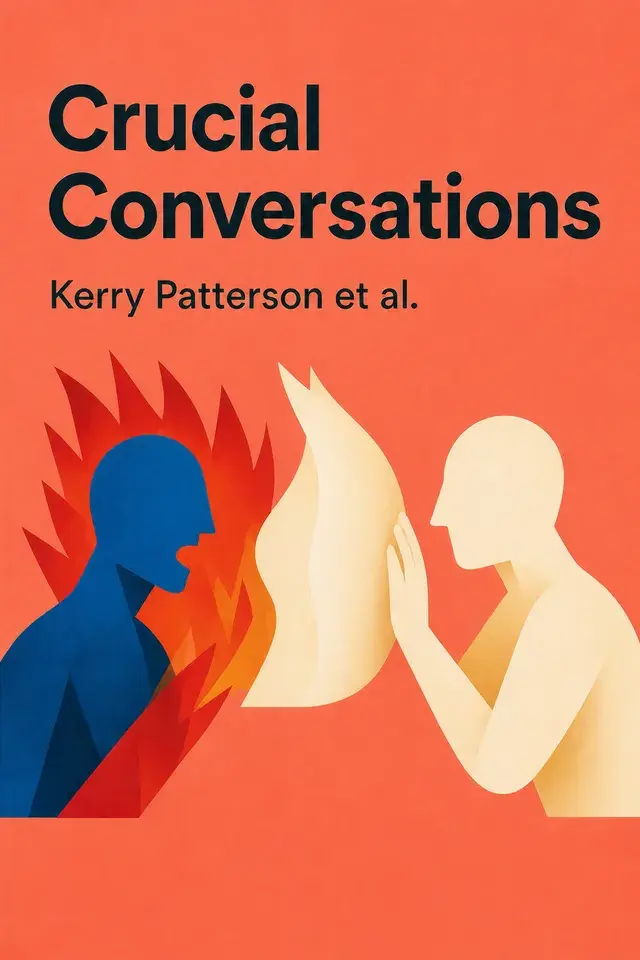
The Fool’s Choice falsely treats honest speech and preserved relationships as mutually exclusive, while dialogue holds candor and respect together.
“What do I really want?” reconnects action with desired results for oneself, the other person, and the relationship.
Safety depends on Mutual Purpose at the entrance to dialogue and Mutual Respect throughout it; each threatened condition calls for a different repair.
The Path to Action links observable events to stories, feelings, and behavior, making interpretation the leverage point for renewed choice.
STATE My Path combines facts, story, others’ paths, tentative language, and testing into one method for risky advocacy.
AMPP moves from sincere invitation and observation to restatement and a tentative best guess when the other person still holds back.
Execution requires a named owner, a specific deliverable, a deadline, and an agreed way to check progress.
How Crucial Conversations builds its case
Follow how the book develops its argument. Each note is a brief orientation, not a replacement for the chapter.
Why Crucial Conversations Matter
Many consequential moments begin as ordinary conversations. The authors call a discussion crucial when two or more people face high stakes, differing opinions, and strong emotions.
Dialogue Over Silence or Force
At the center of a crucial conversation, people often believe they face an impossible choice: speak honestly and damage the relationship, or stay quiet and accept a poor outcome. The authors call this the Fool’s Choice.
Start With the Right Motive
Difficult conversations are often lost before the first important sentence. The authors call their first principle “Start with Heart”: begin by managing your own motives and emotional orientation.
Notice When Safety Breaks
One of the hardest forms of self-knowledge is seeing how our behavior affects a conversation while we are inside it. The chapter opens with a failed product-timeline meeting.
Make It Safe Again
When a crucial conversation becomes unsafe, the natural response is often to argue harder about the original issue. The chapter recommends stepping out of the content, repairing the conditions of dialogue, and then stepping back in.
Master the Stories You Tell
To stay in dialogue when anger, fear, or hurt rises, this chapter begins with an uncomfortable shift in attention: before trying to change the other person or the topic, examine the story you are telling yourself. The authors make a deliberately bold claim.
Speak With Facts and Humility
Crucial conversations can make honesty feel incompatible with respect. The answer in this chapter is STATE My Path, an outward version of the internal reset from Chapter 6.
Explore the Other Path
Once a conversation is safe enough to continue, the next task is not to press your case harder. It is to discover how the other person arrived at theirs.
Turn Dialogue Into Action
Dialogue is not the same as deciding, and deciding is not the same as doing. A conversation can enlarge the Pool of Shared Meaning—the collection of meaning people contribute—and still leave different beliefs about what was agreed.
Practice Across Difficult Cases
The hard test for dialogue is the subtle slight, the defensive partner, damaged trust, fearful authority, or recurring failure that has already gathered a story around it. The chapter’s “Yeah, But” cases argue that the same principles still apply, with better diagnosis, earlier specificity, and more patience.