What you'll learn
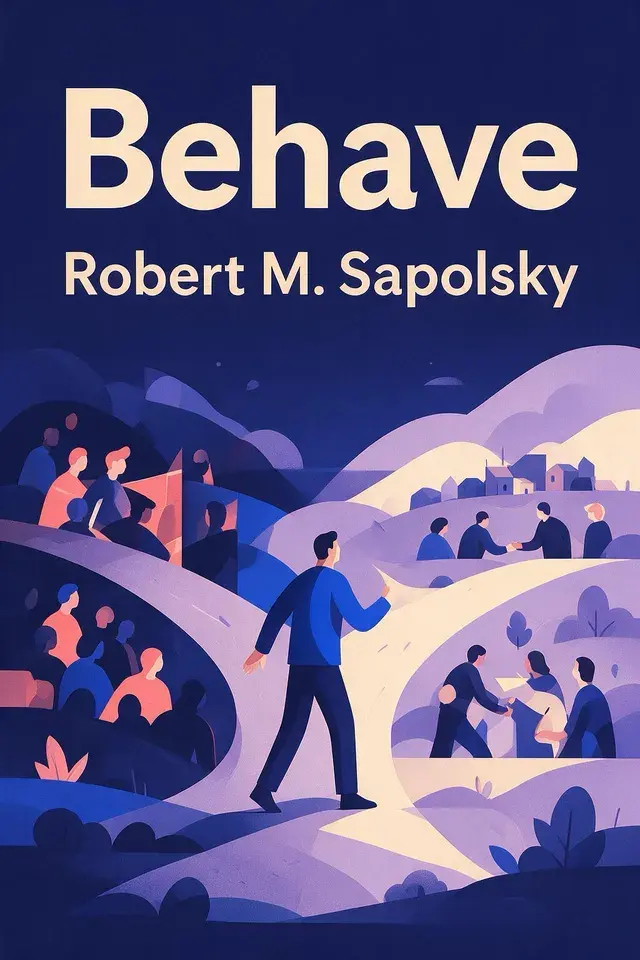
Key ideas from Behave
These ideas compress the book's argument without treating the author's view as settled fact. Use them as an orientation before reading the full work or listening in Wiseley.
Behavior is best explained by widening from the immediate situation through biology, development, culture, ecology, and evolution.
Distant causes converge through the brain, which acts as a final common pathway rather than a self-contained command center.
Plasticity has no built-in moral direction: the same capacity can support learning and compensation while reinforcing fear, addiction, aggression, or harmful skill.
Heritability describes genetic differences in a particular population and sampled environment, not an individual’s destiny.
Culture is a socially transmitted causal inheritance linking ecology and institutions to attention, cooperation, status, and violence.
Multiple identities, individuation, perspective taking, equal-status contact, and shared goals can redirect bias, though no single intervention removes it.
Conformity and obedience are neutral social mechanisms that can coordinate shared life or enable harm when authority and group identity redefine responsibility.
Changed social ecologies, individual resistance, and repeated cooperation show that violent norms can be plastic rather than inevitable.
How Behave builds its case
Follow how the book develops its argument. Each note is a brief orientation, not a replacement for the chapter.
Behavior Needs Every Timescale
To understand human behavior, Robert Sapolsky begins with the behavior itself and then moves backward through time. What happened in the second before the act?
Neural Systems Behind Behavior
Behavior ends in the brain, but it does not begin there. A thought, hormone, past experience, or evolutionary pressure can influence an act only by converging on neural activity: action potentials, neurotransmitters, and circuits that move muscles.
Unconscious Context Enters First
Before we decide what we are doing, the situation may already have begun steering us. This chapter asks what happens immediately before action: how sensory, bodily, linguistic, and social cues enter behavior within seconds.
Hormones Amplify Social Meaning
At the scale of hours to days, hormones change the odds of behavior without writing a script for it. Sapolsky’s central correction is that hormones amplify a socially meaningful challenge, bond, or threat already being processed.
Plasticity, Adolescence, and Experience
Once hormones have shown how circumstances can bias behavior for hours or days, the next question is how temporary states leave longer traces. Sapolsky’s answer is neuroplasticity.
Development Begins Before Birth
To understand an adult, Sapolsky moves backward through development. Childhood is not a rigid staircase, though abilities often emerge in sequences.
Genes Meet Environment
Genes participate in every behavior because they help build neurotransmitters, hormones, receptors, and enzymes. But “genetic” can mean several things.
Ecology Becomes Culture
Culture is not a decorative layer placed over biology. In Sapolsky’s account, it is a causal inheritance: how people do and think about things, learned socially and carried across generations.
Evolutionary Logics of Cooperation
Evolutionary reasoning begins with three conditions: traits vary, some variation is heritable, and variants differ in reproductive success. Selection tracks gene transmission, not survival or progress.
Us, Them, and Social Rank
People do not first see individuals and only later add group labels. The brain sorts Us and Them within milliseconds.
Authority, Conformity, and Morality
Hierarchy becomes action when an authority or group becomes a source of reality, obligation, and belonging. Sapolsky distinguishes obedience—following an authority, sometimes an enduring institution—from conformity, going along with a group.
Empathy and Symbolic Meaning
Empathy begins less grandly than moral wisdom. It can start as sensorimotor contagion: seeing another person hurt makes the body echo the event.
Responsibility, Peace, and Possibility
The book’s final ethical question is not whether behavior has causes. It is what follows when we take those causes seriously without treating people as hopeless machines.