What you'll learn
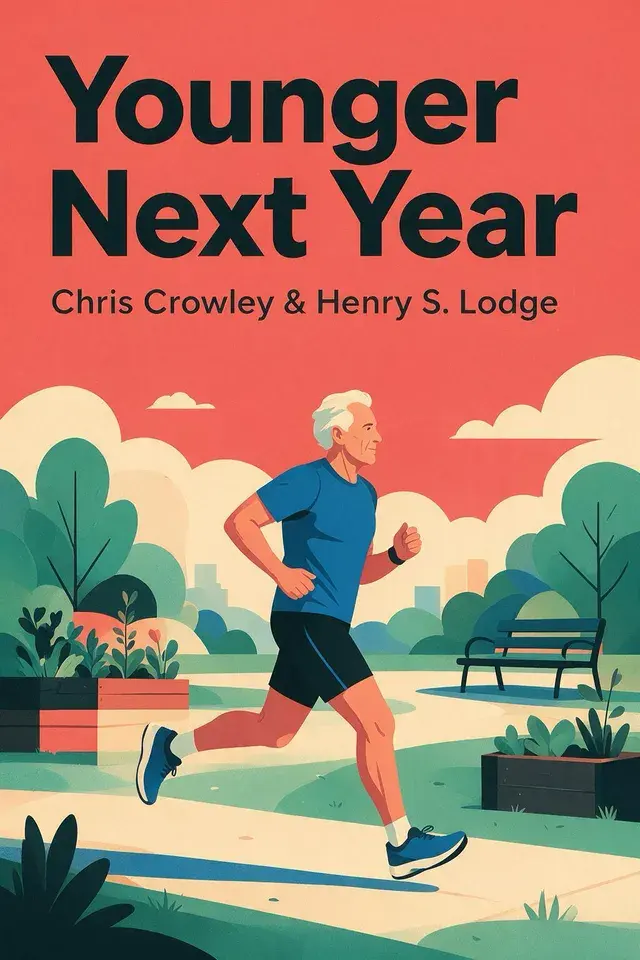
Key ideas from Younger Next Year
These ideas compress the book's argument without treating the author's view as settled fact. Use them as an orientation before reading the full work or listening in Wiseley.
Voluntary aging names the claim that lifestyle can influence much late-life decline without abolishing immutable changes.
The six-day rule turns exercise into a protected lifelong commitment that can survive occasional interruption.
The program is a flexible starting framework: consistency matters more than intensity, and some people may remain at lower levels.
The chapter presents aerobic work as supporting endurance and longevity, while strength training supports the power and coordination of everyday independence.
The book replaces short-term dieting with regular exercise, better food quality, and rough attention to calories and portions.
Connection and caring are presented as biological supports for repair, stress regulation, and survival, not decorative additions to physical health.
Work, volunteering, hobbies, and serious projects can form a second life by preserving structure, purpose, connection, and useful responsibility after formal retirement.
How Younger Next Year builds its case
Follow how the book develops its argument. Each note is a brief orientation, not a replacement for the chapter.
The Next Third
Why settle for a longer life if you can no longer live it well? That question opens Younger Next Year.
Signals of Growth
To make the program coherent, Harry begins with a criticism of preventive medicine. As an internist, he watches patients who once seemed healthy become overweight, apathetic, unfit, injured, seriously ill, or dead in later decades.
Make Exercise a Job
Knowing that exercise matters is not the same as exercising. The biological argument only helps if it survives tiredness, bad weather, family demands, and the wish to do something easier.
Build the Aerobic Base
With the commitment described earlier, this chapter asks what aerobic exercise does inside the body. The authors treat the body as a renewing system, not a fixed object.
Train Across Three Gears
Exercise in Younger Next Year is not one undifferentiated activity. Crowley and Lodge divide it into three metabolic gears, each with a different purpose.
Kedge Toward Capability
Exercise can be medically sensible and still fail to hold a person’s heart. This chapter’s answer is to give it a destination.
Strength for Independence
Endurance and independence are not the same physical achievement. The authors associate aerobic exercise with circulation, stamina, and protection against early death from heart disease and cancer.
Age Honestly, Plan Clearly
Growing older asks for two kinds of honesty. The face and body will change, and practical risks will grow, but neither fact means vitality has disappeared.
Eat for the Long Term
Nutrition, in this book, begins with a rejection of the commercial diet promise. The authors distrust plans that advertise dramatic loss in a few weeks and then claim permanent results.
Menopause Without Surrender
Menopause is presented as a natural transition, not a disease requiring routine treatment. The body moves from one ordered hormonal state to another, but the timetable is unpredictable.
Connect, Care, Commit
The book’s physical program opens onto a larger question: what keeps a person emotionally alive? The authors’ answer is not companionship as decoration.
Build a Second Adulthood
The final design problem is not simply how to live longer. It is how to build a life when familiar structures of work, family, and social expectation begin to fall away.