What you'll learn
Key ideas from The Worry-Free Mind
These ideas compress the book's argument without treating the author's view as settled fact. Use them as an orientation before reading the full work or listening in Wiseley.
A threat-sensitive mind can turn uncertainty into a repeating cycle of negative prediction, fear, and further worry.
Worry can narrow attention; moving between details and a broader view can restore information the anxious frame leaves out.
Purposeful mind wandering can make room for associations and options that effortful deliberation may miss, but surfaced ideas still need consideration.
A vivid goal becomes actionable when paired with intention, milestones, deadlines, noting obstacles, and considering what will support follow-through.
Neuro-repatterning moves from a trigger and curiosity to body awareness and breathing, then naming a need, choosing a useful state, and rehearsing a response.
Shared connection and repeated rituals can support meaningful change when old worry returns.
The flow cycle moves through struggle, release, flow, and recovery; sustained concentration has limits and needs breaks.
Inside The Worry-Free Mind
Read the first chapter in full here. The other 8 continue in the Wiseley app.
Chapter 1 of 9 · 7 min · Audio & text
How Worry Takes Hold
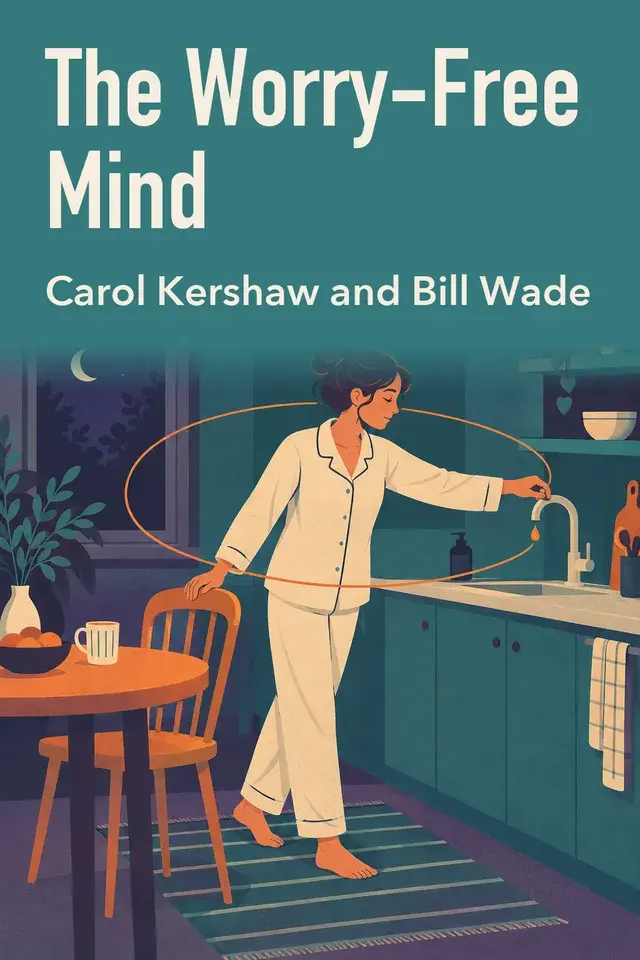
The Worry-Free Mind, by Carol Kershaw and Bill Wade.
Worry often begins when an uncertain event is read as a threat. The mind starts preparing for what could go wrong, and attention keeps returning to the danger. The authors describe this as a self-reinforcing cycle: a perceived threat brings fear and overreaction; that response can make a situation harder, which creates more reason to worry. Their starting point is not that every concern is imaginary. It is that a threat-sensitive mind can treat uncertainty as immediate danger before checking what is actually happening.
The authors call the mind’s tendency to give negative information greater weight a negative bias. In their account, the brain scans for threats and can make quick negative judgments even when confirming information is missing. Worry then dwells on real or imagined problems, jumping toward a bad outcome and searching for ways to prevent it. Trying to anticipate every possible setback may feel like preparation, but it cannot guarantee readiness. The unanswered “what if” can keep the mind circling instead of bringing relief. When this repetition becomes more intense and difficult to interrupt, the authors call it rumination. They distinguish it from problem-solving because attention stays fixed on distress without moving toward workable solutions.
Marie’s opening experience shows how a small uncertainty can gather more worries around it. She wakes to the sound of plumbing and begins thinking about her family, employment, caregiving, and money. Instead of returning to sleep, her thoughts keep expanding. The resulting sleeplessness leaves her exhausted, irritable, and pessimistic. The plumbing noise is not itself proof that all those problems are happening at once. In the authors’ account, the threat-focused mind links one uncertain cue to several feared outcomes. As tiredness and distress accumulate, each new concern can feel more urgent, and it becomes harder to judge any one problem clearly.
The authors describe worry and life shocks as patterns that can undermine confidence. Prolonged negative stress can interfere with clarity, follow-through, confidence, and satisfaction. They also describe sudden, painful events as “life shocks.” Such events may unsettle a person’s sense of safety, connection, or worth. Even after the event passes, fear that it will happen again can persist. Protective withdrawal or suspicion may then keep a person on high alert, making ordinary problems seem unmanageable. The book’s point is that a present worry can carry the weight of an earlier experience, even when the situations differ.
Personal stories influence what people expect from themselves and others. A painful event cannot be undone, but the account built around it can affect what seems possible now. If the story says that danger is always near, or that a person cannot handle change, ambiguous events may appear to confirm it. Attention strengthens the pattern: what the mind repeatedly watches can shape the state it returns to. The authors argue that becoming aware of attention, beliefs, feelings, and bodily responses is part of self-regulation. Their broader claims about brain change and effects on the body belong to their explanatory framework; they are not proof that every worry has the same cause or response.
One early exercise invites readers to change their imagined viewpoint on a troubling scene. They can picture filming it from high above, perhaps from a balloon or helicopter, then imagine watching it from the back of a theater. From that distance, the scene may feel smaller or more manageable. The exercise asks whether the problem looks different when viewed as an observer rather than experienced from inside it. The authors also describe a personal “horror flick”: if a person is acting in the scene, they can imagine changing their lines toward possibility; if they are observing it, they can change the movie. This is a perspective exercise, not a claim that the underlying event did not matter. Its purpose is to loosen the scene’s grip long enough to notice another way of relating to it.
The book also asks readers to assess their emotional reactivity and self-regulation. The self-check uses two columns: one for how a person is now and one for how they would like to be. Each item is rated on a scale from one to ten, with anchors ranging from very little or seldom, through somewhat or sometimes, to extremely or always. The questions cover responses to disappointment, anxiety, stress, and anger, as well as cheerfulness and fulfillment. They ask about avoidance, judging or blaming, how long positive feelings last, flexibility in behavior, willpower, numbing, habitual worry, and feeling victimized.
The aim is to make a pattern visible, not to assign a diagnosis. Comparing the two columns can show where someone feels most reactive and where they want more choice. A person might notice that worry is frequent, that a positive state fades quickly, or that stress leads to avoidance. Naming such a gap does not resolve it, but it gives the person a clearer starting point than treating each episode as an isolated failure. The assessment fits the book’s larger premise: awareness of a repeated response can create room to consider what is happening before reacting automatically.
The authors distinguish useful alertness from persistent over-arousal. When danger is real, a quick threat response can help a person act. Their goal is not to remove alertness, but to describe a more balanced state: relaxed enough to think clearly and alert enough to respond appropriately. In contrast, sustained high alert in situations that are not dangerous can produce reactions out of proportion to the moment and make it difficult to settle or sleep. The authors connect this state with bodily stress responses, including tension and a raised heart rate. Those are claims in their account of worry, and they caution that the book does not replace medical or psychological treatment for serious health conditions. Readers with health concerns should seek professional help.
This opening model gives readers a way to recognize the cycle: uncertainty draws attention toward threat, fear intensifies the story, and repeated alertness can make the next uncertainty feel even more dangerous. Marie’s worries, the perspective exercise, and the self-check each make part of that pattern easier to notice. The book begins with recognition because a reaction that can be observed is no longer only something happening outside awareness. That recognition offers a first opening for a different response, while the later chapters develop the practices for shifting attention and state.
Chapter 2 of 9 · 10 min · Audio & textIn the app
Interrupting the Worry Loop
Worry can make attention feel fixed on one detail: a possible mistake, a tense expression, or a feared outcome. The authors suggest that attention and bodily arousal reinforce a state of mind.
Chapter 3 of 9 · 9 min · Audio & textIn the app
Mind Wandering With Purpose
When a problem has been turned over and over, more effort does not always bring a clearer answer. Sometimes it helps to step away deliberately.
Chapter 4 of 9 · 9 min · Audio & textIn the app
Entering the Deep State
Stress can become harder to manage not only because of what is happening, but also because of the meaning a person gives it. The authors distinguish a mindset that treats stress as potentially useful from one that sees it mainly as harmful.
Chapter 5 of 9 · 9 min · Audio & textIn the app
Rehearse a Better Future
Worry can become a kind of rehearsal: the mind plays feared outcomes again and again, as if staying with them will prevent them. The authors argue that this practice can strengthen worry and consume attention that might be used to shape a desired future.
Chapter 6 of 9 · 10 min · Audio & textIn the app
Repatterning Emotional Habits
An emotional response can belong partly to the present and partly to a pattern learned long ago. The authors argue that early relationships help shape how people handle closeness, separation, frustration, and safety.
Chapter 7 of 9 · 8 min · Audio & textIn the app
Rituals for Renewed Connection
A person can get through a crisis by focusing almost entirely on what must be done. But when the emergency eases, that narrowed way of living may remain.
Chapter 8 of 9 · 9 min · Audio & textIn the app
Practicing Whole Brain Calm
The authors call the calm, flexible state they want readers to develop the “whole brain state,” or “awakened mind.” Their proposal brings attention practice together with an account of brain synchrony: instead of staying locked onto a worry, a person can learn to widen attention, settle, and return to a problem with more room to respond.
Chapter 9 of 9 · 9 min · Audio & textIn the app
Flow, Incubation, and Recovery
This chapter brings focused absorption together with purposeful release. Flow gives attention an absorbing task; incubation begins when you set a problem aside and let attention move elsewhere.
Chapter 1 of 9 · 7 min · Audio & text: How Worry Takes Hold
Wiseley supports reading and listening to summaries in the app.
Continue in Wiseley