What you'll learn
Key ideas from The Science of Self-Discipline
These ideas compress the book's argument without treating the author's view as settled fact. Use them as an orientation before reading the full work or listening in Wiseley.
Self-discipline is presented as choosing long-term well-being over immediate comfort, even when the better action feels unpleasant.
A clear, emotionally credible outcome gives discipline direction when daily actions are repetitive or uncomfortable.
Urge surfing frames cravings as temporary waves that can be observed with curiosity instead of suppressed, fought, or immediately obeyed.
A bounded first attempt and a credible time limit keep essential work from expanding into unnecessary complexity.
Workspace design shifts repeated choices by hiding distractions and making desired actions easy to reach.
Accountability agreements define behavior, communication, evidence, and a constructive response to missed commitments.
The ten-ten-ten rule compares a temptation’s likely consequences at ten minutes, ten hours, and ten days, extending the horizon when needed.
Durable repetition draws on personal, social, and structural motivation and ability, with recovery from missed attempts built into the system.
Inside The Science of Self-Discipline
Read the first chapter in full here. The other 7 continue in the Wiseley app.
Chapter 1 of 8 · 7 min · Audio & text
Discipline as a Trainable Capacity
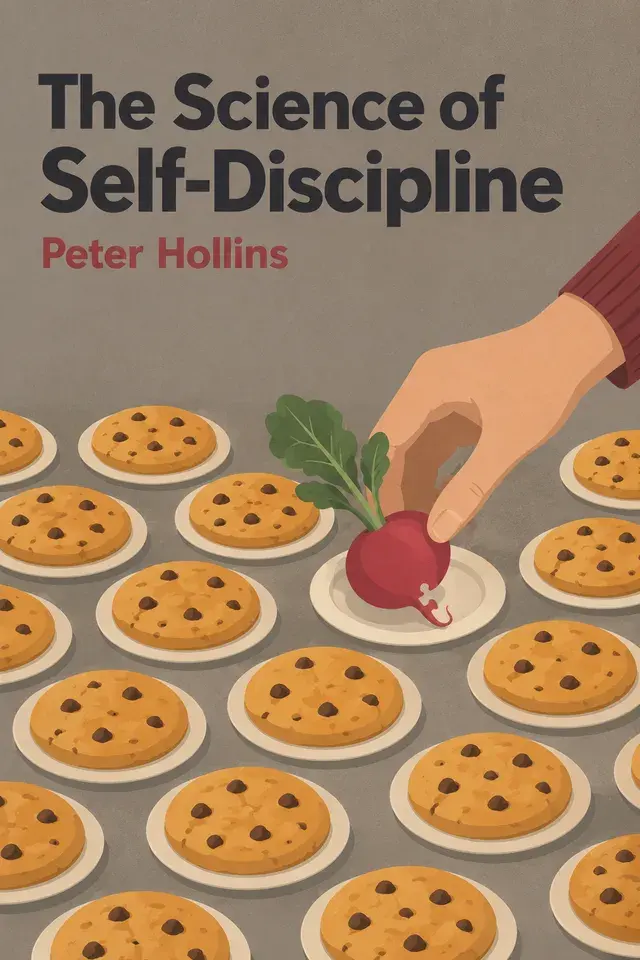
The Science of Self-Discipline, by Peter Hollins.
Peter Hollins defines self-discipline as choosing a difficult or unpleasant action because it supports longer-term well-being. Exercise instead of snoozing, or refuse a sugary snack that may bring an energy crash. The conflict is between an immediate reward and a future condition we value more. In the book’s framing, discipline carries worthwhile goals through discomfort; without it, projects remain intentions and can leave regret. Discipline is both an outcome and a practice that develops while a person pursues a meaningful goal.
That practice is presented as trainable. Hollins compares it to a muscle: repeated use can strengthen it, while repeated surrender can reinforce the opposite pattern. He also argues that effort should not be the only answer. The book aims to raise a person’s baseline capacity and arrange life so that control is not demanded at every moment. This supplies the foundation: we can practice difficult choices and reduce how many difficult choices the day creates.
The biological account is deliberately qualified. The author says willpower and impulsivity cannot be located in one neat brain area, and there is no simple chemical hack. The book reports brain-imaging work linking delayed-reward choices with activity in ventromedial and dorsolateral prefrontal regions. These areas are described as participating in weighing immediate and future outcomes, not as a complete command center for discipline. The source also leaves unresolved how much self-discipline comes from inherited predisposition versus upbringing and environment.
Neuroplasticity, the brain’s capacity to change its connections, is used to explain why repeated choices may alter the capacity itself. Hollins presents brain-imaging findings and a delay-of-gratification follow-up as support for the possibility that disciplined behavior and brain activity or structure are related. But those findings are associations. In the book’s argument, they support trainability without settling whether biology or experience is the primary cause.
At the behavioral level, discipline depends on executive functions. Working memory keeps a goal active while distractions compete for attention. Impulse control helps inhibit an attractive but unhelpful response. Cognitive flexibility allows a person to adapt when circumstances change. Together, these functions help prioritize actions, filter distractions, and keep attention connected to a long-term aim. That is why the author treats focus as a central part of discipline rather than a separate skill.
Hollins proposes meditation as an attention practice that may support this system. He reports that an eight-week mindfulness course was associated with denser gray matter in prefrontal and anterior cingulate areas, alongside a smaller amygdala, which the book associates with primal emotion and fight-or-flight arousal. He interprets these findings as suggesting less emotional reactivity and stronger management of attention and impulses. The source provides the basic procedure—MRI scans of volunteers before and after an eight-week mindfulness course—but omits the sample size, control-group information, and broader methodological limitations, so meditation is presented as a proposed practice supported by reported MRI changes, not as a guaranteed biological shortcut.
Training, however, meets fatigue. Hollins describes willpower as limited, more like a gas tank than a constant supply, and compares its use with muscle fatigue. The chapter reports that exertion is associated with lower cognitive activity and lower blood-glucose levels. It also emphasizes that repeated resistance changes the burden: saying no to a cookie once is not the same as saying no ten times.
The book illustrates this proposed depletion mechanism through Baumeister’s 1996 cookie-and-radish experiment. Sixty-seven participants encountered cookies and sweets alongside bitter radishes. Some could eat the sweets; others had to eat the radishes. Afterwards, they attempted a supposedly unrelated puzzle. The radish group made fewer attempts and quit in less than half the time of the sweet-eating group. Hollins interprets this as evidence that resisting the sweets had reduced persistence before the puzzle began. The example supports the book’s limited-resource model, but it should be understood as the source’s explanation, not as a complete or settled account of physiology.
Ordinary decisions become harder when several burdens arrive together. Hunger or low energy may make immediate food more salient because the author’s account describes the brain as prioritizing short-term survival. Stress is said to shift attention toward immediate outcomes by activating fight-or-flight tendencies and diverting energy from prefrontal control. Repeated temptation adds another demand each time a person must notice a cue, hold the goal in mind, suppress an impulse, and choose again. A sugary snack can therefore be easier to refuse when a person is rested and calm than when hunger, stress, and repeated exposure have already consumed attention and effort.
This is why the book distinguishes strengthening control from conserving it. Strengthening comes from repeated practice, sustained attention, and proposed practices such as meditation. Conserving comes from avoiding high-risk situations, reducing unnecessary exposure, and choosing conditions in which the better option becomes the default. The book’s food examples include shopping after eating and making healthier choices more available, but the broader principle is enough here: reliable discipline should not require a fresh act of resistance at every turn.
Self-discipline, then, is neither fixed character nor inexhaustible force. It has a biological basis, can be developed through practice, and remains sensitive to hunger, stress, attention, and surroundings. The book’s conceptual foundation is therefore double: strengthen the capacity to choose well, and arrange ordinary life so that the capacity is not needlessly spent.
Chapter 2 of 8 · 8 min · Audio & textIn the app
Choose Reasons and Scale the Goal
Discipline is usually selective, not a universal trait. People control particular behaviors because they want a result such as better health, fitness, or attractiveness.
Chapter 3 of 8 · 9 min · Audio & textIn the app
Practice Staying With Discomfort
Discipline becomes visible when an action stops feeling easy. Stress can narrow attention, a perceived physical limit can sound final, and an urge can promise immediate relief.
Chapter 4 of 8 · 7 min · Audio & textIn the app
Recognize Excuses and Start Acting
Choosing a meaningful goal and learning to tolerate discomfort still do not guarantee action. A person can know what matters, recognize an urge, and then lose the day to an interpretation: conditions are not right, preparation is incomplete, or a reward is deserved.
Chapter 5 of 8 · 7 min · Audio & textIn the app
Make Helpful Choices Easier
Self-discipline is often framed as a private contest between intention and impulse. Hollins shifts the contest outward.
Chapter 6 of 8 · 7 min · Audio & textIn the app
Build Support That Requires Action
Self-discipline may feel like a private contest between intention and temptation. Hollins adds a social dimension: other people can make a behavior easier to begin, harder to abandon, or more visible when it is done.
Chapter 7 of 8 · 8 min · Audio & textIn the app
Bring Future Consequences Into View
Self-discipline becomes concrete when it is seen as a trade: accept a less pleasant choice now because it serves a valued result later. The source calls this delayed gratification and treats it as a trainable skill.
Chapter 8 of 8 · 8 min · Audio & textIn the app
Turn Repetition Into Lasting Habits
Motivation is useful for beginning, but it is an emotional state. It can bring excitement, desire, and strong action, then fade within hours, days, or weeks.
Chapter 1 of 8 · 7 min · Audio & text: Discipline as a Trainable Capacity
Wiseley supports reading and listening to summaries in the app.
Continue in WiseleyWhat The Science of Self-Discipline is about
How can self-discipline become more dependable when motivation fades? Peter Hollins examines the roles of attention, discomfort, temptation, relationships, and habits. Practical methods for clarifying goals, reshaping surroundings, and weighing future consequences show how daily choices can support longer-term aims.
About Peter Hollins

Peter Hollins is the author of “The Science of Rapid Skill Acquisition”. The book explores how to turn a chosen goal into a skill through deliberate work.
Explore more books by Peter Hollins