What you'll learn
Key ideas from The Oxygen Advantage
These ideas compress the book's argument without treating the author's view as settled fact. Use them as an orientation before reading the full work or listening in Wiseley.
In the author’s account, sustained overbreathing can lower carbon dioxide and reinforce breathlessness.
The author presents the nose as an air-conditioning passage that adds resistance and carries nasal nitric oxide toward the lungs.
McKeown advises mild air hunger in Breathe Light, easing off for tension or disturbed breathing, and stopping to contact an Oxygen Advantage practitioner for dizziness or anxiety.
Breath-hold studies report acute splenic changes; the proposed exhalation-hold mechanism and lasting effects remain uncertain.
A hunger check can interrupt automatic eating; the book advises gentle starts for preexisting health concerns and medical consultation for high blood pressure or diabetes.
Asthma symptoms and progress vary with triggers, health history, and BOLT scores, so the author describes the exercises as one part of care.
McKeown links habitual mouth breathing and low tongue posture with possible changes in jaw shape, tooth alignment, and airway space.
The program matches breathing practice to a person’s BOLT score, health, lifestyle, and existing routine.
Inside The Oxygen Advantage
Read the first chapter in full here. The other 12 continue in the Wiseley app.
Chapter 1 of 13 · 7 min · Audio & text
The Oxygen Delivery Paradox
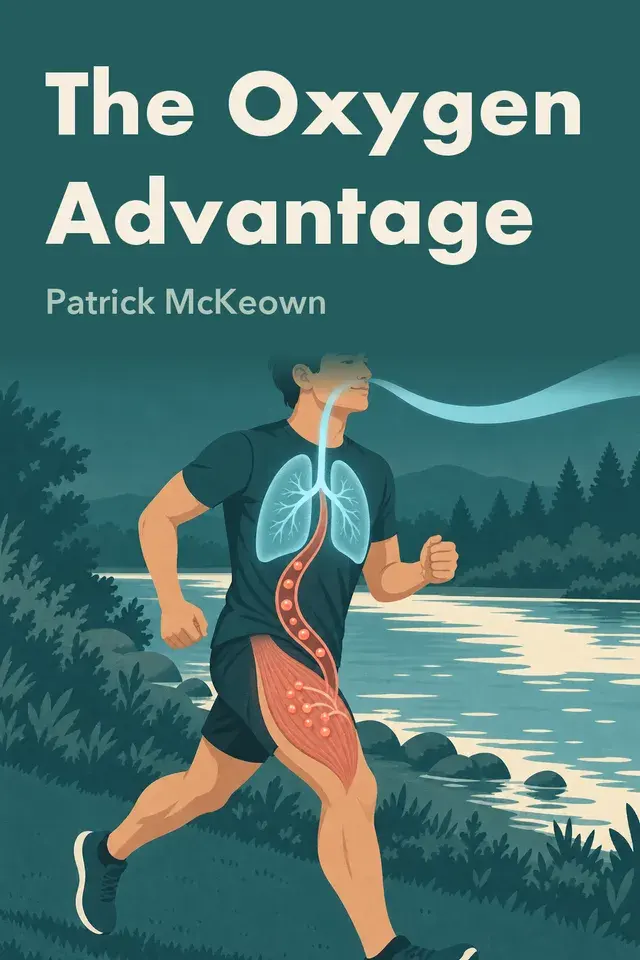
The Oxygen Advantage, by Patrick McKeown.
The Oxygen Advantage begins with a puzzle: if blood is already carrying plenty of oxygen, why might the body still struggle to deliver it where it is needed? Patrick McKeown’s answer centers on carbon dioxide. In his model, breathing too much air can lower carbon dioxide and make it harder for blood to release oxygen to tissues. That is the oxygen delivery paradox: more breathing does not necessarily mean more usable oxygen.
McKeown says that, at rest, healthy people usually have blood oxygen saturation around 95 to 99 percent. Saturation describes how much of the oxygen-carrying hemoglobin in the blood is occupied by oxygen. When it is already high, he argues, larger breaths do little to raise it. He compares this to adding water to a glass that is already full. A deeper breath may feel satisfying, perhaps because it stretches the upper body, but that sensation does not by itself show that tissues are receiving more oxygen.
The book’s next step is to distinguish oxygen in the blood from oxygen delivered to cells. Hemoglobin carries oxygen from the lungs through the bloodstream. McKeown invokes the Bohr effect to explain its release: carbon dioxide, in the right amount, helps hemoglobin let go of oxygen so tissues can use it. Carbon dioxide is produced as the body uses food and oxygen for energy, then carried back to the lungs to be exhaled. In the author’s account, breathing has to remove excess carbon dioxide while retaining enough to support oxygen release.
This makes carbon dioxide more than a waste product in McKeown’s model. If someone breathes more air than the body requires, the lungs may remove too much carbon dioxide. He calls the resulting low-carbon-dioxide state hypocapnia. He argues that hemoglobin then holds oxygen more tightly, so a normal saturation reading can coexist with reduced oxygen delivery to tissues. This is why, in his explanation, increasing breath size can work against the intended result.
Overbreathing does not have to look like dramatic panting. McKeown defines it as breathing more air than the body needs, whether through a faster rate or unusually large breaths. He also describes a feedback process: carbon dioxide is one of the signals that regulate breathing, and breathing removes excess carbon dioxide. According to the book, a pattern sustained for days or weeks can increase sensitivity to carbon dioxide. The body may then respond by breathing more than needed, which can keep the pattern going. A brief spell of heavy breathing, he says, is different from a persistent habit.
The proposed loop can make breathlessness self-reinforcing. If overbreathing lowers carbon dioxide and, in McKeown’s account, interferes with oxygen release, a person may feel short of air or less able to sustain effort. That feeling can prompt still larger breaths. During exercise, the same pattern may intensify: breathlessness leads to heavier breathing, which the author says can further reduce carbon dioxide and make the next effort feel harder. He presents this as one possible contributor to symptoms, not as a complete explanation for every person’s breathlessness.
McKeown suggests noticing everyday signs that might point to a breathing pattern worth examining. These include audible or noisy breathing, frequent sighing, visible chest movement, and mouth breathing. He also mentions fatigue, dizziness, and light-headedness. Such signs are clues in his framework, not a diagnosis. They can vary from person to person, and the book recognizes that not everyone will have the same symptoms.
McKeown introduces the model through his own account of asthma and sleep-disordered breathing. He says that learning Buteyko-based breathing exercises reversed both problems and led him to develop his program. This is a personal report about what he believes changed his health. It helps explain why he came to focus on breathing, but it does not by itself establish the proposed mechanism.
David’s story offers another illustration. McKeown describes him as a well-trained, twenty-year-old footballer who was already a rising star when they met. He was physically fit but frequently became breathless and experienced congestion and coughing, including symptoms after games. The author reports that David changed his breathing habits. McKeown says David no longer had to hide his breathlessness from his coach, and also describes him as one of the star players on his team. The point of the story is the contrast between David’s fitness and his reported breathing difficulty, as McKeown interprets it. It cannot show on its own that the same explanation applies to other athletes.
The book’s opening cautions also set limits on its practices. McKeown says the program is unsuitable during pregnancy. He says anyone with a medical issue should refrain from exercises that simulate high-altitude training, including the Nose Unblocking Exercise, and should follow the program only with a medical practitioner’s consent; he notes that these exercises are comparable to high-intensity exercise. For people with high blood pressure, cardiovascular disease, type 1 diabetes, kidney disease, depression, or cancer, he advises practicing only nasal breathing and gentler exercises until the condition is resolved. These cautions matter because the model is not a substitute for medical assessment.
The central distinction is between oxygen carried in the blood and oxygen released for use in tissues. McKeown’s account proposes that habitual overbreathing can lower carbon dioxide and hinder that release, even when oxygen saturation is already high. That premise sets up the book’s later work on observing and retraining breathing.
Chapter 2 of 13 · 6 min · Audio & textIn the app
BOLT as a Breathing Gauge
BOLT, short for Body Oxygen Level Test, turns McKeown’s account of breathing into a repeatable personal gauge. The score is the number of seconds from a normal exhalation to the first clear signal that breathing wants to resume.
Chapter 3 of 13 · 6 min · Audio & textIn the app
Nasal Breathing Day and Night
McKeown makes breathing through the nose, by day and night, the first habit in his program. He presents it as a way to support calmer breathing and to prepare incoming air before it reaches the lungs.
Chapter 4 of 13 · 5 min · Audio & textIn the app
Quiet Breathing, Better Mechanics
McKeown sets a modest standard for resting breathing: it should be quiet, gentle, nasal, abdominal, regular, and effortless, with an easy pause after exhalation. Seventh Dan tai chi Master Jennifer Lee says tournament judges deduct points when competitors’ breathing is evident; McKeown describes her breathing as abdominal and almost invisible.
Chapter 5 of 13 · 5 min · Audio & textIn the app
Making Nasal Training Work
The practical step is to bring the quiet nasal breathing used at rest into movement. McKeown treats the nose as a pace check: if you cannot keep your mouth closed comfortably, your effort may be ahead of your current breathing control.
Chapter 6 of 13 · 8 min · Audio & textIn the app
Breath Holds and Altitude Adaptation
Elite endurance sports offer a clear reason to ask whether the body can increase its capacity to carry oxygen. The book contrasts controlled breathing practices with blood doping, in which athletes may withdraw and later reinfuse blood, or use laboratory-made erythropoietin, known as EPO.
Chapter 7 of 13 · 8 min · Audio & textIn the app
Progressive Holds Across Sports
The book takes breath-hold practice from a general training idea into different kinds of movement. Its practical emphasis is on scaling the challenge: create a noticeable but controlled need for air, then recover without struggle.
Chapter 8 of 13 · 6 min · Audio & textIn the app
Attention, Thought, and Flow
McKeown extends his breathing approach from physical training to the way we direct attention. He describes flow as being fully absorbed in an activity, with attention gathered on what is happening now.
Chapter 9 of 13 · 7 min · Audio & textIn the app
Breathing, Appetite, and Stress
Weight loss can be difficult to sustain, and McKeown argues that exercise alone may not help if eating continues beyond what a person uses. He presents breathing practice as one possible influence on appetite, not as a substitute for food choices or a guaranteed route to weight loss.
Chapter 10 of 13 · 6 min · Audio & textIn the app
Exercise, Oxidation, and the Heart
Exercise can support health, but McKeown asks whether more is always better. He frames the answer around dose and readiness.
Chapter 11 of 13 · 6 min · Audio & textIn the app
Asthma and the Breathing Loop
The asthma discussion applies the book’s breathing model to a condition where breathing can become part of the problem. When airways narrow, a person may feel short of breath and take in more air.
Chapter 12 of 13 · 5 min · Audio & textIn the app
Growing Airways and Nasal Habits
McKeown treats childhood breathing as part of development, not only as a habit to retrain. He argues that habitual nasal breathing and tongue posture may influence how the jaws and upper airway grow.
Chapter 13 of 13 · 13 min · Audio & textIn the app
A Program Matched to BOLT
McKeown’s program is not one fixed routine. He uses a person’s BOLT score, health, fitness, and response to decide where practice begins and how demanding it becomes.
Chapter 1 of 13 · 7 min · Audio & text: The Oxygen Delivery Paradox
Wiseley supports reading and listening to summaries in the app.
Continue in WiseleyAbout Patrick McKeown
Patrick McKeown is a breathing coach and founder of the Oxygen Advantage program. “The Oxygen Advantage” explores how breathing volume and pattern may affect oxygen delivery, exercise, and health.
Explore more books by Patrick McKeown