What you'll learn
Key ideas from The Laws of Human Nature
These ideas compress the book's argument without treating the author's view as settled fact. Use them as an orientation before reading the full work or listening in Wiseley.
Rationality is cultivated by noticing emotional bias, creating distance from inflamed states, and strengthening deliberate thought.
Nonverbal cues gain meaning from baselines, context, repetition, and culture; even genuine cues do not prove their cause.
Reliable associates are identified through repeated conduct under stress, criticism, responsibility, and cooperation rather than charm, reputation, or isolated success.
Shortsightedness turns goals into reactions, while consequence-tracing and a wider time horizon restore strategic judgment.
Shadow integration brings vulnerability, aggression, ambition, and creativity into conscious, controlled expression rather than leaving them to erupt through a persona.
Envy converts painful comparison and hidden inferiority into criticism, gossip, sabotage, or other hostility.
Groups reshape appearance, belief, emotion, and certainty, often making conformity feel like independent judgment.
Visceral mortality awareness sharpens attention, urgency, and appreciation for impermanent experience.
How The Laws of Human Nature builds its case
Follow how the book develops its argument. Each note is a brief orientation, not a replacement for the chapter.
A Discipline of Rationality
Greene begins with a warning: much of what we call choice is emotion moving beneath awareness. We react, then build a plausible explanation around the reaction.
Masks, Narcissists, and Signals
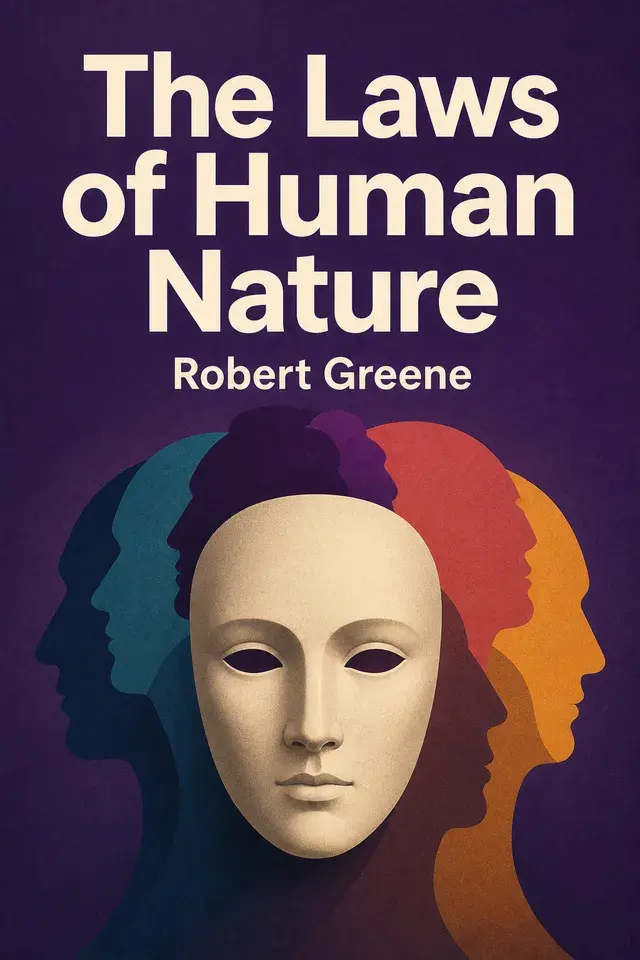
People rarely meet one another without editing themselves. In family life, at work, and in public, they choose words, expressions, clothing, posture, and tone that fit the part they need to play.
Character and Desire
Character is one hidden force behind what looks like fate. Greene does not present people as mechanically fixed.
Foresight and Influence
Strategic awareness begins with two obstacles. One is shortsightedness: mistaking vivid immediate pressure for the whole of reality.
Attitude, Freedom, and Shadow
Freedom, in Greene’s account, begins less with changing circumstances than with changing the attitude that interprets them. The same obstacle can feel like danger, irritation, challenge, or adventure.
Envy and the Grandiose Self
Comparison is not automatically harmful. It can reveal a standard and motivate effort, but it can also become envy: the painful recognition that another person has more, joined to hidden inferiority and entitlement.
Integrated Identity and Purpose
Identity becomes limiting when it is treated as a role to defend rather than a range of capacities to develop. The chapter argues that people begin with emotional, intellectual, assertive, and receptive possibilities, then narrow them to fit family and social expectations.
Belonging Without Surrender
Belonging does more than place people among others. It changes what feels normal, urgent, admirable, and true.
The Work of Authority
Authority is easy to distrust because it can look like domination. Yet people still need someone who can rise above immediate emotion, see the larger picture, make difficult decisions, and hold a group together.
Aggression Under Discipline
Aggression is easiest to notice when it erupts, yet its sophisticated form may arrive quietly. Beneath civilized manners, Greene sees a common frustration: people want to influence others and make uncertain circumstances obey them.
Generations and Historical Currents
People often experience their values as personal discoveries. This chapter argues that they are also products of the generation and historical moment that formed them.
Mortality as a Compass
People know they will die, yet most keep that knowledge at a safe distance. Death becomes an abstraction, hidden behind routine, hospitals, entertainment, and fantasies that technology might defeat it.