What you'll learn
Key ideas from The Ideal Team Player
These ideas compress the book's argument without treating the author's view as settled fact. Use them as an orientation before reading the full work or listening in Wiseley.
Humility makes room for other people without requiring someone to deny real strengths.
Healthy hunger is self-motivated, team-oriented effort that remains sustainable.
People smarts means interpersonal awareness and judgment, not intellectual ability or a guarantee of good intent.
When two virtues are substantially absent, the remaining quality shapes a distinct teamwork risk.
Credentials establish experience, while behavior across people and settings helps reveal how a candidate may work with a team.
Behavior-focused manager questions and self-assessment can reveal strengths and gaps without making a score or label a verdict.
Clear expectations, support, and repeated kind reminders make development understandable and reduce the chance of a surprise dismissal.
A teamwork culture is a deliberate choice sustained through clear expectations woven into everyday organizational systems.
Inside The Ideal Team Player
Read the first chapter in full here. The other 7 continue in the Wiseley app.
Chapter 1 of 8 · 6 min · Audio & text
When Teamwork Has No Shared Standard
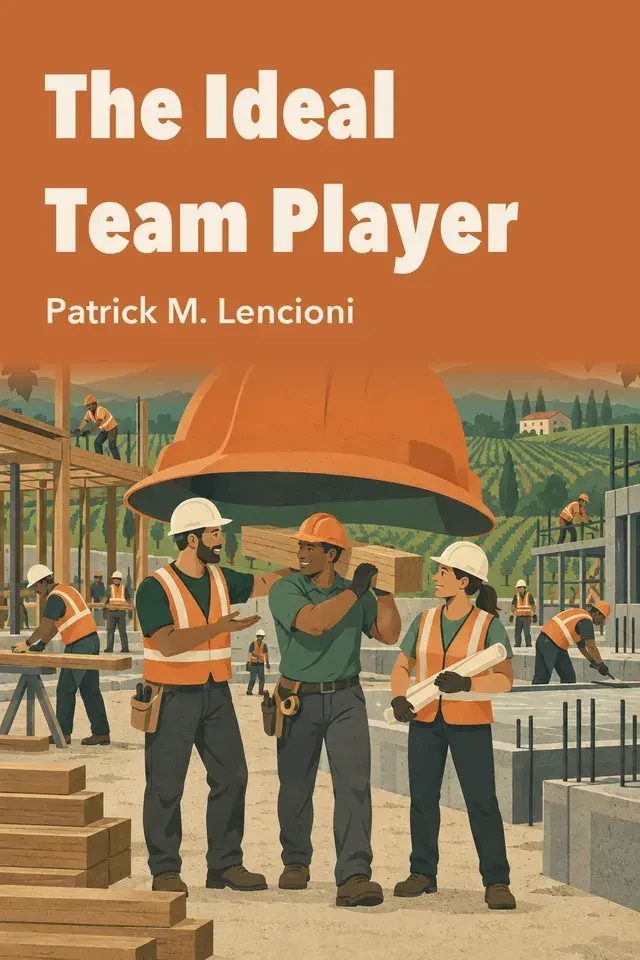
The Ideal Team Player, by Patrick M. Lencioni.
Jeff Shanley had left a successful career in high tech and consulting to join his uncle Bob at Valley Builders in Napa. Jeff had no construction experience. After eight weeks, he was beginning to feel at home when Bob disclosed a serious heart condition and put him in charge immediately. The transition was supposed to take much longer. Now Jeff had to lead while learning an industry and company he barely knew.
The company had more than two hundred employees, and its success mattered to family shareholders who depended on it. Jeff faced two new projects, a hospital and a hotel, each as large as anything Valley Builders had taken on. He suggested dropping one, but Bob explained that contractual and cash flow consequences made that a deal breaker. The hotel advance was already helping fund other work. Bob reassured Jeff that added hires and company scale would make the challenge manageable, though Jeff remained worried about the risk.
Clare, who led administration, and Bobby, who led field operations, also had reservations about Jeff’s appointment. Neither wanted the chief executive role, and they said they trusted Jeff because they knew him, saw his investment in the company, and believed he listened and understood them. Their support gave Jeff a basis to lead, but it did not remove the urgency or his lack of experience.
The staffing need was immediate. Bobby and Clare initially estimated that they needed at least sixty additional people within two months, including several critical hires. Their plan became more daunting: hire at least eighty people to secure sixty additional workers, because they expected at least twenty to leave. Clare said construction turnover was common but considered Valley Builders’ rate unusually high. She connected it partly to the company’s demanding expectations about behavior. Leaders could not solve the shortage simply by filling every opening and hoping for the best.
Oak Ridge showed the cost of an unclear standard. The workplace had become ugly, with a difficult project manager, pushy foremen, and mutual accusations about who was working or slacking. Nancy tried to quiet the conflict by telling people to get along and do their work, but the conditions worsened. Two strong foremen quit. With the company short on labor, leaders felt they could not afford more losses, so they kept people in place even as the job deteriorated.
Nancy and Craig described the conflict differently. Nancy said her part of the work was on track, but she knew little about Craig’s because he no longer invited her to meetings. She kept her head down and wanted to finish the project despite its strained atmosphere. Craig acknowledged that Nancy knew construction and could organize work effectively. He also said her manner and interactions made colleagues and vendors angry or uncomfortable. Craig said Nancy could not attend if she upset everyone, after which she stopped showing up. He recognized that he did not tolerate her attitude well and should have met with her to repair the relationship. Their accounts leave responsibility contested, while Craig acknowledged his own missed opportunity to address the breakdown.
This conflict also exposed the limits of Valley Builders’ earlier teamwork effort. Clare and Bobby said the effort was genuine and included work on trust, healthy conflict, and accountability. But they became busy, stopped reinforcing those ideas, and did not carry them through the broader organization. The company had given teamwork attention; it had not made the expectations durable in daily decisions.
The hiring process had questions about trust, conflict, vulnerability, accountability, and teamwork. Clare argued that interviewers should notice how candidates act as well as what they say. Jeff still questioned what concrete signs could show that a person practiced the desired behaviors. Candidates could give agreeable answers without revealing how they actually worked with others. The company’s rough shorthand—that someone should not be a “jackass”—was too subjective to guide consistent choices. Even people inside Valley Builders disagreed about who fit.
For Jeff, this uncertainty became a business problem. If leaders could not describe team contribution in observable terms, they had to rely on inconsistent impressions. They might keep people whose conduct drove capable colleagues away, while also losing workers the company urgently needed. With a hospital wing and hotel to build within eighteen months, the question of whom to hire, retain, or trust with responsibility was tied directly to whether Valley Builders could deliver its work and remain in business.
Chapter 2 of 8 · 6 min · Audio & textIn the app
Defining Humility, Hunger, and People Smarts
A reliable teammate cannot be identified by competence alone. Lencioni’s standard looks at how a person brings ability into shared work: with humility, hunger, and people smarts.
Chapter 3 of 8 · 6 min · Audio & textIn the app
The Six Gaps in Combination
The model becomes a map of different teamwork risks when the virtues are considered in combination. Lencioni describes three profiles that retain only one virtue, and three that retain two.
Chapter 4 of 8 · 9 min · Audio & textIn the app
Hiring Through Behavioral Evidence
Once a team has named humility, hunger, and people smarts as hiring standards, the challenge is to recognize them in conduct. Lencioni cautions that no diagnostic tool can identify them with complete reliability.
Chapter 5 of 8 · 6 min · Audio & textIn the app
Assessing Current Teammates
With the three virtues as a shared lens, leaders can assess people already on a team as well as new candidates. At Valley Builders, the executives applied the model to the nine people involved in the troubled Oak Ridge project.
Chapter 6 of 8 · 8 min · Audio & textIn the app
Coaching for Change
Once a weakness has been named, development depends on what happens next. A score or candid conversation can point to an area for growth, but it cannot change behavior on its own.
Chapter 7 of 8 · 5 min · Audio & textIn the app
Making the Standard a Culture
A teamwork standard lasts when it becomes part of how an organization works every day. Lencioni treats teamwork as a deliberate choice: a company has to be willing to spend time and effort making it real.
Chapter 8 of 8 · 4 min · Audio & textIn the app
How Individual Virtues Meet Team Dynamics
Near the close, Lencioni places two teamwork models side by side. Humility, hunger, and people smarts describe qualities of an individual.
Chapter 1 of 8 · 6 min · Audio & text: When Teamwork Has No Shared Standard
Wiseley supports reading and listening to summaries in the app.
Continue in WiseleyAbout Patrick Lencioni

Patrick Lencioni is an American author on business and team management. “The Five Dysfunctions of a Team” explores why a capable executive team can fail despite talent, resources, and strategy.
Explore more books by Patrick Lencioni