What you'll learn
Key ideas from The God Delusion
These ideas compress the book's argument without treating the author's view as settled fact. Use them as an orientation before reading the full work or listening in Wiseley.
A response of wonder can accompany religious belief or naturalism; the experience alone does not settle what exists.
Russell’s teapot shows why the burden to support an existence claim rests with the person asserting it.
Cumulative selection can build biological complexity through successive changes that offer advantages along the way.
A designer hypothesis does not resolve complexity’s origin because the designer’s own complexity remains unexplained.
Religious ideas may draw on ordinary mental capacities that evolved for other purposes.
Moral motivation and moral standards are separate questions; divine monitoring is not necessary for people who would remain decent without it.
The moral Zeitgeist is a broad but imperfect consensus that shifts across generations and cannot be reduced to one fixed religious code.
Comparative religious education can expose incompatible claims and leave children to judge when ready.
Inside The God Delusion
Read the first chapter in full here. The other 17 continue in the Wiseley app.
Chapter 1 of 18 · 3 min · Audio & text
Awe Without Supernaturalism
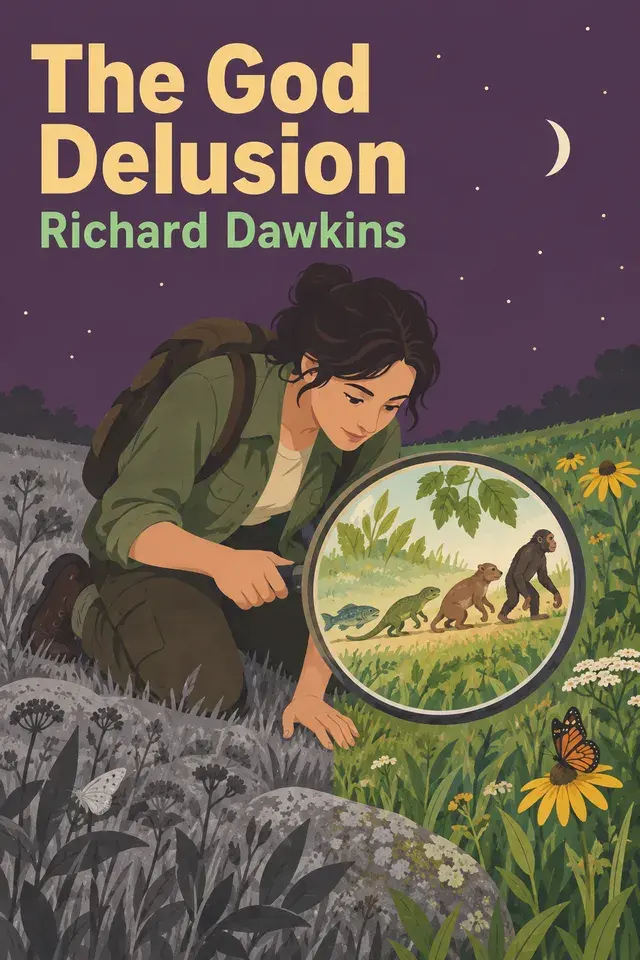
The God Delusion, by Richard Dawkins.
A clergyman recalled discovering, as a child, a teeming world of life in the grass. The encounter became a religious experience and eventually led him to the Anglican priesthood. Dawkins remembers a comparable wonder beneath the stars. The same kind of response to nature led him elsewhere, and he says he cannot readily explain why their experiences took different paths.
That contrast introduces a distinction between feeling and inference. Awe may be intense, even quasi-mystical, without deciding whether a supernatural being exists. Dawkins recognizes this response among scientists and rationalists, and says his own writing aims to evoke wonder at the real world. The feeling is genuine; what it establishes about the source of the world is a separate question.
Nature itself can sustain that wonder. Darwin’s image of an entangled bank presents complex life as the outcome of natural laws. Dawkins sees scientific understanding as enlarging the view: the universe’s scale and elegance can inspire reverence, while natural processes account for life’s intricate forms. Such responses need not be called religious if that word suggests a supernatural presence.
The terms matter because “God” can mean different things. In theism, a supernatural intelligence creates the universe and remains involved: it may answer prayers, judge conduct, or perform miracles. Deism also posits a supernatural intelligence, but one that establishes the laws of the universe and does not intervene afterward or take a particular interest in human affairs. Pantheistic language uses “God” poetically for nature, the universe, or its laws. It expresses reverence for the natural order, not belief in a supernatural person.
Philosophical naturalism holds that the physical world is all that exists. Minds, emotions, beauty, and values arise within that reality; they do not require a supernatural realm. Naturalism does not claim that everything is already explained. Dawkins allows that phenomena not yet understood may eventually fit within a natural account.
Evolution is one such powerful explanation for the complexity of living things. Its reach has a limit: natural selection explains the living world, not the cosmos as a whole. Dawkins suggests that other explanatory processes may help with cosmological questions, but evolution itself does not answer them.
Chapter 2 of 18 · 5 min · Audio & textIn the app
Respect and Public Reason
Dawkins now turns from private belief to religion’s place in law and public life. He rejects the social rule that calls an idea sacred and therefore beyond criticism.
Chapter 3 of 18 · 6 min · Audio & textIn the app
Uncertainty, Science, and Prayer
Agnosticism can mean different things. Sometimes it means that the evidence is not yet enough to settle a question.
Chapter 4 of 18 · 6 min · Audio & textIn the app
Testing Proofs and Experiences
Questions about intelligent life elsewhere and about God share an important feature: neither is settled by intuition alone. But they are not the same question.
Chapter 5 of 18 · 7 min · Audio & textIn the app
Scripture, Scientists, and Wagers
Firsthand conviction can feel like evidence, but it does not travel intact to someone who did not share the experience. Dawkins recalls a friend who heard a seemingly sinister voice while camping.
Chapter 6 of 18 · 4 min · Audio & textIn the app
Natural Selection and Apparent Design
A highly intricate organism is too improbable to assemble by chance in one stroke. Dawkins’s answer is not to deny that difficulty, but to distinguish random assembly from natural selection.
Chapter 7 of 18 · 7 min · Audio & textIn the app
Gaps, Observers, and Fine-Tuning
An incomplete biological record, a planet capable of supporting observers, and life-friendly cosmic constants raise different questions. Treating them as one gap for a designer hides what each kind of evidence can and cannot show.
Chapter 8 of 18 · 6 min · Audio & textIn the app
From Designer to Religious Origins
The question now shifts from how apparent design might arise to why religious belief and practice persist. Dawkins uses a meeting in Cambridge to show how that question can be shielded from scrutiny.
Chapter 9 of 18 · 7 min · Audio & textIn the app
Psychological Roots of Religious Belief
The previous chapter introduced the possibility that religion can emerge from capacities used for other tasks. Here Dawkins asks what those capacities might be.
Chapter 10 of 18 · 5 min · Audio & textIn the app
Memes and the Cargo Cult Test
Psychological tendencies may help explain why some religious ideas feel intuitive. Dawkins adds a cultural question: how do particular traditions spread, persist, and change?
Chapter 11 of 18 · 5 min · Audio & textIn the app
Evolutionary Roots of Moral Intuition
Darwinian evolution can seem to leave little room for compassion: hunger, fear, and sexual desire more directly aid survival and reproduction. Dawkins argues that this apparent conflict rests on confusing the gene’s evolutionary success with an organism’s motives.
Chapter 12 of 18 · 7 min · Audio & textIn the app
Morality, Scripture, and Group Identity
The question “If there is no God, why be good?” can confuse moral motivation with moral standards.
Chapter 13 of 18 · 7 min · Audio & textIn the app
Moral Change and Fundamentalist Faith
An appeal to religion as a fixed anchor for morality faces a historical problem: standards of decent conduct change. Dawkins calls the broad, shifting social climate the moral Zeitgeist.
Chapter 14 of 18 · 6 min · Audio & textIn the app
Absolutism, Suffering, and Human Status
Dawkins tests moral certainty against its consequences in arguments about private sex, abortion, and human status. To show how a rule can reach into private life, Dawkins points to the Taliban’s stated punishment of execution for homosexuality, which he describes as a private act between consenting adults that harms no one else.
Chapter 15 of 18 · 6 min · Audio & textIn the app
Moderate Faith and Violent Extremes
Richard Dawkins argues that religious extremism cannot be understood only as a sudden departure from otherwise harmless faith. In his account, a wider habit helps create the conditions: society treats religious belief as deserving deference, while many traditions teach that faith without questioning is a virtue.
Chapter 16 of 18 · 7 min · Audio & textIn the app
Childhood Belief and Educational Choice
A child's acceptance of a religion cannot be treated as a considered choice simply because it is sincere. Dawkins turns his criticism of religious authority toward the conditions in which children acquire belief: fear, family bonds, inherited labels, and schooling.
Chapter 17 of 18 · 7 min · Audio & textIn the app
Consolation, Culture, and Secular Inspiration
Dawkins begins with a cultural case for retaining biblical literacy. The King James Bible is a major source of English idioms and literary allusions, while books such as the Song of Songs and Ecclesiastes also have literary merit in their own right.
Chapter 18 of 18 · 5 min · Audio & textIn the app
The Limits of Human Intuition
Dawkins closes by asking how much of reality human beings can grasp without help. Our senses offer a narrow window: visible light is only a small band between radio waves and gamma rays.
Chapter 1 of 18 · 3 min · Audio & text: Awe Without Supernaturalism
Wiseley supports reading and listening to summaries in the app.
Continue in WiseleyAbout Richard Dawkins
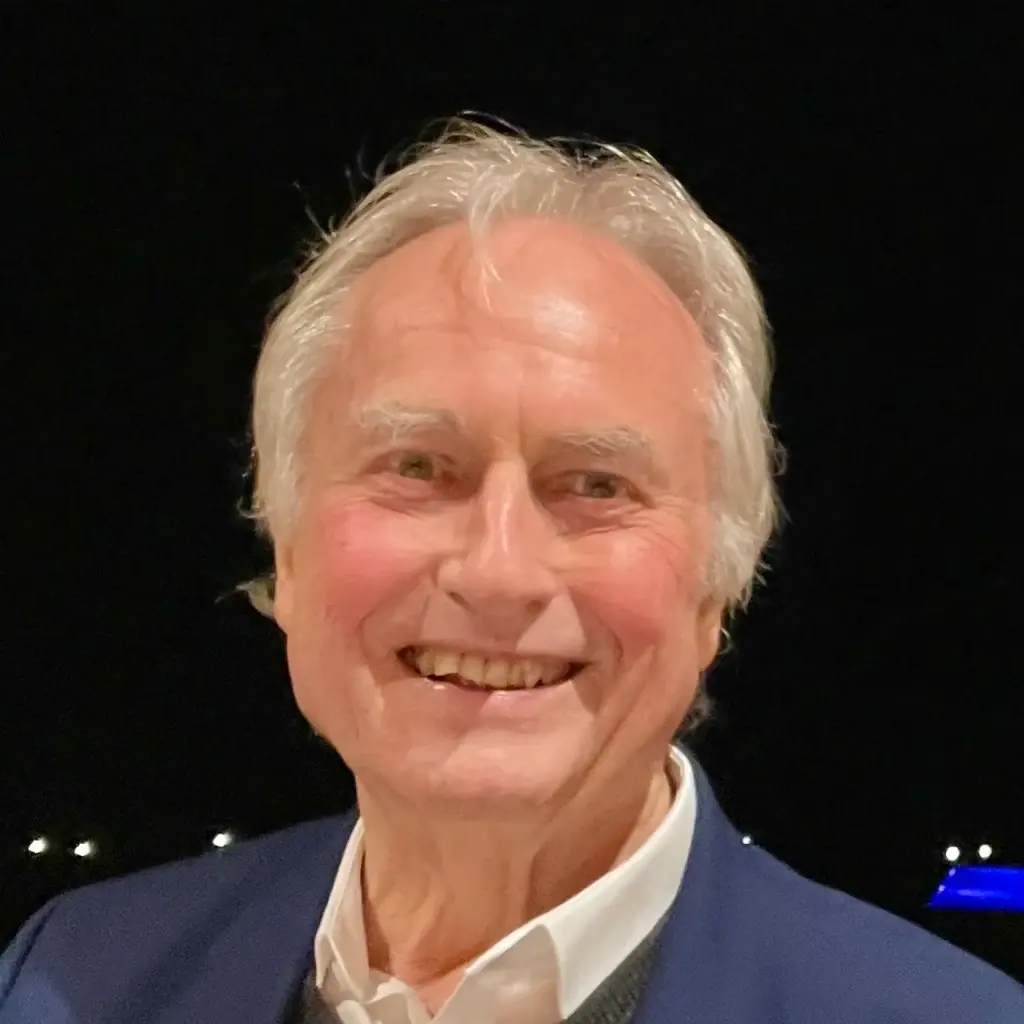
Richard Dawkins is a British evolutionary biologist and science writer. His books, including The Selfish Gene and The Blind Watchmaker, explain evolutionary ideas to a general audience.
Explore more books by Richard Dawkins