What you'll learn
Key ideas from The Free-Time Formula
These ideas compress the book's argument without treating the author's view as settled fact. Use them as an orientation before reading the full work or listening in Wiseley.
An honest hourly audit records ordinary activities and distractions, even on a demanding day.
Values, vision, responsibilities, strengths, and audit evidence clarify which goals fit the current season.
The five stages distinguish deferred ideas, long-term goals, deadline-sensitive projects, a current vital goal, and all-consuming emergencies.
Minimalism applies to excess in commitments and work as well as belongings, while Good Enough standards limit effort that no longer serves an important goal.
Margin, realistic expectations, and regular adjustment help a calendar fit ordinary life.
Intentional leisure includes rest and entertainment; the right balance changes with energy and life season.
Deep work is a single-objective block whose quality depends on barriers prepared before attention is tested.
Focused effort becomes more sustainable when it alternates with deliberate recovery that supports future energy, enthusiasm, and creativity.
Inside The Free-Time Formula
Read the first chapter in full here. The other 9 continue in the Wiseley app.
Chapter 1 of 10 · 5 min · Audio & text
Free Time Without Overwork
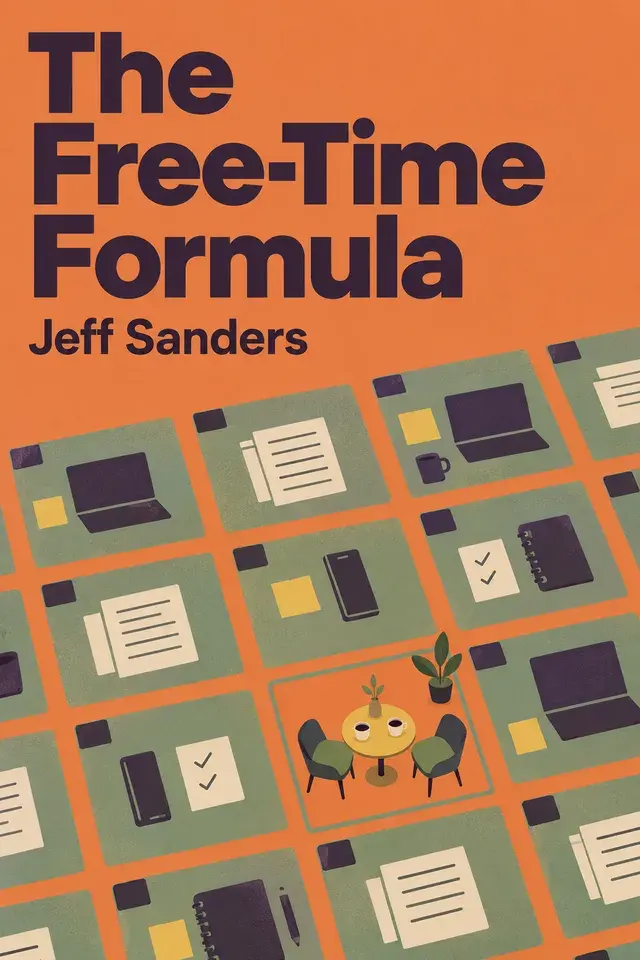
The Free-Time Formula, by Jeff Sanders.
Jeff Sanders opens with a crisis that exposed the cost of treating every available hour as work time. After an earlier period of overwork, he tried to make his schedule more flexible. For a while, he felt he could accomplish a great deal without feeling crushed. But that improvement did not last. He became ambitious again, accepted more commitments than the calendar could hold, and squeezed out breaks and the gaps that let him respond to surprises. In one eight-week stretch, he added speaking engagements, audiobook production, a book contract, a membership launch, more exercise, and a weekly podcast as he continued to manage his personal responsibilities. Contract and billing difficulties, along with a family medical problem, then landed on top of that already full schedule.
When he felt unable to manage it all, he developed symptoms resembling a heart attack and went by ambulance to the emergency room. The doctor concluded he had suffered an esophageal spasm; the condition is presumed to be caused in part by stress and anxiety. Sanders presents the episode as a warning: ambition had become entangled with a calendar so packed that setbacks felt unmanageable. Months later, he stopped planning excessive goals and intentionally full days. He says the added space let him reflect, handle unpredictable problems, and focus on significant work.
The point is not that success requires abandoning ambition. Sanders argues that building a life able to do less can be more useful than continually trying to build oneself up to handle more. His experience also shows that recognizing the problem once does not prevent it from returning. Without a clear sense of what the available time is for, new commitments can fill the space again.
That tension appears in the Sanderses’ Friday date nights. Their planned start moved from 5:00 to 5:30 and then to 6:00. On one occasion, they skipped the evening because both would rather finish their projects than leave anything undone. A calendar can reserve time for leisure, but the reservation does not decide what wins when work remains unfinished. The open block becomes a contest between an intention and an impulse. Scheduling a break does not by itself make that time feel available or protect it from the pull of one more task.
Work is not inherently the problem. Sanders recognizes that it can be fulfilling, help people reach meaningful goals, and offer a way to contribute creatively. Some people may happily choose to spend open hours on work they enjoy. The concern is work that fills every gap because busyness has become the default, or because a person no longer knows what else to do. The distinction is whether work is a chosen part of a desired life or an automatic response that crowds out other things a person values.
For Sanders, free time is not a special category of minutes separate from the rest of the day. People may already describe some of their time as personal time, family time, exercise, socializing, a nap, or entertainment. What counts as free time, and how much someone wants, differs from person to person. Wanting to unwind can be a real need, but the label alone does not tell us whether a block of time is restorative or satisfying.
Calling free time a myth does not mean that everyone can disregard practical boundaries. Work, family, mortgages, and other responsibilities shape what choices are possible. Sanders’s point is that people still make choices within those limits, even when it is difficult to see them clearly. Time itself cannot be slowed or managed; the practical question is what activities receive the limited hours of the day. A fulfilling life, in this account, depends less on continually increasing output than on choosing how to use time.
The Free-Time Formula gives the book its answer in outline. Its seven steps move from examining the life and time use a person has now, to clarifying priorities, supporting energy, cutting unnecessary activity, scheduling meaningful goals, preventing distraction, and establishing a rhythm of focused work and stepping back. Sanders presents the steps as a sequence, while allowing readers to move at their own pace. A person might begin with a small change to the calendar or use the framework for a broader life redesign. The chapters ahead explain each step; here, the central question is why make time at all if it will simply be filled by default?
The book begins by asking how to create time that feels genuinely available: time that can serve rest, personal aims, relationships, or work a person has chosen. The goal is not an ever-growing tally of completed tasks. It is a calendar that supports the life its owner wants to live.
Chapter 2 of 10 · 6 min · Audio & textIn the app
Audit the Life You Have
Before deciding what to change, get an honest picture of your life as it is now. Jeff Sanders begins with two complementary records: a self-evaluation of your current circumstances and an audit of how you actually spend a day.
Chapter 3 of 10 · 7 min · Audio & textIn the app
Choose the Vital Few
When the first audit has made actual time visible, the next task is deciding what deserves attention now. A list can hold many important demands, but Sanders argues that only one can be the highest priority at a given moment.
Chapter 4 of 10 · 5 min · Audio & textIn the app
Triage Projects and Ideas
Once a few vital goals have been chosen, the next problem is deciding what to do with everything else that matters. Demands can exceed the time and attention available.
Chapter 5 of 10 · 7 min · Audio & textIn the app
Protect Energy and Recovery
Sanders treats health as part of the capacity that makes meaningful effort possible. He recalls having separate seasons for work and fitness, as though pursuing one required neglecting the other.
Chapter 6 of 10 · 10 min · Audio & textIn the app
Subtract Work and Friction
Once you know which goals matter most right now, the next question is what can be removed. The author treats this as the letting-go part of a larger effort to clear obstacles.
Chapter 7 of 10 · 8 min · Audio & textIn the app
Build a Calendar That Fits
A calendar can look responsible and still misrepresent a life. In college, Jeff Sanders scheduled classes, booked a few sessions at the university gym, and left plenty of open space for social time.
Chapter 8 of 10 · 6 min · Audio & textIn the app
Make Free Time Intentional
Free time can feel abundant on the calendar and still disappear without leaving much satisfaction behind. The difference often lies in whether you choose how to use it or fall into whatever is easiest.
Chapter 9 of 10 · 8 min · Audio & textIn the app
Defend Focus and Set Boundaries
Plans can drift when attention is pulled in every direction. A task that should take a focused stretch of effort can expand, and interruptions can make creative work harder.
Chapter 10 of 10 · 5 min · Audio & textIn the app
Work in Sustainable Rhythms
Sustained achievement depends on a rhythm of concentrated effort and planned recovery. Sanders calls this crunch and release: work intensely on what matters, then step away deliberately.
Chapter 1 of 10 · 5 min · Audio & text: Free Time Without Overwork
Wiseley supports reading and listening to summaries in the app.
Continue in WiseleyAbout Jeff Sanders

Jeff Sanders is an author and host of The 5 AM Miracle podcast. “The Free-Time Formula” explores how to create usable free time when responsibilities and ambitions compete.
Explore more books by Jeff Sanders