What you'll learn
Key ideas from The Five Dysfunctions of a Team
These ideas compress the book's argument without treating the author's view as settled fact. Use them as an orientation before reading the full work or listening in Wiseley.
Trust is confidence that teammates can expose mistakes, weaknesses, and concerns without fear of reprisal.
Trust supports respectful peer pressure; it does not excuse missed commitments or shield people from necessary challenge.
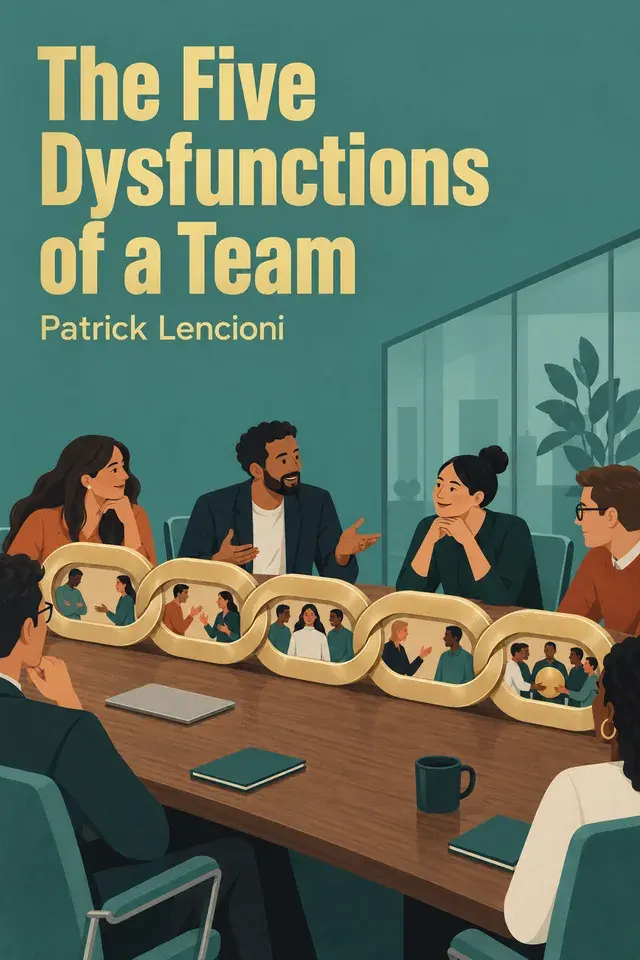
Trust enables open conflict; conflict supports commitment; commitment makes peer accountability possible; accountability protects collective results.
Even strong teams require continuous work because cohesion can drift back toward dysfunction.
Productive conflict is passionate disagreement about ideas, bounded by respect and separated from personal attack.
Commitment combines decision clarity with buy-in, so dissent can remain while the team moves together.
Clear public goals make peer accountability possible and keep expectations from becoming private assumptions.
Results mean collective objectives, not merely profit, status, career advancement, or departmental success.
Inside The Five Dysfunctions of a Team
Read the first chapter in full here. The other 7 continue in the Wiseley app.
Chapter 1 of 8 · 6 min · Audio & text
Why Smart Teams Fail
The Five Dysfunctions of a Team, by Patrick Lencioni.
Teamwork is introduced as a rare competitive advantage, not because its principles are mysterious, but because organizations struggle to practice them consistently. When people align, they can accomplish more together than alone. Yet teams are made of imperfect human beings. Under pressure, self-protection, politics, and avoidance can overpower talent. Lencioni uses a realistic business fable to show that teamwork is possible but fragile enough to become a serious business problem.
DecisionTech looks like the kind of company that should succeed. It has exceptional investors, capable executives, a strong business plan, and substantial resources. But after its promising start, the company deteriorates. Deadlines slip, employees leave, morale falls, political behavior spreads, unity weakens, and execution slows. The decline matters because it cannot be explained by a shortage of talent or opportunity. A well-resourced organization can still lose momentum when its leaders fail to operate collectively.
The board removes chief executive Jeff because DecisionTech is too important and high-profile to lose to internal politics, and because the person at the top is accountable for the environment. That does not mean every problem began with him. The harmful pattern involves the whole executive staff. Leadership responsibility includes the conditions leaders permit, not only the decisions they personally make.
Kathryn Petersen is an unexpected replacement. Her age, limited technology background, and apparent cultural mismatch make the appointment surprising to the executives and initially to the board. The Chairman supports her because her operational record and unusual ability to build teams matter more than deep industry-specific expertise. Kathryn herself sees a possible advantage in not being absorbed by technical detail. She can concentrate on leading the organization and observing how its leaders behave.
Her first move is deliberate observation. She walks the halls, speaks with direct reports, attends meetings, listens, and takes notes. To the executives, this looks like almost nothing, and their doubts about her grow. But she is gathering evidence before intervening. She already has an agenda for leadership retreats, and the behavior she sees confirms that the problem is more serious than she first understood.
The executive staff is not even treated as a team. Meetings contain tension without open arguments. Discussions fail to become meaningful exchanges, decisions stall, and people seem to be waiting for the meeting to end. This is not harmony. The absence of visible conflict can conceal disagreement that nobody is willing to address. Individually, most members appear reasonable and perhaps well-intentioned. Collectively, however, their habits produce a political and ineffective organization.
The examples are behavioral rather than biographical. Mikey is highly talented in marketing, yet she talks excessively, complains about DecisionTech, and signals contempt by rolling her eyes when challenged. Martin attends meetings but works on his laptop, speaks mainly to correct inaccuracies, and often uses sarcasm. His expertise has become a form of distance. Nick has impressive credentials and little meaningful work, while privately judging colleagues as inferior and believing he is the only qualified candidate for chief executive. Together, these patterns show how status, expertise, disengagement, and private comparison can keep an executive group from becoming a team.
Kathryn's first direct test comes when Martin announces a promising opportunity with ASA Manufacturing that conflicts with the beginning of the Napa retreat. The opportunity has genuine value, and she does not pretend otherwise. But she refuses to let it quietly displace the team's work. Instead of replying by email, she confronts him face to face, tells him the appointment can be moved, and explains that DecisionTech's immediate priority is to become a functioning team. Without that foundation, the company cannot reliably sell or improve its future.
Jeff initially gives some support to Martin's position, yet he accepts Kathryn's reasoning once she explains the leadership priority. Her distinction is crucial. Disagreement is not disloyalty; direct disagreement can clarify what matters. What she rejects is indirect lobbying and avoidance, especially when they allow the executive team's central problems to remain untouched.
The chapter therefore begins with a decision about sequence. DecisionTech does not need another strategy conversation before it understands whether its leaders can work together. Kathryn chooses team repair first, not because customer opportunities are irrelevant, but because unresolved collective behavior can undermine every opportunity that follows. The company has smart people and resources. What it lacks is a leadership team willing to act like one.
Chapter 2 of 8 · 5 min · Audio & textIn the app
Trust Requires Exposure
Kathryn begins the first retreat by making the problem behavioral. DecisionTech has experienced executives, cash, better technology, and a strong board, yet it trails competitors in revenue and customer growth.
Chapter 3 of 8 · 6 min · Audio & textIn the app
Conflict Creates Commitment
Trust first changes a team by making disagreement safe enough to be useful. Its immediate reward is not harmony but honest ideological conflict: members can challenge a proposal, expose a concern, and stay focused on what the company should do.
Chapter 4 of 8 · 5 min · Audio & textIn the app
Change Must Survive Regression
After the first off-site, DecisionTech's executives do not carry its gains back into the office automatically. Within days, they are guarded, barely interact, and behave as if Napa never happened.
Chapter 5 of 8 · 7 min · Audio & textIn the app
Accountability Has Consequences
Once a team learns to argue honestly, the next test is whether candor changes what people do. At DecisionTech, productive conflict is increasing, but Carlos still sees avoided strategic questions.
Chapter 6 of 8 · 5 min · Audio & textIn the app
The Five-Step Causal Chain
By the end of the fable, DecisionTech’s executive team appears to be working differently. Members report greater trust, better conflict, and stronger buy-in around shared objectives.
Chapter 7 of 8 · 6 min · Audio & textIn the app
Trust and Productive Conflict
The model's first two links are practical, not abstract ideals. A team cannot debate honestly when members are protecting themselves, and recurring tension grows when disagreement stays hidden.
Chapter 8 of 8 · 7 min · Audio & textIn the app
Commitment, Accountability, Results
Once a team can challenge ideas openly, it still has to turn debate into action. Lencioni calls this next requirement commitment: clarity about what has been decided and enough buy-in for members to support it.
Chapter 1 of 8 · 6 min · Audio & text: Why Smart Teams Fail
Wiseley supports reading and listening to summaries in the app.
Continue in WiseleyAbout Patrick Lencioni

Patrick Lencioni is an American author on business and team management. “The Five Dysfunctions of a Team” explores why a capable executive team can fail despite talent, resources, and strategy.
Explore more books by Patrick Lencioni