What you'll learn
Key ideas from Negotiation Genius
These ideas compress the book's argument without treating the author's view as settled fact. Use them as an orientation before reading the full work or listening in Wiseley.
A BATNA sets the basis for a reservation value, and estimated reservation values define a ZOPA without predicting the final price.
Multi-issue packages keep possible trades open, letting concessions on lower-priority terms support gains on more important ones.
A stated demand is a clue to the interest or constraint behind it, and the reason may be negotiable when the demand is not.
Fixed-pie assumptions and vivid details can hide shared interests and make salient terms outweigh less visible costs.
Independent information, known-answer tests, consistency checks, and attention to omissions make claims easier to assess.
Trust has separate dimensions of competence and character, so rebuilding it starts with identifying the particular concern.
Negotiation is worthwhile when its likely gains outweigh the time, relationship costs, and signals it creates.
Inside Negotiation Genius
Read the first chapter in full here. The other 12 continue in the Wiseley app.
Chapter 1 of 13 · 10 min · Audio & text
Prepare to Claim Value
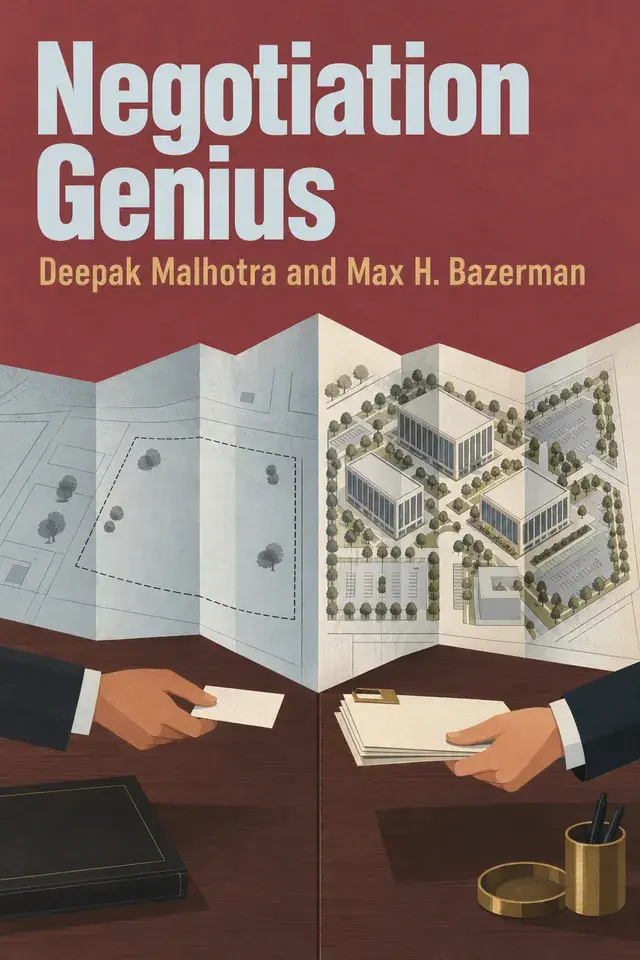
Negotiation Genius, by Deepak Malhotra and Max H. Bazerman.
Negotiation is often treated as a talent people either have or lack. Malhotra and Bazerman argue that it is a learnable skill: preparation, a clear framework, and deliberate choices can improve results beyond what instinct alone achieves. Although the chapter opens with the Roosevelt photographer case, it develops its framework through a simple negotiation over price. Its central question is how to claim more value without mistaking a deal that beats your fallback for the best deal you could have reached.
Preparation starts with your best alternative to a negotiated agreement, or BATNA: what you would do if these talks ended without a deal. List realistic alternatives, estimate what each is worth, and identify the best. Your reservation value follows from that alternative. It is the point at which accepting a deal and pursuing your BATNA are equally worthwhile. For a seller, it is the lowest acceptable price. A hoped-for price, a sense of what is fair, or the original purchase price does not establish this limit.
The Hamilton property case shows why the calculation needs careful assumptions. The seller, an executive vice president of Pearl Investments, could accept a $38 million offer from Quincy Developments for apartments. But the seller expected further bargaining with Quincy to raise that figure by 10 to 15 percent, producing an estimated range of $41.8 million to $43.7 million. The authors use $42.65 million as the seller’s estimated reservation value within that range. The figure depended on the seller’s forecast of the Quincy negotiation; risk aversion or optimism could have led the seller to weigh the range differently. It was a working estimate, not a fact about what the land was worth.
Next, estimate the other side’s alternatives and limit from its point of view. Connie Vega, the potential buyer, might find another suitable property, build elsewhere, or wait for future opportunities. The exercise treats waiting as her best alternative. If the property would be worth between $36 million and $44 million for residential use, a midpoint of $40 million, increased by 20 percent for condominium development, suggests a $48 million buyer reservation value. That calculation assumes development costs are already included. With these estimates, the zone of possible agreement, or ZOPA, runs from the seller’s $42.65 million floor to Connie’s $48 million ceiling, a range of $5.35 million. The ZOPA describes prices both might accept; it does not predict the closing price or guarantee agreement.
In the imagined negotiation, the seller opens at $49 million, Connie counters at $45 million, and they settle at $46 million. The seller has beaten the reservation value and might regard the result as a success. But the opening rested on a mistaken estimate of the buyer’s limit. Later information indicates that Estate One, Connie’s company, wanted the land for commercial development and would have been willing to pay up to $60 million. This indicates a buyer reservation value of up to $60 million, rather than Estate One’s general financial capacity. The $49 million offer therefore placed an unnecessarily low ceiling on the seller’s possible share. A more demanding measure of performance asks not only whether a negotiator beat the fallback, but whether available information could have improved the estimate. Research into zoning prospects might have changed the seller’s view; some unknowns may still have remained.
The Roosevelt photographer case illustrates why the other party’s BATNA matters. Roosevelt’s campaign had printed three million brochures bearing a photographer’s image without permission. The photographer could demand up to a dollar per copy, while reprinting would cost the campaign money and time. The campaign manager framed the brochures as valuable publicity, then asked what the photographer would pay to use the photographs. The photographer offered only $250. The manager had recognized that the photographer’s alternative was weak: no deal meant little or no income and lost national exposure. That publicity made the photographer’s weak alternative relevant and led him to offer the campaign $250 to use the photographs.
A first offer can also shape expectations. An offer acts as an anchor, drawing attention toward its number. In a house-appraisal study described by the authors, agents given the same property information but different list prices judged the house more valuable when they saw a higher price. Most said the list price had not influenced them. This helps explain why an informed, aggressive but justifiable opening may move discussion in your favor. If you do not know enough about the other side’s limit or the likely ZOPA, further research—or letting the other side open—can prevent you from anchoring the deal too low. An opening well beyond what the other side might accept can preserve room to bargain, but an extreme or uninformed demand may offend, damage credibility, or derail talks. The offer needs a meaningful basis, and its aggressiveness should fit the setting and relationship.
When the other side anchors first, do not let its number silently replace your own analysis. Acknowledge the offer, then briefly ask whether it rests on new information. A genuine competing offer or other credible fact may require you to revise your estimate; repeated arguments that add nothing should not. If the anchor cannot be ignored, respond with a counter-anchor grounded in your own view and explain why the two sides need to work toward agreement. When an offer is so extreme that it cannot serve as a starting point, say so, present your perspective, and invite a restart. Spending too long debating the anchor can keep it central; a short probe followed by a redirection helps bring the discussion back to your terms.
Preparation also means setting an aspiration: a target informed by your estimate of the ZOPA. The authors argue that ambitious but realistic targets can encourage stronger opening offers and sustained bargaining, improving outcomes. But a target affects satisfaction too. If you judge the final result against a very high aspiration, you may feel disappointed even when the deal beats your reservation value. These are different standards: the target can guide effort, while the BATNA provides a fallback for evaluating whether the deal was worthwhile.
Once bargaining begins, concessions should be deliberate and reciprocal. Give-and-take helps settle on a specific deal, but one-sided concessions can invite further demands. Make a concession visible, explain what it costs, and say what you expect in return. Silence after an offer can also prevent nervous self-bargaining: a counterpart who waits rather than objects may prompt you to soften your own offer without being asked. Smaller concessions over time may signal that someone is nearing a limit, but they may also be a deliberate tactic, so the pattern alone does not reveal a reservation value. Careful questions that test important assumptions can improve your estimate; asking repeatedly for an opposing anchor’s justification can instead reinforce it.
Claiming value affects the relationship as well as the price. The authors urge negotiators to consider whether their approach preserves respect and reputation, even if that means giving up some short-term gain. At Princeton, the head of the Institute for Advanced Study asked Albert Einstein how much salary he expected. Einstein replied, “$3,000 annually, unless you think I can get by with less.” Princeton offered $15,000. The authors present the larger offer as a way to avoid exploiting a possibly uninformed request and to signal good faith, loyalty, and integrity. At the same time, an unexpectedly attractive offer deserves thought before acceptance. It may reflect information you lack, a mistaken estimate of the ZOPA, or a difference in the other side’s alternatives or resources. A favorable number is not, by itself, proof that you have understood the deal.
The chapter’s framework makes preparation part of negotiation rather than an afterthought. Know the alternative that sets your limit, estimate the other side’s alternatives, and treat the possible agreement range as provisional. Then choose offers, targets, and concessions that fit what you know, while staying alert to new evidence and the relationship at stake. A favorable deal is a useful result; judging whether it was the best available one requires a better estimate of the value left unclaimed.
Chapter 2 of 13 · 9 min · Audio & textIn the app
Create Value Across Issues
When a negotiation has several issues, the terms need not be treated as separate contests. Differences in what each side values, when it needs something, or what it expects can reveal trades that leave both parties better off.
Chapter 3 of 13 · 9 min · Audio & textIn the app
Investigate Interests and Constraints
An apparent deadlock is a reason to investigate, not yet proof that no agreement is possible. Chris’s American buying team and a European supplier had settled on price and annual quantity but remained divided over exclusivity.
Chapter 4 of 13 · 12 min · Audio & textIn the app
Recognize Cognitive and Motivational Bias
Knowing a sound negotiation framework does not guarantee that we will follow it. What catches our attention, how an outcome is described, and what we want to believe about ourselves can all shape judgment.
Chapter 5 of 13 · 6 min · Audio & textIn the app
Build Deliberate Negotiation Expertise
Knowing the names of negotiation biases does not make anyone immune to them. Experience can help, but it does not automatically become expertise.
Chapter 6 of 13 · 8 min · Audio & textIn the app
Influence and Resist Persuasion
Negotiation depends partly on what a proposal offers, but also on how it is presented. The same terms can feel different when they are described as a gain, a loss, a concession, or a chance others are already taking.
Chapter 7 of 13 · 7 min · Audio & textIn the app
Search Beyond the Obvious
Negotiators often concentrate on the question directly in front of them: what price is sensible, what offer will be accepted, and how the parties can reach agreement. That focus is useful, but it can hide people, rules, and information that determine a deal’s real value.
Chapter 8 of 13 · 9 min · Audio & textIn the app
Detect Deception and Preserve Honesty
A negotiation can turn on facts one side knows and the other cannot verify. Malhotra and Bazerman distinguish a direct lie from a technically true statement chosen to mislead.
Chapter 9 of 13 · 7 min · Audio & textIn the app
Correct Ethical Blind Spots
Negotiation ethics is often framed as a question of whether someone knowingly lied or withheld information. But people can fall short of their own standards without noticing.
Chapter 10 of 13 · 7 min · Audio & textIn the app
Negotiate from a Weak Position
A weak alternative—the best alternative to a negotiated agreement, or BATNA—limits your leverage, but it does not determine every term. Power is comparative: the other side’s alternatives and what it stands to gain matter too.
Chapter 11 of 13 · 9 min · Audio & textIn the app
Resolve Distrust, Anger, and Threats
When a counterpart seems reckless or unreasonable, pause before deciding they are irrational. Hostility can grow from missing information, hidden constraints, interests you have not recognized, or a need to protect dignity.
Chapter 12 of 13 · 6 min · Audio & textIn the app
Know When Not to Negotiate
Negotiation skill includes deciding whether a conversation should become a negotiation. Weigh the possible improvement against the time, effort, relationship effects, and signal that bargaining sends.
Chapter 13 of 13 · 5 min · Audio & textIn the app
Practice the Negotiator's Craft
Reading this book is only a beginning. Repeatedly negotiating creates experience, but experience alone does not make someone an expert.
Chapter 1 of 13 · 10 min · Audio & text: Prepare to Claim Value
Wiseley supports reading and listening to summaries in the app.
Continue in WiseleyWhat Negotiation Genius is about
Negotiation Genius asks how people can prepare for better agreements without relying on intuition alone. It teaches ways to assess alternatives, claim and create value, and uncover hidden interests, then examines bias, influence, deception, ethics, difficult counterparts, and when walking away is wiser. The result is a framework for more deliberate negotiation.
About Deepak Malhotra & Max H. Bazerman

Deepak Malhotra
Deepak Malhotra is an American professor who studies negotiation and conflict resolution. “Negotiation Genius” explores how people can prepare for better agreements without relying on intuition alone.
Explore more books by Deepak Malhotra
Max H. Bazerman
Max H. Bazerman is an American behavioral economist. “Negotiation Genius” explores how people can prepare for better agreements without relying on intuition alone.
Explore more books by Max H. Bazerman