What you'll learn
Key ideas from Make Your Bed
These ideas compress the book's argument without treating the author's view as settled fact. Use them as an orientation before reading the full work or listening in Wiseley.
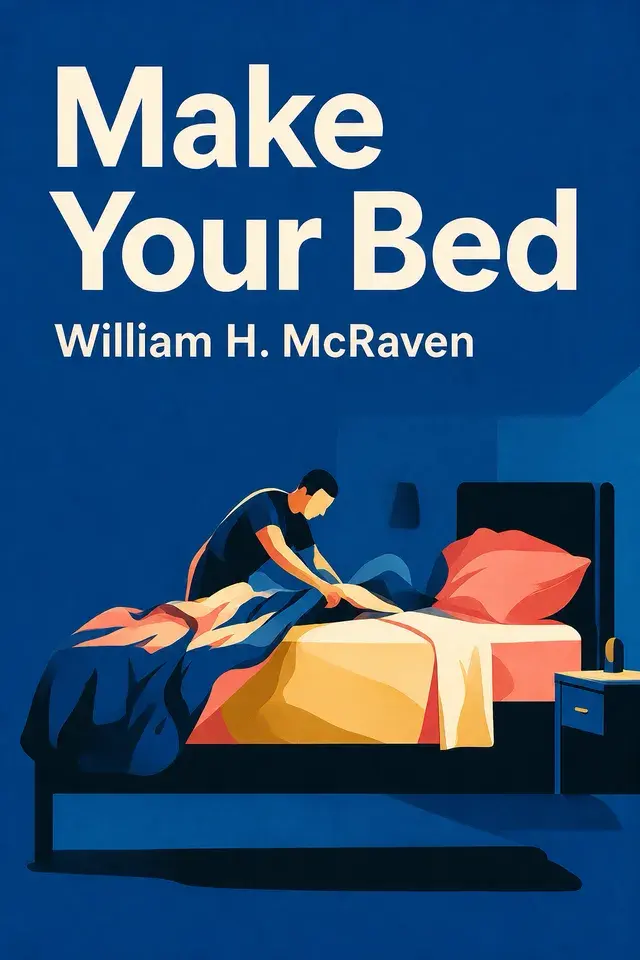
Making the bed turns the day’s first responsibility into a precise, completed act of order and attention.
Demanding work becomes sustainable when people coordinate effort, compensate for one another's weakness, and allow support to move in both directions.
Setbacks become instructive when people refuse blame, continue forward, reflect on what happened, and adapt their next effort.
Courage moves toward an honorable goal through fear while remaining bounded by preparation, self-knowledge, and awareness of limits.
One person’s visible example can shift a group’s shared expectation from quitting toward enduring hardship together.
The bell symbolizes quitting, which ends possible paths before their outcomes are known.
How Make Your Bed builds its case
Follow how the book develops its argument. Each note is a brief orientation, not a replacement for the chapter.
Order Before Momentum
McRaven opens with an ordinary task: making the bed. In SEAL training, it was the first responsibility of the day, before inspections, swims, runs, obstacle courses, and harassment.
Strength Requires Other People
Order and discipline can give a person a beginning, but demanding work quickly exposes a limit: no one carries it indefinitely alone. McRaven's second lesson begins with a rubber raft in SEAL training.
Drive On, Learn Forward
McRaven’s treatment of adversity begins with an uncomfortable fact: effort does not guarantee a fair result. In SEAL training, a trainee could be ordered to lie in wet sand and accept an arbitrary punishment, regardless of how hard he had worked.
Courage With Clear Limits
McRaven’s treatment of courage begins by separating it from recklessness. He does not present danger as proof of character, or caution as weakness.
Composure Creates Hope
For McRaven, darkness is more than the absence of light. It names the conditions that make judgment difficult: fear, doubt, fatigue, confusion, grief, and crisis.
Refuse the Bell
The bell in SEAL training is the clearest symbol of quitting. It offers an immediate exit from early mornings, cold swims, runs, obstacles, physical training, and hardship.