What you'll learn
Key ideas from Ikigai
These ideas compress the book's argument without treating the author's view as settled fact. Use them as an orientation before reading the full work or listening in Wiseley.
Ikigai is presented as a personal reason for being that gives daily activity meaning and keeps life engaged.
Together, the practices portray ikigai as purpose cultivated through acceptance, responsibility, and repeated behavior under imperfect conditions.
Flow is more likely when goals and feedback are clear, challenge matches skill, and distractions are limited.
Comparing activities that reliably produce flow can reveal patterns pointing toward personal ikigai.
Longevity is presented as a social ecology in which useful activity, friendship, learning, celebration, and hope reinforce personal purpose.
The longevity-oriented movement pattern is frequent and gentle, woven into ordinary routines rather than dependent on strenuous workouts.
Wabi-sabi and ichi-go ichi-e frame imperfection, change, and unrepeatable encounters as reasons for fuller presence.
How Ikigai builds its case
Follow how the book develops its argument. Each note is a brief orientation, not a replacement for the chapter.
Ikigai and the Longevity Question
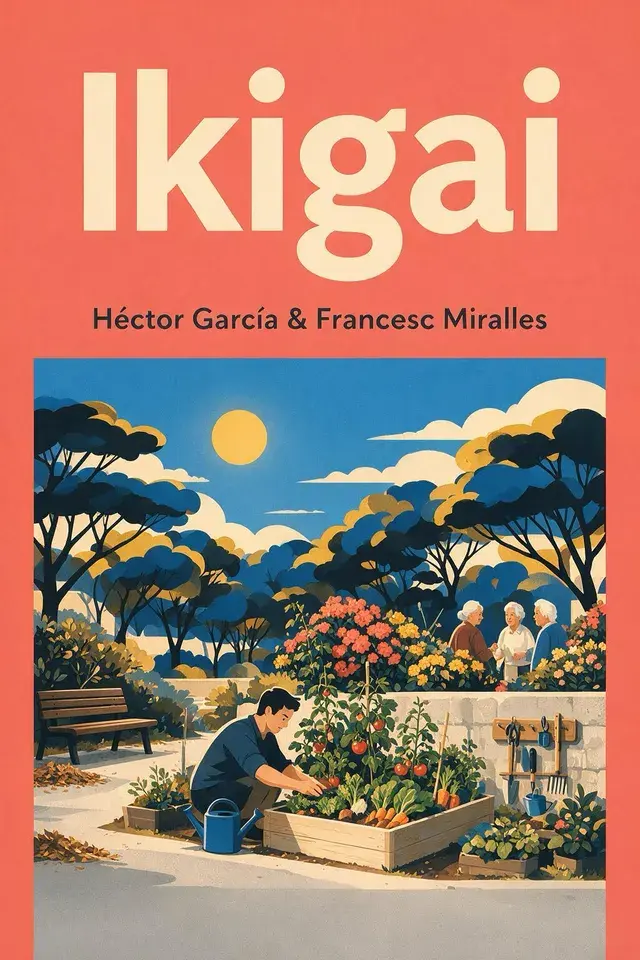
Ikigai begins with a question larger than how to extend life: what makes a person want to rise and take part in another day? Héctor García and Francesc Miralles use ikigai to mean a personal reason for being, or a reason to get up in the morning.
Aging Through Active Engagement
After the opening longevity discussion, the authors turn from the dream of defeating aging to the more practical question of preserving health and vitality. They imagine “aging escape velocity”: if medical progress added a year of life for every year lived, the boundary could keep moving forward.
Meaning, Acceptance, and Purpose
When life feels empty, Ikigai treats that emptiness as a question of direction rather than a feeling that must first disappear. Viktor Frankl’s logotherapy asks what reason for living could draw a person toward the future.
How Flow Turns Work Meaningful
The previous discussion leaves a practical question: how does purpose become sustained activity? The authors answer with flow.
Craft, Ritual, and Everyday Flow
After establishing flow as absorbed attention, the book widens its range. It asks whether presence belongs only to remarkable performances.
A Longevity Built Together
Earlier, ikigai appeared as a personal reason for being. In the book’s longevity portrait, however, purpose is never only private.
Moderation, Movement, and Breath
The bodily side of ikigai, as this book presents it, is not a punishing health program. It is a way of keeping the body available for meaningful daily life through moderation, regular movement, and conscious breathing.
Resilience, Presence, and Ikigai
To live by an ikigai is not to be protected from loss. It is to develop a way of meeting change without surrendering the activities and relationships that make life meaningful.