What you'll learn
Key ideas from Evicted
These ideas compress the book's argument without treating the author's view as settled fact. Use them as an orientation before reading the full work or listening in Wiseley.
Eviction is presented as a mechanism that produces poverty, not merely a consequence of it.
Racial segregation and shrinking affordable supply narrow housing choices, allowing landlords to treat scarcity as bargaining power.
Eviction court turns absence, unequal representation, and admissions of arrears into rapid judgments that can precede a meaningful hearing.
Money judgments and private reporting convert a housing dispute into debt and a record that can restrict future rental and financial access.
Forced moves often lead to overcrowded, hazardous housing, while eviction records, exhaustion, and scarce alternatives delay the later move to something better.
Displacement can disrupt jobs, schooling, medical care, and family stability, while records and racialized screening make the next home harder to secure.
Decent housing is treated as a public foundation for health, work, family continuity, dignity, and civic participation.
Broad vouchers can stabilize households, while legal counsel and tenant protections can prevent some removals and restore due process.
How Evicted builds its case
Follow how the book develops its argument. Each note is a brief orientation, not a replacement for the chapter.
Seeing Eviction as a System
Evicted begins with a question that changes how poverty is seen: what if losing a home is not simply a consequence of hardship, but one of the ways hardship is produced? Matthew Desmond argues that housing is not a passive backdrop.
The Rent-Debt Trap
Rent debt is produced long before a landlord files anything. In the households Desmond follows, rent competes with heat, medicine, food, and unstable income.
The Removal Machine
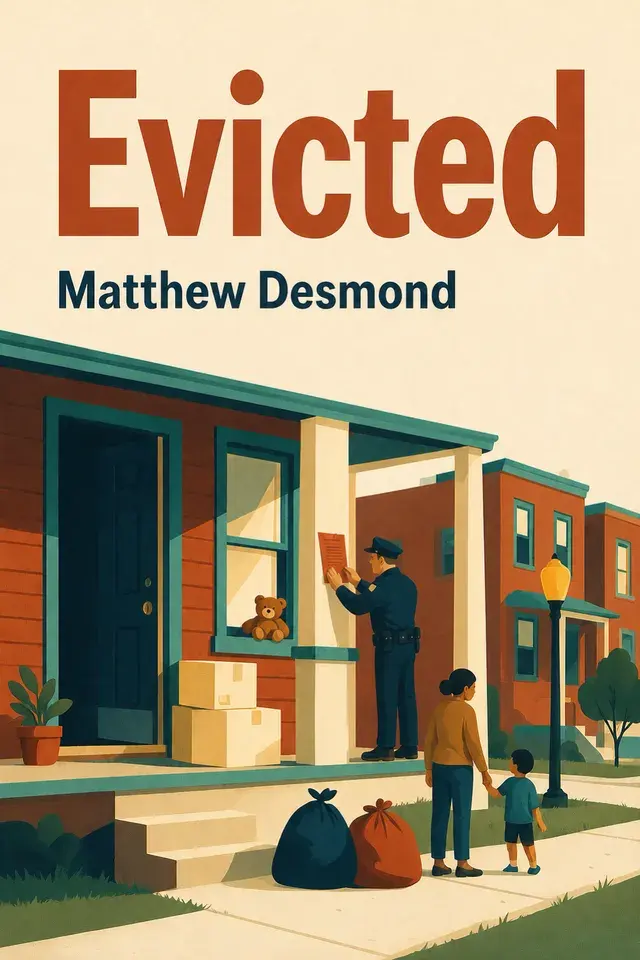
Eviction can look like a neutral sequence: rent goes unpaid, a landlord files, a judge rules, and a tenant leaves. In Desmond’s account, removal is a chain of discretionary decisions.
Where Displaced Families Land
Eviction does not end when a household leaves an apartment. It often determines what kind of home comes next.
The Cascade Through Work, Health, and Family
Eviction does not end when a family leaves a unit. It changes the form of hardship.
Housing as a Public Foundation
Housing is presented as a public foundation, not a private backdrop. A decent home offers refuge, privacy, safety, and a place where identity, family routines, and aspirations take shape.