What you'll learn
Key ideas from Eat More, Live Well
These ideas compress the book's argument without treating the author's view as settled fact. Use them as an orientation before reading the full work or listening in Wiseley.
Rossi suggests aiming for at least 30 different plant foods each week to make variety part of the eating pattern.
A plant-based label does not guarantee food quality; whole foods provide varied nutrients and fibres together.
A low-FODMAP approach should move from brief restriction to reintroduction and personalization with clinical guidance.
Associations, animal experiments, early studies, clinical trials, and personal stories provide different strengths of evidence.
A plant-forward shift can stay additive and gradual, with favourite foods and animal foods still included if desired.
Gradual fibre increases, water, thorough chewing, movement, stress care, and sleep all belong in a practical approach to digestion.
Inside Eat More, Live Well
Read the first chapter in full here. The other 9 continue in the Wiseley app.
Chapter 1 of 10 · 5 min · Audio & text
A Plant-Based Spectrum
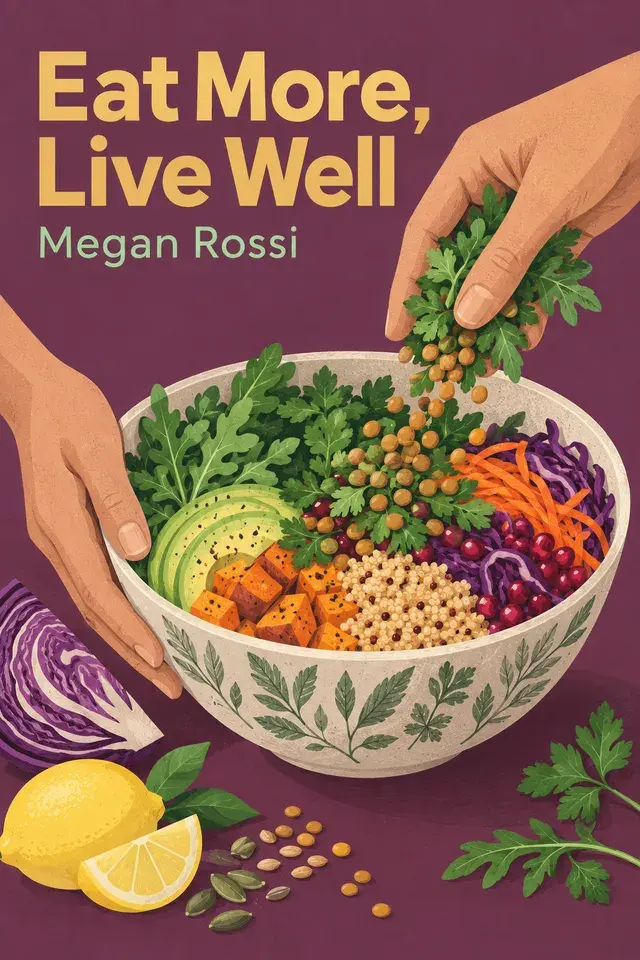
Eat More, Live Well, by Megan Rossi.
Plant-based eating can sound like a demand to remove every animal food. Megan Rossi uses it more broadly: plants form the foundation, while the rest of the diet can vary. Someone might begin by adding vegetable meals or meat-free days; others may eat flexitarian, vegetarian, or vegan. The label matters less than making room for a wider range of plants. Rossi presents this as an inclusive approach, not a test of dietary purity.
That distinction shapes the book’s central proposal. It is about adding variety, not dividing foods into permitted and forbidden categories. Rossi does not ask everyone to become vegan or vegetarian. Animal foods can remain part of a person’s pattern, and the balance is a personal choice. The approach also does not depend on calorie counting or weighing food. Its direction is toward more plants, without requiring the same endpoint or pace for everyone.
As a practical guide, Rossi suggests aiming for at least 30 different plant foods across a week. The point is variety: a food eaten repeatedly does not bring the same range as several different plants. Her count can include wholegrains, fruit, vegetables, nuts, seeds, legumes, herbs, and spices, as well as tea and coffee. The number is a target to work toward, not a reason to turn meals into a rigid scorecard. Even small additions can move someone toward a more varied pattern.
The reason Rossi gives for valuing variety begins with fibre and gut microbes. Humans cannot digest fibre with their own enzymes, so it passes into the large intestine, where microbes can use it. Different plant foods bring different kinds of fibre. In this chapter, that is the essential link: eating a wider range of plants provides a wider range of material for gut microbes. The later discussion of particular foods and possible effects across the body belongs to other parts of the book.
The approach also depends on food being enjoyable. Rossi’s principles include tasting, pausing, and enjoying meals, alongside cultivating community around food. This matters because a plan that feels like constant deprivation may be difficult to sustain. She argues that preferences are not fixed: preparation, repeated exposure, and gradual change can alter how appealing a food seems. That leaves room for experimentation rather than assuming that an early dislike has to determine what someone will enjoy forever.
Rossi uses the gradual reduction of salt in breakfast cereals as an example of how preferences may shift. When a change is made in small steps, people may adjust without experiencing a sharp break from what they know. Her point is not that every taste will change on command. It is that a person’s sense of what tastes normal can move over time, making gradual adjustments more workable than an abrupt overhaul.
David’s experience shows how that principle can fit into a demanding routine. A shift-working doctor often relied on drive-through food. Rather than asking him to remake his whole diet at once, Rossi’s plan introduced legumes at work, a plant-based snack to keep in his car, and a different route home. Each change addressed a moment in his day when convenience had been steering his choice. The example treats habits as part of the problem to solve, not as evidence that someone lacks willpower.
David did sometimes return to his previous choices. Rossi treats those relapses as part of change, not as failure. When he wanted an occasional burger, the suggestion was to add two different vegetables and eat it without guilt. After weeks of eating more wholesome plant-based meals, David reported that a fast-food burger tasted less appealing than he remembered and gave him less of a kick. His story is a personal example, not a guarantee that everyone’s preferences will change in the same way. It does illustrate why a flexible plan can leave room for an old favorite while making new routines possible.
Rossi also makes a case for plant-centered eating through claims about health and environmental impact. She links plant variety and fibre to nourishing gut microbes, and argues that shifting the balance toward plants can benefit the environment. Those are part of her rationale for the approach, not conditions a reader must accept to take it up. Her position is pro-plants, not a demand to remove animal foods. The central invitation is to build meals around a broader range of plants, at a pace and in a pattern that can be enjoyed and shared.
Chapter 2 of 10 · 10 min · Audio & textIn the app
What Plant Diversity Provides
A plant-based food is simply a food that comes from a plant. That includes roots, leaves, stems, fruits, wholegrains, nuts, seeds, and foods made from them.
Chapter 3 of 10 · 5 min · Audio & textIn the app
When More Plants Feel Difficult
When adding plants brings bloating, gas or changed bowel habits, it can feel as though the foods themselves are the problem. Rossi treats those symptoms as worth taking seriously, but not as a reason to condemn plant foods as a group.
Chapter 4 of 10 · 10 min · Audio & textIn the app
Microbes Beyond the Gut
The gut is not a sealed digestive compartment. In Rossi’s account, gut microbes communicate with other parts of the body through nerves, immune activity, and substances moving through blood and lymph.
Chapter 5 of 10 · 5 min · Audio & textIn the app
Change Without All-or-Nothing
The obstacles to eating more plants can look like separate problems: weight, calories, cost, time, nutrition or digestive discomfort. The author treats them as practical choices, not reasons for an abrupt, all-or-nothing change.
Chapter 6 of 10 · 11 min · Audio & textIn the app
Build the Diversity Diet
A principle becomes useful when it can fit into an ordinary week. The Diversity Diet’s toolkit is built from small, repeatable choices: notice which plants you eat, keep a few varied ingredients on hand, and find ways to add them to familiar meals.
Chapter 7 of 10 · 7 min · Audio & textIn the app
Everyday Food, Made Plant-Rich
These recipes bring plant variety into familiar parts of the day: breakfast, snacks, and lunch. Their method is practical.
Chapter 8 of 10 · 8 min · Audio & textIn the app
Flexible Plant-Forward Meals
At dinner, flexibility is less a separate recipe category than a way of assembling a meal. The book’s mains combine vegetables, grains and protein, then use seasoning and format to make the result familiar.
Chapter 9 of 10 · 6 min · Audio & textIn the app
Treats, Drinks, and Fermentation
The recipe section carries plant variety into desserts, smoothies, drinks, and quick snacks. These remain treats and refreshments, while showing how fruit, nuts, seeds, grains, and even vegetables can appear in familiar, enjoyable forms.
Chapter 10 of 10 · 4 min · Audio & textIn the app
Adapting for Sensitive Digestion
For readers who find some plant-rich meals difficult, Rossi offers practical adjustments that preserve as much variety as possible. Her FODMAP-lite approach is built around changing ingredients and portions within recipes.
Chapter 1 of 10 · 5 min · Audio & text: A Plant-Based Spectrum
Wiseley supports reading and listening to summaries in the app.
Continue in WiseleyAbout Megan Rossi

Megan Rossi is an Australian dietitian and gut health researcher. “Eat More, Live Well” explores why varied, mostly whole plant foods can form the base of eating and how fiber and gut microbes relate to wider health.
Explore more books by Megan Rossi