What you'll learn
Key ideas from Crossing the Chasm
These ideas compress the book's argument without treating the author's view as settled fact. Use them as an orientation before reading the full work or listening in Wiseley.
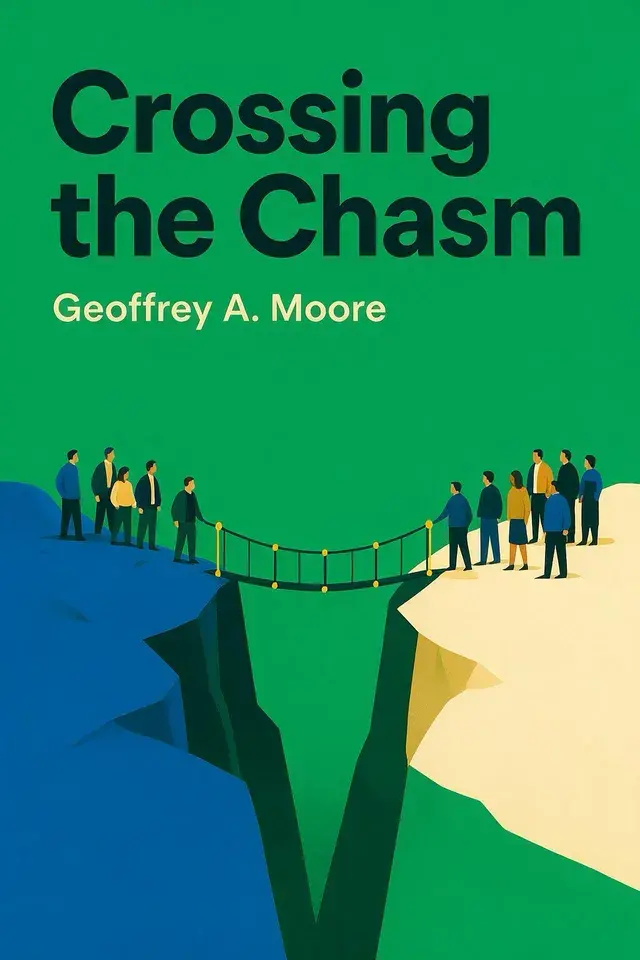
The central chasm separates visionary demand for strategic leaps from pragmatist demand for dependable, referenceable continuity.
Pragmatists adopt incremental improvements when peer evidence, standards, dependable integration, and service reduce the risk of waste.
Crossing the chasm is organized around one tightly bounded niche where a complete whole product can create referenceable leadership.
The chosen segment must be large enough for required revenue, small enough for leadership, and connected to credible follow-on markets.
The whole product is the shipped offering plus every product, service, relationship, and support element needed for the target customer’s compelling outcome.
Market and product reference beacons make an unfamiliar offer understandable, comparable, and tied to an existing budget.
Channel transitions move from traction to volume after a trusted mainstream relationship and whole-product delivery are established.
How Crossing the Chasm builds its case
Follow how the book develops its argument. Each note is a brief orientation, not a replacement for the chapter.
The Curve Hides a Chasm
Moore begins with a painful contradiction. A high-tech venture can have a working product, enthusiastic customers, publicity, and early orders, yet still be heading toward failure.
Map the Adopter Worlds
The early market is not a single kind of customer. It is a working relationship between two different actors: technology enthusiasts and visionaries.
Earn Pragmatist Trust
Once a new technology reaches the mainstream market, novelty has lost its persuasive power. Moore describes pragmatists as buyers of incremental, measurable, predictable improvement.
Attack One Beachhead
Once a technology reaches the chasm, the company must change the question it is answering. Early adopters may ask whether an innovation is possible or strategically exciting.
Choose the Head Pin
Once a company accepts that crossing the chasm requires a single beachhead, the next question is which one. It sounds like a normal segmentation exercise, but the conditions are unusual.
Build the Whole Product
Once a beachhead has been chosen, the next question is not simply what the company can ship. It is whether the target customer can achieve the outcome that made the purchase urgent.
Make the Offer Easy to Buy
Once a company has chosen a beachhead and assembled its whole product, one obstacle remains: the offer must fit the customer’s buying mind. Pragmatists want a familiar category, credible alternatives, a clear reason to prefer one choice, and confidence that the vendor and supporting market will endure.
Launch Through the Right Channel
Once a company has chosen its beachhead and specified the needed whole product, it still has to make the offer reachable. Moore treats distribution as the vehicle for crossing the chasm and pricing as its fuel.
Rebuild for Mainstream Growth
The chasm is not merely a gap in a marketing funnel. It is a phase change in the enterprise itself.