What you'll learn
Key ideas from Biohack Your Brain
These ideas compress the book's argument without treating the author's view as settled fact. Use them as an orientation before reading the full work or listening in Wiseley.
Neuroplasticity and hippocampal neurogenesis are presented as mechanisms through which learning and lifestyle can support change across the lifespan.
The Better Brain Diet centers minimally processed, mostly plant foods with healthy fats, omega-three sources, complex carbohydrates, fiber, and colorful produce.
The chapter presents regular movement as a direct brain intervention supporting cerebral blood flow, cognition, mood, sleep, and stress resilience.
Medication interactions and planned surgery make healthcare-practitioner review essential before a new supplement routine.
Sleep is framed as brain maintenance, supported by regular timing, reduced evening stimulation, and attention to possible apnea.
Repeated, varied cognitive challenges are presented as pathways to attention, memory, problem solving, creativity, and cognitive reserve, though research remains evolving.
Incremental habits, chosen tracking metrics, accountability, and compassionate recovery turn lapses into feedback rather than failure.
Inside Biohack Your Brain
Read the first chapter in full here. The other 6 continue in the Wiseley app.
Chapter 1 of 7 · 6 min · Audio & text
The Brain Is Built to Change
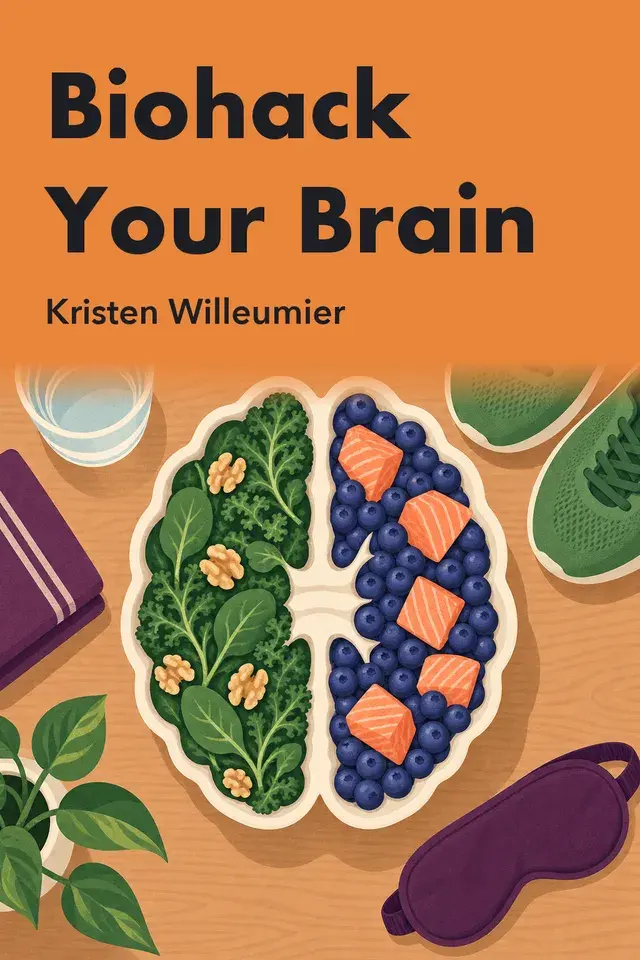
Biohack Your Brain, by Kristen Willeumier.
Biohack Your Brain begins with a premise: cognitive decline is a risk, not a fixed destiny. The brain coordinates movement, automatic functions, sensory interpretation, thought, memory, mood, personality, and communication with the body. Because it is living tissue, its condition reflects circulation, stress, injury, disease, and daily choices. The author asks how that biology can be supported and changed.
The anatomy makes the argument concrete. The book describes roughly 100 billion neurons, glial support cells, and more than 100 trillion connections. Gray matter processes information; white matter carries signals. The cerebrum supports language, learning, memory, problem solving, and emotion. The hippocampus supports memory and new-cell growth; the amygdala assigns emotional significance; the prefrontal cortex supports planning; and the brain stem regulates automatic functions. These parts operate as a network.
That network is shaped by experience and mental state. The chapter treats consciousness and brain activity as reciprocal, distinguishing conscious awareness from subconscious habits and deeper unconscious memories or emotions. It describes brain waves as bioelectric oscillations associated, in the author’s model, with arousal or relaxation: higher frequencies accompany alertness, lower frequencies calmer states. Hypnotherapy illustrates the proposed use of a trance-like state to access subconscious material. The chapter also rejects the ten-percent myth, classical-music IQ claims, and rigid left/right-brain labels as oversimplifications.
Blood flow is the main bridge between structure and performance. Although the brain is about 2 percent of body weight, the text says it receives 15 to 20 percent of the body’s blood supply and uses about three times as much oxygen as muscle. Blood delivers oxygen, glucose, and nutrients, then removes waste. Poor circulation, the author argues, can undermine mood, concentration, memory, creativity, and decision-making, so brain fog should not automatically be blamed only on sleep, diet, or stress.
Stress needs a careful distinction. Acute stress can support survival, motivation, focus, and accomplishment. Chronic stress may constrict or damage vessels, suppress neurogenesis, overactivate neurons, and alter pathways. Excess cortisol is linked to disrupted sleep, weight gain, impaired recall, hippocampal shrinkage, and a more reactive amygdala associated with fear and anxiety. The warning is not to eliminate every demand, but to prevent temporary mobilization from becoming persistent.
Against that background, aging is described as variable rather than one straight decline. The author says the brain may continue developing into the twenties or thirties, while later aging can bring average losses in brain volume and lapses in short-term memory, reasoning, or verbal fluency. Yet emotional regulation, empathy, sustained attention, knowledge, and vocabulary may strengthen or peak at different ages. Fit, mentally active older adults are presented as capable of remaining mentally healthy and improving brain function even in their eighties and beyond. These are averages and possibilities, not a single timetable.
Plasticity explains how such variation could occur. New learning and repeated use can strengthen, redirect, or create neural pathways, while harmful habits can weaken them. Neurogenesis—the production of new neurons—is presented as continuing in the hippocampus even in later life, supporting possible gains in memory, learning, executive function, and stress handling. Together, neurogenesis and neuroplasticity leave room for improvement after aging, disease, or injury. Evidence connecting new cell growth with slowing or reversing Alzheimer’s is described as promising but early.
The NFL study supplies a clear example. One hundred active and retired players from twenty-seven teams underwent cognitive testing and brain imaging; many had multiple concussions and other impacts. Despite elite conditioning, many showed severe damage and insufficient blood flow in memory-related regions. After six months of individualized coaching and lifestyle changes, the author reports improved perfusion in some areas on repeat scans. She uses this to argue that injury can shape risk without fixing the outcome, while these individualized findings are not a guarantee. A living brain remains responsive to repeated inputs over time.
Chapter 2 of 7 · 7 min · Audio & textIn the app
Eat for a Better Brain
The Better Brain Diet puts brain health first, with weight loss as a possible secondary benefit. It is a seven-step process of small daily changes.
Chapter 3 of 7 · 6 min · Audio & textIn the app
Move to Grow and Protect
Movement is presented here as a direct intervention on the brain, not merely as a way to change the body. The author’s central idea is that regular activity keeps the cardiovascular system delivering oxygen, glucose, and nutrients through the brain’s dense network of vessels.
Chapter 4 of 7 · 6 min · Audio & textIn the app
Supplement With Guardrails
Supplements are presented as targeted adjuncts, not a universal cure. The author arranges them in three tiers.
Chapter 5 of 7 · 5 min · Audio & textIn the app
Recover Through Water, Sleep, and Calm
Recovery is the quiet layer beneath the book’s other brain-health interventions. Willeumier treats hydration, beverage choice, sleep, and stress regulation as conditions that let memory, mood, focus, and executive function recover.
Chapter 6 of 7 · 5 min · Audio & textIn the app
Train Thought, Learning, and Reserve
With the book’s bodily foundations in place, this chapter turns to deliberate mental and cognitive training. Its central idea is practice: repeated work can change how thoughts are handled and how abilities are exercised.
Chapter 7 of 7 · 5 min · Audio & textIn the app
Measure, Adapt, and Personalize
At the close of the book, the author turns its many interventions into a feedback loop. First measure what is happening, then make one manageable change, track the result, and adjust with appropriate support.
Chapter 1 of 7 · 6 min · Audio & text: The Brain Is Built to Change
Wiseley supports reading and listening to summaries in the app.
Continue in WiseleyWhat Biohack Your Brain is about
Biohack Your Brain by Kristen Willeumier asks how everyday choices can influence a brain that remains adaptable across life. It connects nutrition, movement, sleep, hydration, stress regulation, cognitive challenge, supplements, and measurement into an individualized program. Its practical value is a framework for choosing small changes, tracking results, and recognizing evidence and safety limits.
About Kristen Willeumier

Kristen Willeumier is a neuroscientist and author. “Biohack Your Brain” explores how everyday choices can influence a brain that remains adaptable across life.
Explore more books by Kristen Willeumier