What you'll learn
Key ideas from ADHD 2.0
These ideas compress the book's argument without treating the author's view as settled fact. Use them as an orientation before reading the full work or listening in Wiseley.
ADHD is a variable pattern of attention and executive-function regulation, not simply a deficit or a guaranteed gift.
ADHD can involve an unreliable toggle between task-focused and default-mode processing, producing distraction, rumination, omission, or hyperfocus.
Connection is framed as therapeutic infrastructure because belonging can reduce shame, loneliness, and the relational adversity surrounding ADHD.
The right difficult matches challenge with interest and ability, allowing engagement and creativity to emerge where boredom or mismatch suppresses them.
Schedules, reminders, clear expectations, selective screen limits, and meaningful rewards provide external regulation without requiring constant supervision.
Exercise is framed as an immediate nonmedical cognitive intervention that can prime focus, motivation, mood, and emotional regulation.
The final principle is personal fit, with combined supports and attention to process replacing outcome-based judgments of self.
Inside ADHD 2.0
Read the first chapter in full here. The other 6 continue in the Wiseley app.
Chapter 1 of 7 · 8 min · Audio & text
A Spectrum, Not a Verdict
ADHD 2.0, by Edward M. Hallowell and John J. Ratey.
ADHD is easy to misunderstand because it can look like opposite things. A person may drift through a routine task, then become absorbed for hours in a compelling one. Someone may forget an instruction, yet produce an inventive solution under pressure. Hallowell and Ratey use these contrasts to challenge two incomplete views: ADHD as a defect, or as a flattering label for creativity. In their account, it is a variable pattern of attention and executive-function regulation. The person is not short of mental activity. The difficulty is directing, sustaining, sequencing, and stopping that activity to fit the moment.
The distinction matters because casual language can trivialize the condition. Saying “I’m so ADD” may mean ordinary distractibility, while clinical ADHD involves a persistent pattern with real consequences. The authors reject the idea that ADHD is laziness or a lack of discipline. A mind can be intensely active while visible productivity remains inconsistent. The useful question is not simply whether someone will do a task, but whether they can reliably organize attention and action when stimulation is low or demands are high.
What makes ADHD variable is partly the fit between a person and the environment. Interest or novelty can make attention unusually strong. Boredom, by contrast, may feel like a mental emergency and provoke an automatic search for stimulation. That search can lead toward conflict or harmful compulsions, but it can also lead toward invention, enterprise, or an unexpected solution. The same person may appear unreliable in one setting and remarkably capable in another. Hyperfocus does not disprove the problem; it is part of the paradox. Attention can be abundant and powerful, yet difficult to aim.
Executive functions show the cost most clearly. Planning, organizing, beginning, remembering, and finishing can break down even when the person understands what needs to happen. A task may disappear from working memory moments after it was assigned. Others may interpret the forgotten chore as selfishness, defiance, or passive aggression, when the authors describe it as a failure of regulation. The person may then deliver a brilliant presentation on time when enough interest or pressure is present. Uneven performance can make ADHD invisible, invite disbelief, and deepen shame.
The authors present ADHD as a spectrum of traits rather than a single appearance. Common pairings include creativity with disorganization, energy with impulsivity, rapid productivity with procrastination, and independence with difficulty accepting help. Curiosity may generate fresh associations while pulling attention away from the original track. Imagination can anchor a person in meaningful work, while ordinary reality feels so unstimulating that practical obligations are neglected. Strong reactions to criticism and strong use of encouragement can also coexist. None of these pairs makes the strengths unreal, and none cancels the impairment.
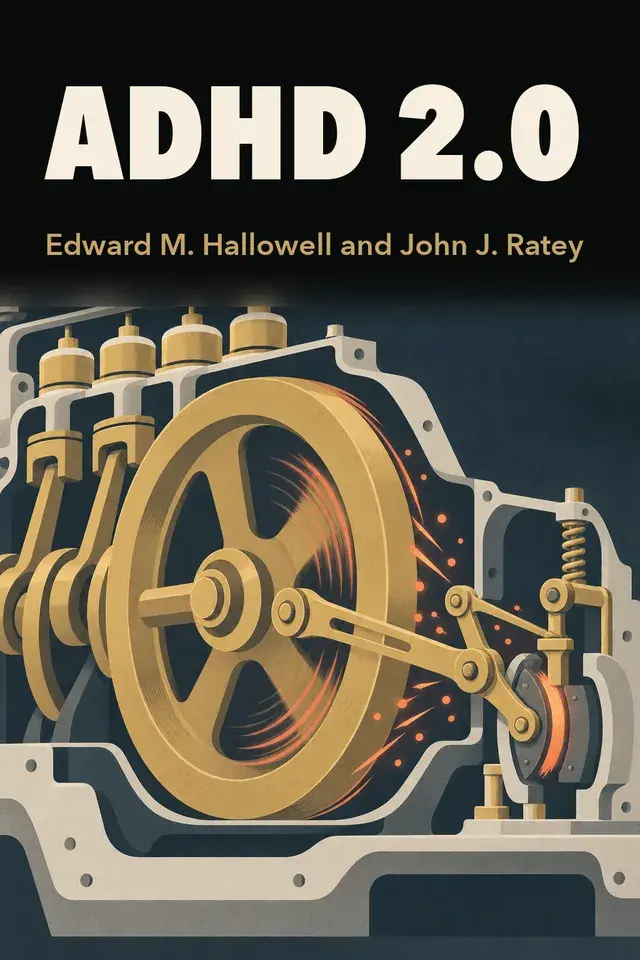
A simple image from the book captures this tension: an engine with extraordinary power and brakes that do not regulate it well. The problem is not a lack of power, but an imbalance between drive and control. Without understanding, repeated failures can distort self-image until a capable person sees only evidence of inadequacy. The authors’ strengths-based language is meant to correct that distortion, not romanticize the cost. ADHD can damage school, work, relationships, safety, and well-being. It can also support creativity, ingenuity, persistence, and original problem-solving when circumstances allow those qualities to be used.
The book describes ADHD as partly heritable and biologically based, but not as the result of one gene or one fixed presentation. Inherited tendencies raise likelihood; they do not dictate an individual outcome. Environment and development affect how visible the pattern becomes. A child may compensate for years, then struggle when adult responsibilities increase. What looks like adult onset may be an earlier vulnerability exposed by new demands. The authors also note that modern life can make many people more scattered and stimulation-dependent without giving everyone clinical ADHD.
That environmentally shaped resemblance is what they call VAST: variable attention stimulus trait. In the book’s framework, VAST is an environmentally induced cousin of ADHD, and a trait rather than a formal disorder. Constant electronic communication and abundant stimulation may train habits of checking, switching, and seeking novelty. Someone can recognize a great deal of themselves in the VAST description and still not meet the threshold for ADHD. The two profiles may share paradoxical strengths and difficulties, but they are not interchangeable labels.
The boundary is functional and developmental, not merely verbal. VAST has no fixed number of symptoms, impairment requirement, or formal diagnostic criteria. ADHD does. The appendix summarizes ADHD as a persistent pattern of inattention and/or hyperactivity-impulsivity that interferes with functioning or development. The criteria require symptoms for at least six months, several signs before age twelve, presence in at least two settings, clear interference with social, school, or work functioning, and no better explanation by another mental disorder or psychosis. Symptoms must also be inappropriate for developmental level. Thresholds vary with age, and presentations may be combined, predominantly inattentive, or predominantly hyperactive-impulsive. Symptoms and presentations can change over time, but a checklist alone is not enough.
That qualification protects both sides of the reframing. It prevents every lapse, busy period, or screen-shaped habit from becoming a diagnosis. It also prevents genuine impairment from being dismissed because a person is talented or capable of intense focus. In Hallowell and Ratey’s view, ADHD is neither a verdict against a person nor a guarantee of special gifts. It is a variable pattern whose costs and capacities become more visible under different demands and conditions. Naming that pattern accurately is the starting point for support that fits the actual person, rather than a stereotype.
Chapter 2 of 7 · 8 min · Audio & textIn the app
The Brain’s Toggle and Brakes
ADHD can look like a contradiction. A person may be unable to begin a routine task, yet become absorbed in a difficult interest.
Chapter 3 of 7 · 6 min · Audio & textIn the app
Connection Before Correction
ADHD is often approached as a behavior problem: someone is distracted, impulsive, or inconsistent, so other people try to correct the behavior. Hallowell and Ratey argue that this misses a prior condition.
Chapter 4 of 7 · 5 min · Audio & textIn the app
Find the Right Difficult
For people with ADHD or VAST, the authors say, boredom can suppress engagement. But difficulty alone is not the answer.
Chapter 5 of 7 · 9 min · Audio & textIn the app
Engineer a Stellar Environment
The book's environmental argument begins with a reversal: attention is not only something inside a person. Surroundings can act as a tonic or a drain, changing how readily ADHD or VAST-related difficulties appear.
Chapter 6 of 7 · 8 min · Audio & textIn the app
Move to Focus and Motivate
Exercise, in this chapter, is not a vague wellness extra. Hallowell and Ratey present movement as an immediate cognitive intervention: something to do before a paper, presentation, or study session to prime attention, and a regular practice to help maintain it.
Chapter 7 of 7 · 9 min · Audio & textIn the app
Medication and Personal Fit
Medication occupies a charged place in ADHD discussions, but the authors ask readers to treat it as a tool rather than a moral or ideological test. In their account, properly prescribed medication can produce the most immediate benefit, sometimes within an hour.
Chapter 1 of 7 · 8 min · Audio & text: A Spectrum, Not a Verdict
Wiseley supports reading and listening to summaries in the app.
Continue in WiseleyAbout Edward M. Hallowell & John J. Ratey

Edward M. Hallowell
Edward M. Hallowell is an American psychiatrist. “ADHD 2.0” explores how a brain marked by inconsistent attention and impulsivity can also generate creativity, energy, and insight.
Explore more books by Edward M. Hallowell
John J. Ratey
John J. Ratey is an American psychiatrist and author. “ADHD 2.0” explores how a brain marked by inconsistent attention and impulsivity can also generate creativity, energy, and insight.
Explore more books by John J. Ratey