What you'll learn
Key ideas from Your Brain on Art
These ideas compress the book's argument without treating the author's view as settled fact. Use them as an orientation before reading the full work or listening in Wiseley.
Neuroplasticity responds to salient experience, while personal history helps explain why the same encounter can mean different things to different people.
Tailored arts activities can offer everyday routes to emotional regulation without promising the same outcome for everyone.
Masks, layered paintings, expressive writing, and simple drawings can give difficult experiences a form when words are hard to reach.
Familiar, personally meaningful songs can cue movement and bring memory or communication within reach when other routes are difficult.
Salient experiences can focus attention and support memory through curiosity, novelty, humor, motivation, and practice.
Open, evidence-grounded art looking can invite curiosity, reflection, and perspective-taking without requiring a single right interpretation.
Singing, dancing, and moving in sync are associated with belonging and trust, though the mechanisms and effects are still being studied.
Inside Your Brain on Art
Read the first chapter in full here. The other 12 continue in the Wiseley app.
Chapter 1 of 13 · 8 min · Audio & text
How Art Enters the Brain
Your Brain on Art, by Susan Magsamen & Ivy Ross.
Neuroarts is an emerging field that studies how art and aesthetic experience affect the body, mind, health, learning, and social life. The authors open with the account of a man with advanced Alzheimer’s who recognized his son after hearing songs from his past. It is one reported experience, not proof that music works the same way for everyone. It illustrates how sensory input can become important through a person’s memories and emotions.
The authors call purposeful attention to our surroundings an aesthetic mindset. It includes curiosity, open-ended play, sensory awareness, and creative engagement, whether making art or experiencing it. Their adapted survey asks how often people notice beauty and design, feel moved, create, and find connection through art. It groups responses under aesthetic appreciation, intense aesthetic experience, and creative behavior. The score is an overall snapshot, not a diagnosis; comparing it again after a month or two is meant to help readers reflect on how their attention and engagement may change.
That reflection starts with the senses. Smell, taste, hearing, sight, and touch use different receptors and neural routes, but their signals contribute together to perception, memory, emotion, and bodily response. A smell may evoke a memory; a sound can draw attention away from surrounding noise. The authors describe broad pathways through the brain, but these are simplified maps: regions cooperate rather than working as isolated departments. Much of the body’s processing happens before we consciously notice it.
Touch offers one example of how sensory experience can cross expected boundaries. In a study described by the authors, blindfolded participants handled household objects and later chose the exact spoon they had touched from two similar spoons 73 percent of the time. Their recognition could persist for weeks. The authors use the result to illustrate that touch can recruit visual-processing regions even when a person cannot see the object.
The brain also filters incoming information. Salience means the practical or emotional importance that makes something stand out, like a friend’s voice becoming clear amid party chatter. When an experience matters, neural activity and chemical signaling can support changes in synapses, the junctions through which neurons communicate. Neuroplasticity is the brain’s capacity to strengthen, weaken, or reorganize these connections. Learning and memory are part of this changing network, and less-used connections may be pruned.
The familiar phrase “cells that fire together, wire together” is a shorthand, not a rule that every co-active neuron automatically fuses with another. The authors emphasize that the intensity and salience of experience matter. Their descriptions of brain regions are also broad guides to a more connected system. This helps explain why arts can be consequential inputs without implying that every artwork changes every brain in the same way.
Marian Diamond’s rat study made the role of surroundings more visible. In the early 1960s, she gave groups of rats the same food, water, and light, while varying opportunities to explore. One group had changing toys and objects, another had an unchanging exercise wheel, and a third lacked exploratory objects. After several weeks, the enriched group’s cerebral cortex was reported to be 6 percent thicker than the impoverished group’s, whose brains had lost mass. The result showed a structural difference associated with different environments in rats. It supports the idea that experience matters, but does not establish an identical effect in people.
To describe an aesthetic moment, neuroscientist Anjan Chatterjee and colleagues proposed the aesthetic triad: sensorimotor systems, the reward system, and cognitive knowledge and meaning-making. Sensorimotor systems register sensation and action. Reward can make an experience pleasurable and encourage a person to repeat what preceded it. Knowledge and meaning bring in culture, personal history, and the circumstances of the encounter. Together, the triad explains why aesthetic experience is more than a reaction to beauty. Art may also be difficult, uncomfortable, or emotionally mixed, and still matter deeply.
Personal and cultural history help shape that meaning. The authors note that some traditions in India associate white with mourning, while black is used in that way in the United States. Objects and colors do not carry the same significance for everyone. Responses to art can vary even more widely, because each person brings distinctive experiences and associations to it.
The default mode network, or DMN, is associated with inward attention, autobiographical memory, mind-wandering, imagining the future, and judgments of personal meaning. The authors describe it as helping connect an artwork, song, or landscape with a person’s memories and sense of self. An encounter can prompt a new association or an “aha” moment; what becomes memorable or meaningful depends partly on what the person brings to it.
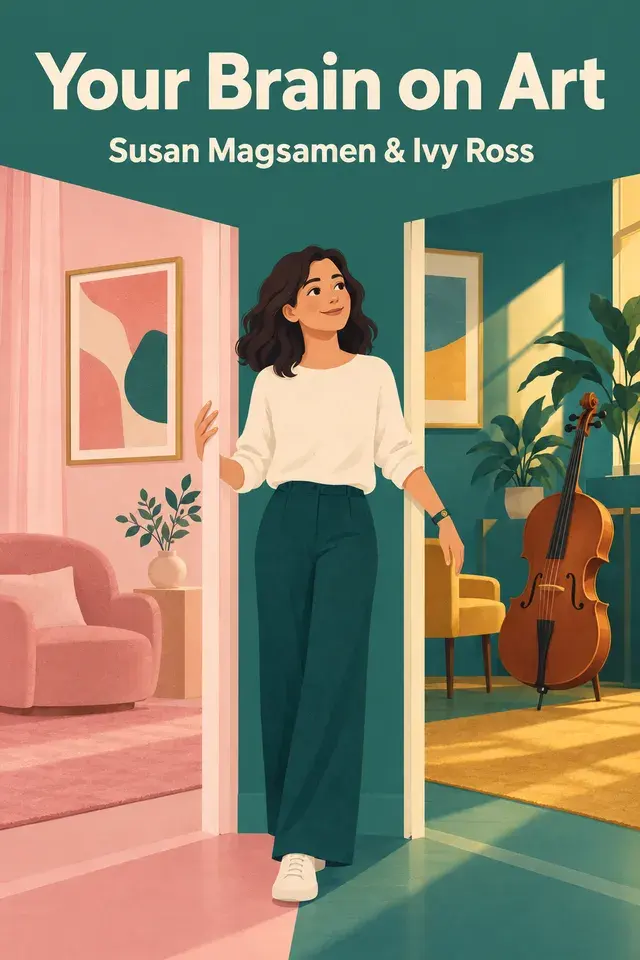
A Space for Being, an exhibition created for the 2019 Milan design fair, put these ideas into an environment. Visitors explored three rooms with different combinations of furniture, color, texture, lighting, sound, and scent. Wristbands measured changes in heart rate, respiration, and temperature. These were practical body measurements, not brain scans. At the end, guests received a personalized data visualization revealing the space in which they felt most at ease based on their real-time biological feedback. Many visitors were surprised when their measured response differed from the room they expected to prefer.
Rab Messina consciously admired the first and last rooms but wanted to leave the colorful middle one. The personalized data visualization later revealed that her body had been most at ease in that middle room. She connected the mismatch to past experiences of race, class, and exclusion from elegant spaces. Her account shows how a bodily response and a stated preference can diverge, and how personal history may help explain the difference. It does not mean the same room will affect everyone alike.
Together, these examples offer the book’s starting framework: sensory experience, attention, emotion, memory, and bodily response interact. Salient encounters can shape neural connections and personal meaning, while enriched surroundings offer varied opportunities for experience. The aesthetic mindset and its score provide a way to reflect on how each person notices and engages with that world.
Chapter 2 of 13 · 7 min · Audio & textIn the app
Aesthetic Practices for Well-Being
Stress is not something to eliminate. It is a protective response that mobilizes the body when a threat or challenge appears, even when the threat is only anticipated.
Chapter 3 of 13 · 9 min · Audio & textIn the app
Making Trauma Expressible
An event can be frightening, painful, or overwhelming without automatically becoming trauma. The authors distinguish the event from its imprint.
Chapter 4 of 13 · 8 min · Audio & textIn the app
Creative Care for Mental Health
After art has helped make difficult experience expressible, the next question is where that expression can be supported. The examples here move through therapy, classrooms, and community studios.
Chapter 5 of 13 · 7 min · Audio & textIn the app
Arts for Pain and Physical Repair
Arts can contribute to physical health because pain, illness, and injury affect more than one system at a time. The authors cite a review that mapped more than six hundred psychological, biological, social, and behavioral mechanisms.
Chapter 6 of 13 · 7 min · Audio & textIn the app
Music, Memory, and Care
Music can reach people through memory and movement when ordinary conversation or attention is difficult. Connie Tomaino saw this possibility on her first visit to a dementia ward in 1978.
Chapter 7 of 13 · 8 min · Audio & textIn the app
How Arts Change Learning
Learning is not simply information delivered to a student. Experience keeps forming and shifting connections in the brain, and repeated practice can strengthen pathways that encode memory.
Chapter 8 of 13 · 6 min · Audio & textIn the app
Learning for Different Minds
Learning changes shape from person to person. Neurodiversity names this range of ways people process the world, and also a movement for inclusion.
Chapter 9 of 13 · 8 min · Audio & textIn the app
Curiosity, Awe, and Flourishing
Flourishing, as the authors use the term, is a rich and meaningful way of living, not simply feeling happy or having no symptoms. It includes purpose, relationships, character, health, curiosity, care, and openness.
Chapter 10 of 13 · 7 min · Audio & textIn the app
Creativity as Everyday Practice
Creativity is often treated as a rare talent or a sudden flash of inspiration. Magsamen and Ross describe it as a capacity people use in ordinary life: imagining a new recipe, finding a workaround, or making up a bedtime story.
Chapter 11 of 13 · 7 min · Audio & textIn the app
Art, Culture, and Community
Human beings use creative expression not only to make things, but to carry shared knowledge and give communal life meaning. The authors trace an early version of this role to gatherings around fire.
Chapter 12 of 13 · 5 min · Audio & textIn the app
The Social Brain in Sync
Being alone is not the same as being lonely. Time by yourself can be restorative.
Chapter 13 of 13 · 7 min · Audio & textIn the app
Designing an Aesthetic Future
The future Magsamen and Ross imagine begins with sensory literacy: learning to notice what the body takes in and how a person responds. Sight, hearing, taste, touch, and smell are familiar categories, but researchers debate how many senses there are.
Chapter 1 of 13 · 8 min · Audio & text: How Art Enters the Brain
Wiseley supports reading and listening to summaries in the app.
Continue in WiseleyWhat Your Brain on Art is about
Your Brain on Art asks how artistic and aesthetic experiences shape the brain, body, and everyday life. It connects sensory processing and plasticity with practices in well-being, mental health, physical care, learning, flourishing, and community. Readers gain a framework for understanding varied responses and choosing creative, sensory, and environmental practices for particular needs.
About Susan Magsamen & Ivy Ross

Susan Magsamen
Susan Magsamen is the founder and director of the International Arts + Mind Lab at Johns Hopkins University. “Your Brain on Art” explores how artistic and aesthetic experiences shape the brain, body, and everyday life.
Explore more books by Susan Magsamen
Ivy Ross
Ivy Ross is an American business executive and designer. “Your Brain on Art” explores how artistic and aesthetic experiences shape the brain, body, and everyday life.
Explore more books by Ivy Ross