What you'll learn
Key ideas from Young Forever
These ideas compress the book's argument without treating the author's view as settled fact. Use them as an orientation before reading the full work or listening in Wiseley.
Health span counts years lived in good health; life span counts total years lived.
Chronological age counts years lived, while biological age describes changing processes that may respond to a person’s exposures.
The ten hallmarks form a connected network, so dysfunction in one process can influence several others.
A longevity-oriented food pattern emphasizes mostly whole foods and varied plants while allowing for individual biology, culture, and tolerance.
Strength training, recovery, and adequate protein work together to support muscle and everyday function.
Stress care, supportive relationships, community, and purpose are health foundations that help make well-being meaningful and sustainable.
Retesting relevant measures helps track change, while results remain clues rather than diagnoses or guarantees.
A durable longevity routine is a personal combination of habits that can grow over time, not a universal prescription.
Inside Young Forever
Read the first chapter in full here. The other 11 continue in the Wiseley app.
Chapter 1 of 12 · 6 min · Audio & text
Longer Life, Healthier Years
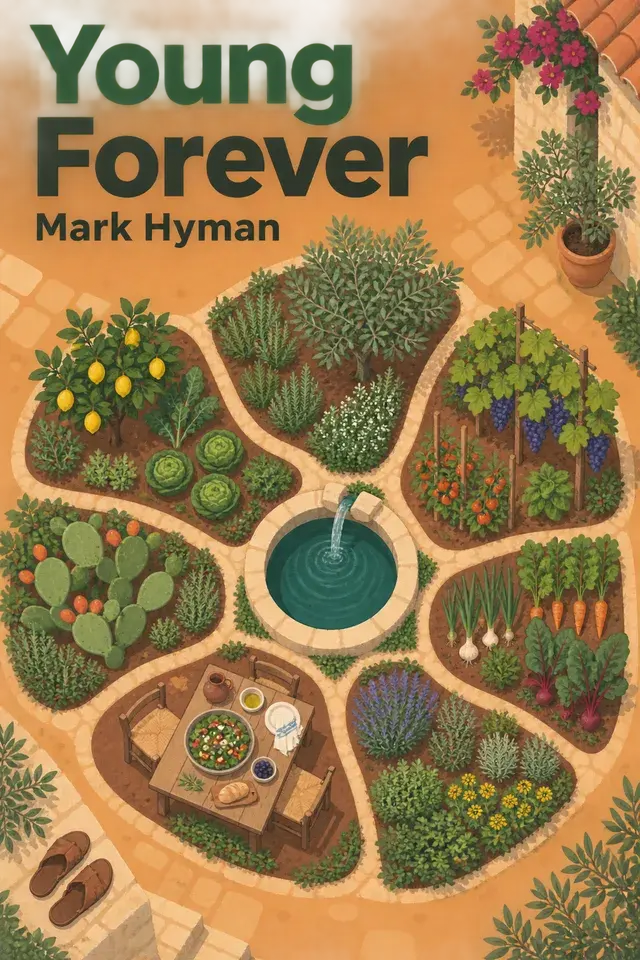
Young Forever, by Mark Hyman.
To ask how long we can live is not quite the same as asking how well we can live. Life span is the total number of years a person lives; health span is the time spent in good health. Mark Hyman makes the second measure the more meaningful goal. He wants the years of vitality and capacity to grow, so old age does not automatically mean a long period of illness, dependence, or inability to do valued activities. In this framing, longevity matters most when health and lived experience keep pace with the calendar.
Hyman argues that much of what people accept as normal aging is not fixed or inevitable. Some decline, he says, reflects biological changes and conditions that may be influenced by habits and environment. That is a reason to challenge resignation, not a promise that aging can be stopped or every disease reversed. The practical question is whether people can preserve more strength, energy, and independence than they otherwise would. He argues that changes can matter at different ages, while keeping the goal focused on health and capacity rather than an extraordinary lifespan claim.
To approach that question, the book introduces a systems view. Hyman describes the body as connected rather than a collection of isolated parts. A diagnosis can have contributing influences that cross organ boundaries, so treating one symptom at a time may leave relevant causes untouched. Functional or network medicine, as he presents it, asks how conditions and inputs may relate, then looks for opportunities to support health across the system. Here this remains an organizing perspective, not yet a detailed explanation of mechanisms or a step-by-step treatment plan.
The Blue Zones give this idea a human-scale frame. Hyman describes places such as Sardinia and Ikaria, where unusually long-lived populations retain traditions around food and daily life. He draws attention not to a single superfood or exercise routine, but to patterns embedded in ordinary routines: food grown, gathered, and prepared locally; walking and physical work that happen as part of the day; close family and community ties; and ongoing roles that give older people something useful to do. The accounts make health span look less like a separate project and more like a way of arranging daily life.
In Sardinia, the shepherd Carmine’s life illustrates several of these patterns at once. He tends animals and gardens, stays connected to family and community, reads, and keeps an active interest in the world around him. In Ikaria, scenes of gardening, climbing terraces, preserving food, and eating with others similarly show movement, food, and social life interwoven. The book treats these observations as adaptable lessons, not proof that copying one person’s habits guarantees a century of life. Modern readers may not share the same landscape, farming traditions, or community structure; the author suggests building analogous supports where they live.
That distinction matters. Blue Zone life cannot simply be packaged as a universal menu or workout. The useful idea is to notice what these environments make easier: nourishing food, regular movement, belonging, and a sense of usefulness. People can adapt those principles rather than imitate every local custom. In this opening chapter, the communities supply examples of conditions Hyman believes can support health; later chapters develop the biology and specific practices behind his program.
Janice’s story gives a different kind of illustration: one patient’s reported response to change. At 66, she had severe obesity and several serious health problems, including heart and kidney disease, high blood pressure, fatty liver, and type 2 diabetes treated with insulin. Hyman says she was facing possible organ transplants. In a group program, she changed from a diet he describes as junk food to a plant-rich, high-fiber, low-glycemic pattern and took a multivitamin, fish oil, and vitamin D. The account says she stopped insulin within three days, came off all medication within three months as several measures improved, and lost 116 pounds over a year, returning to an active life. Those are striking reported outcomes, but Janice is one person in one account. Her experience cannot establish that the same changes will produce the same results for other people; it illustrates why Hyman thinks health can change, not what everyone should expect.
Hyman also looks toward future rejuvenation science, including the possibility that emerging discoveries may one day restore cells or tissues to younger states. The chapter presents such outcomes as possibilities, not achievements readers can assume are available. Research described in this future-facing discussion does not settle whether these approaches will prove safe or useful in people; the source says human safety work is still needed for some techniques. These prospects may be exciting, but the book’s near-term case for improving health span rests on existing habits and conditions, not on a promised breakthrough.
The motivating question is therefore less about reaching a record age than about how much health and capacity can be carried into the years ahead.
Chapter 2 of 12 · 7 min · Audio & textIn the app
Causes Beneath the Calendar
Chronological age is a calendar count: it tells how long a person has lived. Biological age describes how far the body’s aging processes have advanced.
Chapter 3 of 12 · 8 min · Audio & textIn the app
Ten Interlocking Hallmarks
Aging is described here not as ten separate faults, but as a network of changes that can reinforce one another. The hallmarks offer a map of that network: nutrient-sensing disruption, genomic instability, telomere attrition, impaired protein maintenance, epigenetic change, senescent cells, mitochondrial dysfunction, microbiome disruption, stem-cell exhaustion, and chronic inflammation.
Chapter 4 of 12 · 6 min · Audio & textIn the app
Balance Across Seven Systems
After examining aging at the cellular level, Hyman shifts to a whole-body map. His practical question is not only which pathway has gone wrong, but what conditions may be putting pressure on the body and what it may be missing.
Chapter 5 of 12 · 8 min · Audio & textIn the app
Food, Signals, and Cellular Repair
Nutrition debates often frame food as a contest between opposing diets. Mark Hyman instead begins with a broad baseline: eat real food, in moderate amounts, and mostly plants.
Chapter 6 of 12 · 6 min · Audio & textIn the app
Movement, Rest, and Meaning
Movement, sleep, emotional care, and meaningful connection belong to the same picture of health. Hyman presents them as foundations that support physical capacity and a life worth extending.
Chapter 7 of 12 · 7 min · Audio & textIn the app
Hormesis and the Boundaries of Exposure
Hormesis is the body’s adaptive response to a limited challenge. A manageable stress may activate repair and resilience; a greater or longer exposure can overwhelm those responses and cause harm.
Chapter 8 of 12 · 5 min · Audio & textIn the app
Promise and Limits of Innovation
Near the end of Young Forever, Hyman shifts from practices presented as usable foundations to a therapeutic frontier. He imagines medicine moving beyond blocking pathways toward supporting the body’s repair functions.
Chapter 9 of 12 · 8 min · Audio & textIn the app
Measure, Prioritize, Personalize
How can you tell whether a change is helping? Hyman’s sequence begins with a broad laboratory baseline, then uses self-assessment quizzes to identify imbalances.
Chapter 10 of 12 · 9 min · Audio & textIn the app
Build a Flexible Nutrition Plan
Hyman’s practical nutrition plan is a flexible pattern, not a universal menu. He calls it Pegan, a playful name for an approach that borrows from both paleo and vegan diets.
Chapter 11 of 12 · 9 min · Audio & textIn the app
Turn Principles Into Daily Practice
Taking stock of symptoms and assessment results matters when it helps decide what to address first. Hyman treats quiz answers and test findings as clues to imbalances across connected systems, not as a reason to tackle every possible problem at once.
Chapter 12 of 12 · 4 min · Audio & textIn the app
Make Longevity Serve Life
The final chapter turns from how to add years to what those years might make possible. Hyman describes himself at sixty-three as strong and active, still building muscle and taking on demanding sports.
Chapter 1 of 12 · 6 min · Audio & text: Longer Life, Healthier Years
Wiseley supports reading and listening to summaries in the app.
Continue in WiseleyAbout Mark Hyman
Mark Hyman is an American physician and author. “Young Forever” explores why aging brings disease and loss of function and what can be changed.
Explore more books by Mark Hyman