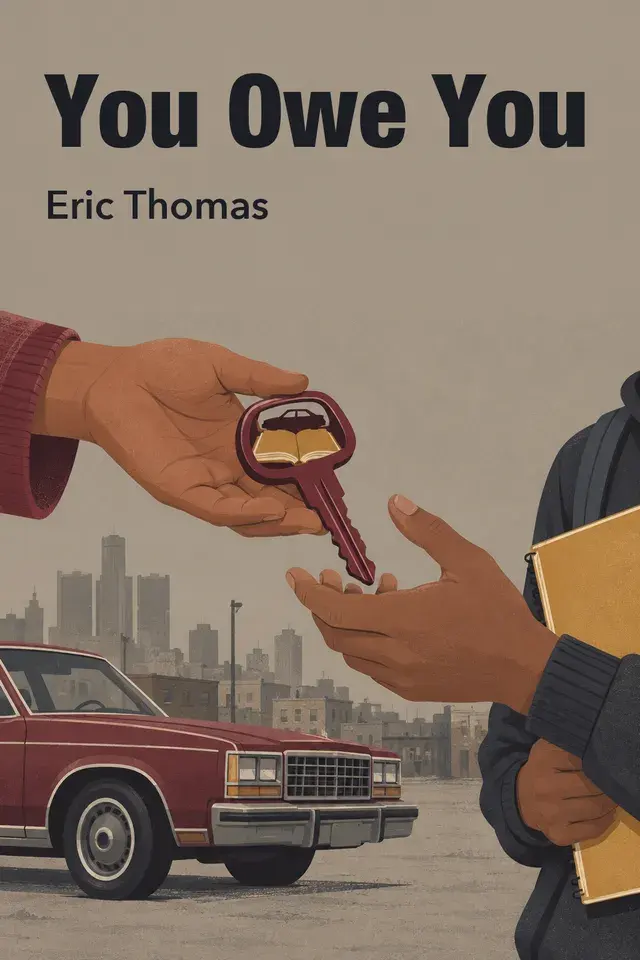
What you'll learn
Key ideas from You Owe You
These ideas compress the book's argument without treating the author's view as settled fact. Use them as an orientation before reading the full work or listening in Wiseley.
Thomas presents agency as responsibility for the next choice, even when hardship and injustice are real.
Feelings are valid, but direct questions and evidence can test assumptions about other people’s intentions.
A gift becomes a usable strength through attention, experimentation, and continued practice, though it does not guarantee a career or income.
A goal names an outcome; a why explains the deeper commitment that makes the outcome matter.
Purpose takes shape through repeated use of gifts in service, even before their final direction is clear.
A move from good toward great begins by naming what works, what could expand, what fear protects, and a possible next step.
Generosity that exceeds a person’s capacity can deplete the giver and harm the giver and recipient; sustainable care includes self-care.
Inside You Owe You
Read the first chapter in full here. The other 10 continue in the Wiseley app.
Chapter 1 of 11 · 8 min · Audio & text
Take Ownership of Your Direction
You Owe You, by Eric Thomas.
Eric Thomas begins with a distinction between taking responsibility and pretending life is fair. In the Detroit working-class world he grew up in, a common path was to finish high school, work in the auto industry, raise a family, and retire. He calls that a good life, and it was the life his parents lived. His point is not that everyone must choose a bigger ambition. It is that a person can take responsibility for the choices still available, even when real circumstances have limited the options.
Thomas tells how, as a boy, he learned that Jesse, the man who had raised and adopted him, was not his biological father. He felt betrayed and angry. As he grew older, he pushed away people who might have helped and eventually left home. He slept in friends’ homes and abandoned buildings, scavenged food, and faced cold and danger. His mother continued to care about him, even while disagreeing with his decision. She helped him get a license and a car, which sometimes gave him shelter. He took an overnight job at McDonald’s and kept going to school.
Looking back, Thomas describes his response as a victim mindset: he believed that others had ruined his life, and his choices added more harm to an already painful situation. He does not say the family’s decision to conceal his biological parentage was harmless. He allows that anger and sadness are real and legitimate. The distinction he draws is between feeling pain and letting pain decide what happens next. He wishes he had found a way to be angry while staying safe, fed, and clothed. For him, ownership begins when he can recognize both what happened to him and what he chose in response.
His mother’s story offers another response to hardship. Thomas describes Vernessa as growing up with few resources and little expectation placed on her. After an assault left her unable to speak for a time, she was also ridiculed by other children. Reading helped her imagine a different life. As a young mother, she worked and pressed toward independence. When she told a welfare caseworker she planned to leave assistance, she also directly asked for a voucher for household furniture. That determination did not make poverty or racist hostility disappear. In Thomas’s telling, it shows how a person can keep making choices within difficult conditions.
Thomas also points to Inky Johnson, whose football career at the University of Tennessee ended after a severe injury nearly killed him and left him unable to use his right arm. Johnson returned to school, earned a master’s degree in sports psychology, and became a motivational speaker. Thomas sees his change of direction as an example of responding to a loss without treating it as the end of every possible path. Their hardships were different, but both stories help establish the chapter’s claim: circumstances matter, and a person can still consider what to do next.
From these examples, Thomas sets out three practices: take ownership of yourself, own your decisions, and set a standard. Ownership means treating yourself as responsible for your life, rather than waiting for someone else to take charge. Owning decisions means noticing that daily actions—whether to study, look for work, or get up and exercise—are choices, even when a crisis or obstacle was not. This is not a claim that people cause every hardship they face. It is a way to locate the next decision they can make.
The third practice, setting a standard, turns a general desire into behavior that can be repeated. Wanting to be fit does not tell you what to do today; a standard connects the goal to exercise and attention to diet. Wanting to own a home can lead to standards for saving and learning about finances. Wanting an education can lead to standards for homework, studying, and learning the material. Thomas calls a goal intangible and a standard solid ground. The standard makes the direction visible, so a person can tell whether daily choices are moving toward it.
Thomas uses his education to show what happens when there is no clear standard. It took him twelve years to earn a four-year degree. During a period when simply having a place to sleep felt like enough, he did not recognize how badly his education was suffering. Later, when he felt more secure and saw a degree and then a PhD as his next steps, he set standards and followed them. The contrast is not that he suddenly became more deserving. His sense of what he could aim for changed, and he put concrete expectations between his current circumstances and the goal.
A standard also makes follow-through a series of decisions instead of a promise made once. Thomas recalls missing classes and homework while giving himself reasons that sounded worthwhile, including teaching a GED class or speaking on campus. He came to see those moments as choices about priorities. In the same spirit, if someone sets an alarm to get up at five in the morning and does not get up, his advice is to own the miss and try again the next day. The standard still matters, but accountability does not require pretending that a missed commitment never happened.
Thomas’s reflection exercise gives a way to examine those choices. Recall a recent challenge and ask what happened, what your first instinct was, how you responded, and what followed. Then consider a moment when you felt helpless. Name the feelings, separate them from the facts you can identify, and imagine a different response. For a challenge ahead, anticipate your first reaction and consider what taking more control might change. This review does not promise that a different response will produce a particular result. It helps make the next choice more deliberate by showing how reaction, action, and outcome connect.
Thomas presents this responsibility within a history of racial and economic constraints. His family’s limited expectations made sense in a world shaped by enslavement, segregation, poverty, and the urgent demands of survival. His account as a Black man does not suggest that attitude alone removes those barriers. Nor does aiming higher make a conventional working life a failure. His argument is narrower: hardship can constrain a person’s choices without deciding every choice that remains. Standards give those choices a practical direction, while honest reflection helps a person see where to begin again.
For Thomas, ownership is the starting point of a longer process. It means acknowledging what happened, taking responsibility for the next decision, and turning an intention into actions that can be kept and reviewed. The work is not finished when a goal is named. It begins when that goal has a standard behind it and the person can look clearly at what they do next.
Chapter 2 of 11 · 7 min · Audio & textIn the app
Reopen the Door to Support
Taking responsibility does not mean pretending old wounds have disappeared or carrying every burden alone. Thomas describes how a victim mindset can make uncertainty feel like proof that the world is against you.
Chapter 3 of 11 · 8 min · Audio & textIn the app
Recognize and Train Your Superpower
Taking responsibility for your choices also raises a question: what can those choices develop? Eric Thomas calls a natural ability or inclination a superpower.
Chapter 4 of 11 · 7 min · Audio & textIn the app
Find the Why Behind Goals
A goal tells you what you hope to reach. A why tells you what the goal is meant to serve.
Chapter 5 of 11 · 5 min · Audio & textIn the app
Turn Gifts Into Purposeful Service
A reason behind a goal can point toward service, but purpose becomes practical through what a person does repeatedly. Recognizing a gift is a beginning; Thomas describes walking in purpose as putting that ability to use day by day, where it may help someone.
Chapter 6 of 11 · 8 min · Audio & textIn the app
Prepare for Unexpected Openings
Eric Thomas uses “miracle territory” to describe the possibilities that open when people actively use their gifts and serve. It is not a promise that effort can command a particular outcome.
Chapter 7 of 11 · 11 min · Audio & textIn the app
Learn, Express, Pursue Excellence
Thomas argues that knowledge can widen the life a person imagines and the work they can do. He pairs education with expression and excellence: learn a subject, make what you know understandable, and apply it with care.
Chapter 8 of 11 · 7 min · Audio & textIn the app
Move From Good to Great
A good season can be worth appreciating and still stop making room for what you want to become. Thomas calls the challenge moving from good to great.
Chapter 9 of 11 · 8 min · Audio & textIn the app
Build a Business From Practice
A venture can begin before its founder knows how to run a business. Thomas began speaking without a guide to the field or a clear strategy.
Chapter 10 of 11 · 7 min · Audio & textIn the app
Shape a Professional Direction
A professional direction involves more than choosing a job. It connects the role you want with the person you are and the contribution you hope to make.
Chapter 11 of 11 · 5 min · Audio & textIn the app
Make Yourself a Priority
Taking responsibility for your life also means taking responsibility for the person living it. Thomas closes by arguing that you owe yourself care and attention, because a life shaped by other people’s needs can drift away from your own values.
Chapter 1 of 11 · 8 min · Audio & text: Take Ownership of Your Direction
Wiseley supports reading and listening to summaries in the app.
Continue in WiseleyAbout Eric Thomas
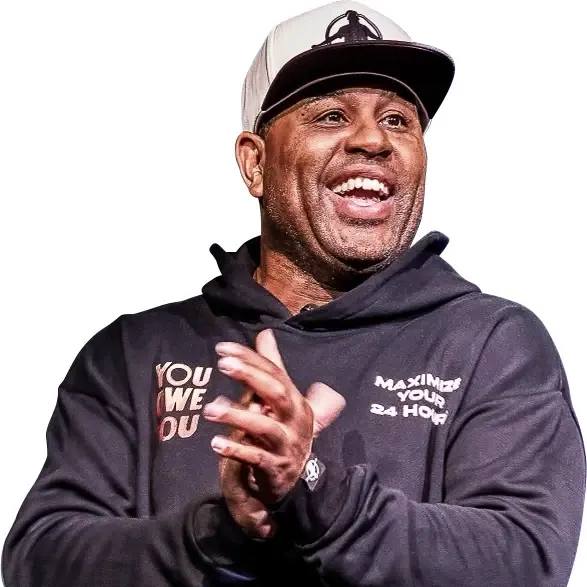
Eric Thomas is an American motivational speaker and author. “You Owe You” explores how people can take responsibility for lives shaped by painful circumstances and connect daily work to deeper purpose.
Explore more books by Eric Thomas