What you'll learn
Key ideas from You Can Fix Your Brain
These ideas compress the book's argument without treating the author's view as settled fact. Use them as an orientation before reading the full work or listening in Wiseley.
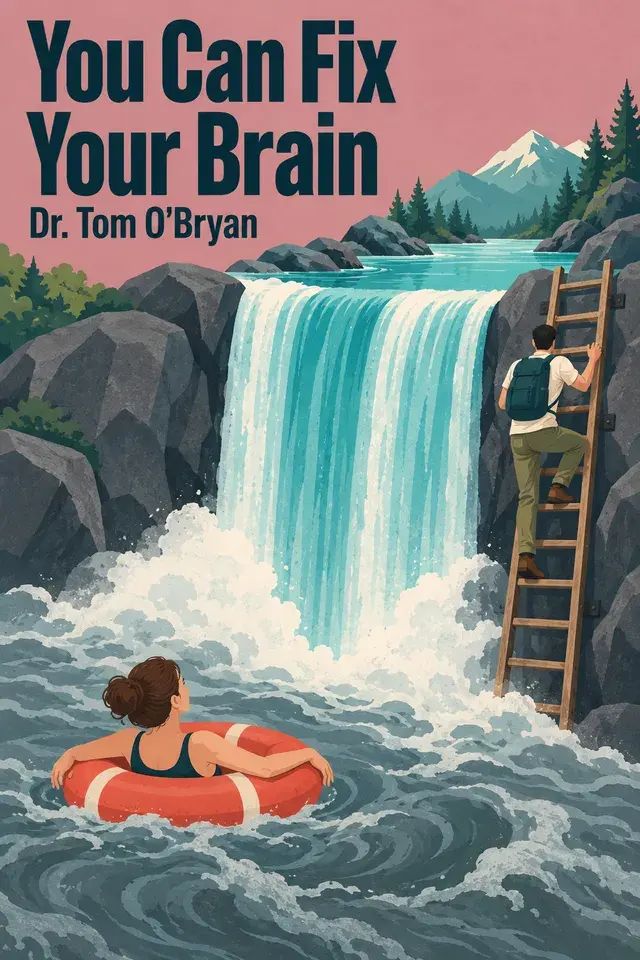
Symptom relief may help in the moment, while the waterfall metaphor also invites questions about possible upstream contributors.
Inflammation supports repair, but repeated triggers may keep it active and turn defense into collateral tissue damage.
The author presents gut microbes and brain stress as a two-way loop that may affect digestion, immune signaling, mood, and resilience.
A detailed timeline turns scattered symptoms, illnesses, exposures, and treatment responses into questions a clinician can investigate.
The Pyramid of Health groups possible contributors into structure, biochemistry, mindset, and electromagnetic influences.
Mindfulness, conscious breathing, and gradual meditation practice train attention without requiring thoughts or difficult feelings to disappear.
The weekly base-hit plan pairs food and symptom records with gradual changes, practitioner input, and attention to small improvements.
Inside You Can Fix Your Brain
Read the first chapter in full here. The other 11 continue in the Wiseley app.
Chapter 1 of 12 · 4 min · Audio & text
Follow Symptoms Upstream
You Can Fix Your Brain, by Dr. Tom O'Bryan.
Dr. Tom O’Bryan opens by widening the question behind brain fog, memory problems, fatigue, and changes in mood. He argues that these complaints may involve processes elsewhere in the body, and that several influences may interact. The brain, in this view, cannot always be treated as an isolated starting point. A symptom is a reason to ask what may be contributing, not proof of a particular cause.
He explains this with a waterfall. Imagine someone swept into rough water below a waterfall. A life jacket can help keep the person afloat. O’Bryan compares symptom-relieving treatments, including medication, to that support: they may be needed and useful, but they do not explain what sent the person into the water. The ladder in his metaphor represents trying to get back upstream and investigate what may be driving the problem. The question is not only how to manage what is happening now, but also what might be sustaining it.
For example, he says that a sleep aid or melatonin may help with insomnia in the short term, while leaving open why sleep became difficult. This distinction does not make relief unimportant. O’Bryan cautions readers never to stop medication without a doctor’s approval. He suggests that addressing possible underlying contributors may sometimes change what treatment a person needs, so any reduction should be discussed with a doctor.
The search upstream also has limits. O’Bryan acknowledges that some possible sources, such as air pollution or chemicals in food, may not be fully avoidable. His proposal is to notice and investigate what can reasonably be addressed, rather than expect complete control over every influence. The metaphor sets a direction for inquiry, not a promise that every source will be found or removed.
O’Bryan uses his own cataract as an example of looking beyond the immediate complaint. He recounts a heavy-metal test that showed a high lead level and connects that finding with his childhood near an auto plant in Detroit. He says toxins had built up in his body for 40 years and eventually caused his cataract. He presents this as his own history, not a universal explanation for other people’s symptoms.
Leona’s history offers another example. She had been seen by several doctors, yet, in O’Bryan’s account, her brain fog, memory lapses, and mental fatigue remained concerns even as medication slightly suppressed other physical symptoms. Looking back across her life led to questions about circumstances before and after her birth, and during childhood. O’Bryan presents those questions as a way of broadening the investigation, not as proof that a particular exposure caused her condition. Her story shows why he wants clinicians to hear more than the immediate complaint, while its hypotheses remain specific to her account.
These examples establish an approach, not a universal explanation. O’Bryan emphasizes that what matters to one person may not matter to another, so progress depends on learning what fits an individual’s circumstances. He recommends taking small steps and building understanding over time. His suggested pace is roughly an hour a week, focused on one actionable idea at a time, with meaningful progress measured over months rather than overnight. He does not promise a quick fix or perfection.
He also asks readers to meet setbacks with honesty and kindness instead of self-blame. A lapse can be information about how difficult a change is, rather than a reason to abandon the effort. The opening message is therefore to pursue relief when it is needed while continuing to ask what may lie upstream. The chapters that follow examine possible contributors and practical areas of attention, but the guiding question remains personal: what deserves investigation in this person’s case?
Chapter 2 of 12 · 7 min · Audio & textIn the app
The Immune Cascade
In Dr. Tom O’Bryan’s account, the immune system is a defense network that can become part of the problem if it keeps responding after a threat has passed.
Chapter 3 of 12 · 7 min · Audio & textIn the app
Brain Barriers and Early Signals
The brain depends on a steady supply of blood and on a barrier that controls what enters from the bloodstream. Building on the book’s account of immune activity, O’Bryan describes two possible routes by which upstream stressors might affect brain function: damage to this barrier and reduced bloodflow.
Chapter 4 of 12 · 8 min · Audio & textIn the app
The Gut Brain Conversation
The gut, in this chapter, is more than a digestive tube. The author describes an ongoing conversation between the gut and the brain.
Chapter 5 of 12 · 8 min · Audio & textIn the app
Mapping the Toxic Burden
Tom O’Bryan describes environmental exposure as a cumulative load. Substances enter through air, food, and skin, and the body processes and eliminates them.
Chapter 6 of 12 · 6 min · Audio & textIn the app
Turn Symptoms Into Evidence
The book’s earlier chapters propose ways the body might affect the brain. Here, O’Bryan shifts from mechanisms to investigation: bring a person’s history, current symptoms, and selected test results together, then decide with a clinician what question to pursue.
Chapter 7 of 12 · 4 min · Audio & textIn the app
The Four Domains of Health
The Pyramid of Health gives O’Bryan a way to organize the possible influences he has discussed. It expands a three-part framework associated with his mentor, George Goodheart, by adding electromagnetic influences to structure, biochemistry, and mindset.
Chapter 8 of 12 · 6 min · Audio & textIn the app
Structure, Nerves, and Movement
O’Bryan treats spinal structure as one possible route through which daily habits may affect wider health. Bones, joints, discs, muscles, ligaments, and tendons support movement and help maintain the passages through which spinal nerves travel.
Chapter 9 of 12 · 6 min · Audio & textIn the app
Train Attention and Resilience
O’Bryan relays Hans Selye’s definition of stress as anything that activates a sympathetic nervous system response, whether chemical, physical, or emotional. When that response persists, O’Bryan describes a body on alert: quick, shallow breathing, a faster heartbeat, tense muscles, and an anxious or watchful mind.
Chapter 10 of 12 · 9 min · Audio & textIn the app
Food as Brain Input
Dr. Tom O’Bryan treats food as a set of inputs that may affect inflammation, metabolism, gut health, and brain function.
Chapter 11 of 12 · 10 min · Audio & textIn the app
Build a Practical Food Plan
After the book’s broad food-selection framework, O’Bryan turns to carrying it out. He proposes a start without gluten, dairy, or sugar.
Chapter 12 of 12 · 6 min · Audio & textIn the app
Reduce Exposures, Keep Asking Why
After discussing structure, biochemistry, and mind-set, O’Bryan turns to the fourth domain: electromagnetic influences. He describes electromagnetic radiation as energy carried in electric and magnetic waves, with a field around its source.
Chapter 1 of 12 · 4 min · Audio & text: Follow Symptoms Upstream
Wiseley supports reading and listening to summaries in the app.
Continue in WiseleyAbout Tom O'Bryan

Tom O'Bryan is the author of “You Can Fix Your Brain”. The book explores how brain symptoms may connect to immune activity, gut function, and exposures elsewhere in the body.
Explore more books by Tom O'Bryan