What you'll learn
Key ideas from Words on the Move
These ideas compress the book's argument without treating the author's view as settled fact. Use them as an orientation before reading the full work or listening in Wiseley.
Language changes through ordinary use, including in an imagined community without outside contact.
A marker’s interpersonal force depends on context and can accompany a factual claim without changing the event it describes.
Repeated implications can become conventional meanings, with older and newer senses sometimes overlapping during the transition.
Repeated use can shift a word’s meaning and stress until it becomes a grammatical marker.
Small changes passed between generations can move neighboring vowels and form regional chain shifts.
Writing can make conventions look fixed and can slow change, while spoken language continues to shift.
Inside Words on the Move
Read the first chapter in full here. The other 6 continue in the Wiseley app.
Chapter 1 of 7 · 4 min · Audio & text
Language as a Living Process
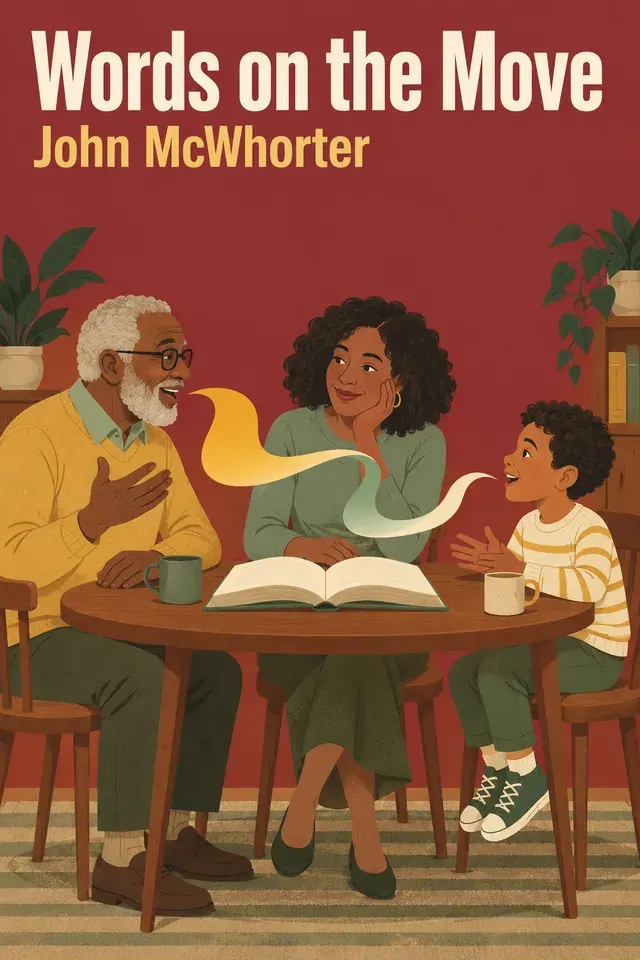
Words on the Move, by John McWhorter.
A language is never a finished object. It is a process carried by people who use it, and its words and sounds keep changing. Many people accept that English has changed over centuries, yet feel uneasy when a change they hear now seems disruptive. The question is how language can keep changing and still let people understand one another. McWhorter’s answer begins with ordinary use: change is part of language’s life, not evidence that speech has become disorderly.
This process does not depend on someone deliberately inventing a new word, or on one community borrowing from another. People think and speak, passing language along in daily life. The author argues that even a community imagined as isolated for a very long time would develop forms that outsiders might eventually find unfamiliar. Change is inherent in language.
Shifting associations offer a glimpse of how change can begin. Ghostly connects to the idea of spirits, which can be understood as spiritual or as ghost-related. The neighboring association can gradually come to the fore, so that a word once tied to spiritual matters is heard more directly in connection with ghosts. No speaker needs to announce a new definition. A familiar word is used and understood amid related ideas, and over time one association can become more prominent.
Adorable shows a related shift. The word is connected with inspiring adoration, but applying that idea to something small or cherished can feel warm and sincere. In time, adorable comes to mean charming or delightful, especially in that kind of context. Its modern sense does not simply cover everything people admire. The example shows how a word’s associations can make a new use feel natural, without a deliberate decision to replace its earlier meaning.
These examples help explain why a language’s continuity can be easy to miss. People usually inherit much of what they say from others, so communication carries forward familiar words even as their associations shift. Change does not mean that speakers suddenly lose all common ground. It means that the shared language is continually being carried forward in slightly altered forms. From close up, a new use can seem like a break from the past; seen across time, it belongs to the same process that produced the language people already know.
Dictionaries can make that process harder to notice. Their printed pages look stable, and their definitions can give the impression that a word has one lasting meaning. But a dictionary records a picture of language at a particular moment; it cannot preserve language from change. Samuel Johnson hoped his dictionary might fix English, then recognized that no dictionary could keep a living language from shifting. Dictionaries remain useful records, but they cannot capture every use or make an entry timeless.
McWhorter invites readers to view change as something to understand, rather than as a puzzle or decline. That perspective makes an unfamiliar form part of an intelligible process. It also explains why people can acknowledge change in the distant past while objecting to some forms around them now. The author’s point is not that every new use pleases every listener, or that every individual use communicates equally well. It is that language as a whole continues to change through ordinary human use, and this movement need not make it chaotic.
There is a separate question about formal conventions. Many familiar rules of formal usage may have little to do with clarity or logic, yet people use them as signals of formality and social standing. They can matter in education and other formal settings, where expectations affect how speech and writing are received. Their social force is real, even though it does not make them timeless laws governing all language. Recognizing that distinction lets us understand natural change without dismissing the conventions people encounter in particular settings.
Chapter 2 of 7 · 7 min · Audio & textIn the app
The Social Work of Words
Words can tell us what happened while also showing how a speaker feels about it and how they are treating a listener. McWhorter calls this interpersonal dimension FACE: Factuality, Acknowledgment, Counterexpectation, and Easing.
Chapter 3 of 7 · 7 min · Audio & textIn the app
Meanings Move by Implication
Consider reduce in Shakespeare’s Henry V. The Duke of Burgundy describes a country damaged by war and hopes to reduce it to its former state.
Chapter 4 of 7 · 6 min · Audio & textIn the app
How Words Become Grammar
Grammar can seem like a fixed set of rules, but its pieces have histories. A word can gradually become a piece of grammar: repeated use shifts what it means, how strongly it is stressed, and eventually how it sounds.
Chapter 5 of 7 · 9 min · Audio & textIn the app
Vowels Move Through Time
A useful starting point for pronunciation is to stop treating spelling as a map of the mouth. English has many more vowel sounds than vowel letters, and letters behave inconsistently: the u in cute, cut, and put represents three different sounds.
Chapter 6 of 7 · 7 min · Audio & textIn the app
New Words from Old Material
New vocabulary does not always arrive as a wholly new sound or a borrowed word. Speakers push familiar words together, let them run together, or hear an old form as built from different pieces.
Chapter 7 of 7 · 5 min · Audio & textIn the app
Writing, Standards, and Speech
Writing gives language a visible shape, and that shape can mislead us. A sentence on a page stays still, so spellings and conventions can look like the language itself: stable, inherited, and governed by rules.
Chapter 1 of 7 · 4 min · Audio & text: Language as a Living Process
Wiseley supports reading and listening to summaries in the app.
Continue in WiseleyWhat Words on the Move is about
John McWhorter traces how everyday speech reshapes meaning, grammar, pronunciation, and vocabulary. He asks why language changes and how people communicate amid that movement, using examples from conversation, English history, regional accents, and word formation. The book offers a way to understand linguistic change while distinguishing social conventions from timeless rules.
About John McWhorter
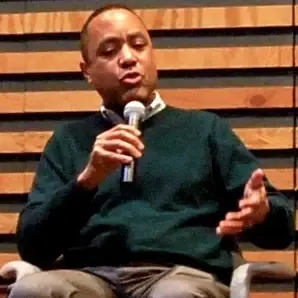
John McWhorter is an American linguist and academic. “Words on the Move” explores how everyday speech reshapes meaning, grammar, pronunciation, and vocabulary.
Explore more books by John McWhorter