What you'll learn
Key ideas from Willpower Doesn't Work
These ideas compress the book's argument without treating the author's view as settled fact. Use them as an orientation before reading the full work or listening in Wiseley.
Environment includes physical settings, relationships, information, food, and social norms that cue behavior and shape what feels possible.
Hardy distinguishes growth-producing eustress from destructive distress; challenge needs substantial recovery to support sustained growth.
Removing clutter, distractions, and incompatible commitments reduces friction around a chosen direction.
An implementation intention links a specific obstacle to an immediate action; rehearsal helps the response begin with less deliberation.
Novelty and meaningful difficulty can renew attention by disrupting complacency and requiring adaptation.
A demanding task becomes a learning system when real practice, coaching, immediate feedback, and another attempt are connected.
Inside Willpower Doesn't Work
Read the first chapter in full here. The other 9 continue in the Wiseley app.
Chapter 1 of 10 · 9 min · Audio & text
The Environment Shapes the Self
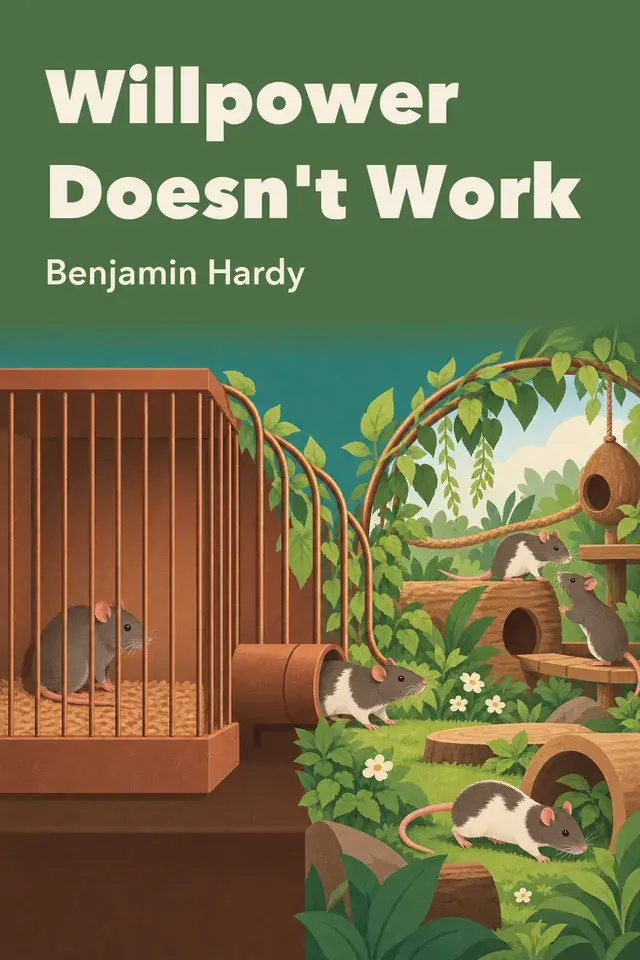
Willpower Doesn't Work, by Benjamin Hardy.
When people fail to keep a resolution, the familiar explanation is that they lack discipline. Hardy questions that diagnosis. He asks whether their surroundings keep prompting the behavior they are trying to change. If an action must be defended against the same cues day after day, the struggle may reflect a conflict between a person and a context, rather than a fixed flaw in character.
Hardy uses “environment” broadly. It includes physical places, but also relationships, information, food, music, and the rules people encounter. A room matters, as do the people in it, the ideas they discuss, and what the group treats as normal. These surroundings supply cues and expectations that can make some actions feel natural and others unusual.
The cues operate at more than a personal scale. Hardy links changes in daily life to the shift toward seated work and packaged food, alongside expanding technology and information. A person trying to change a habit still lives inside those wider conditions. His weight-loss discussion uses this contrast to suggest that individual effort can be working against everyday patterns in work, food, and culture.
Social expectations also help define what seems possible. Groups have explicit rules, such as how a sport is played, and unwritten ones, such as what friends commonly do together. People can absorb these expectations without deciding to adopt them. Their information and relationships also influence which choices they notice and which futures seem realistic. Hardy’s point is that behavior takes place inside a web of cues, expectations, and available options.
That web affects inner life as well as action. Hardy argues that people do not form beliefs, values, and goals in isolation from their cultural and historical surroundings. A change in relationships or circumstances can alter what someone thinks and feels; those changes may then shift what they want. The person’s actions can, in turn, create or select new surroundings. Context and individual response keep influencing each other.
The loop also shapes identity. Hardy draws on the idea that people infer their character from their own actions. If someone acts in a new way, that action can become evidence about who they are and what they can do. A different sense of self may support different choices later. Hardy therefore treats identity and capability as responsive to context, rather than as qualities that show up identically in every situation.
This does not mean that circumstances dictate every action. Hardy rejects both the idea that people can act entirely free of conditions and the idea that they are merely products of those conditions. Gravity and physical needs constrain what is possible; culture, resources, and history also narrow the available choices. Within those limits, people retain room to act and can sometimes reshape the contexts influencing them. That room is not equal for everyone, and some surroundings are far harder to change than others.
Hardy’s foster-family account illustrates how a changed context can affect a household. He says that graduate study and more than three years as a foster parent changed his view of environment. He had once treated it as a mostly static backdrop. He came to see himself and the people around him as shaped by their circumstances. The children, he says, had faced early difficulties with learning and sleep. He also notes that, because of legalities surrounding foster children, he cannot go into much detail about their early environment. He describes their county as having low upward income mobility, a reminder that opportunity is shaped by conditions beyond a household’s choices.
Hardy and his wife had to learn parenting quickly and reorganize their schedules and priorities. They arranged a more structured setting for the children: a rigorous school, activities, travel, a long period without refined sugar, about twelve hours of sleep each night, and nightly academic help. Hardy says the nearly year-long refined-sugar-free period reframed the children’s biology, including their self-confidence, ability to learn, sleep, and calm. He also says that traveling to more than thirty states broadened their worldview. The children thrived at school and became engaged in activities; Hardy shares these changes as effects of their changed environment, while the account does not isolate the contribution of every condition.
The environment also changed the adults. The new responsibilities required more patience and prompted Hardy and his wife to try to become kinder and more loving. He describes them as imperfect parents, not as an ideal model. The account’s point is that a new set of demands and relationships can alter the people responding to them, as well as the children living within that setting.
A different illustration comes from Hardy’s account of Nate, a real-estate agent who traded a 1990s Camry for a Tesla costing more than one hundred ten thousand dollars. Within a month, Hardy reports, Nate’s online presence and network had grown, and sales of his real-estate education products had quadrupled. Those sales enabled him to pay off the car within two months. Hardy also says prominent peers began treating Nate as credible and inviting him to events.
Hardy interprets the car as more than transportation. In Nate’s work and social life, it became a visible cue of authority, credibility, and commitment to his ambition. Other people responded to that cue, and Nate’s confidence rose. Hardy links these responses to a feedback loop: a changed environment affected how others saw Nate; those reactions influenced how he saw himself; greater confidence and a changed sense of possibility supported further action. The story suggests how behavior and identity may reinforce one another, without showing that the car alone caused the reported outcomes.
The example is an individual account, not a guarantee or a general recommendation to buy an expensive car. Hardy says Nate did not know exactly how the purchase would affect him, and acknowledges that not everyone can afford one. The useful point within Hardy’s argument is the proposed relationship between context and response: surroundings can send signals, other people may react to them, and those reactions can influence confidence and action.
Together, the family and Nate’s story show two sides of the same relationship. A household can change as people take on new roles and arrange different conditions. A person can also choose a change in surroundings and then respond to the new cues and social reactions it brings. Neither story proves that context controls outcomes. They illustrate Hardy’s broader claim that a person’s sense of what is possible, and the actions that follow, are shaped in part by the conditions around them.
The framework leaves room for agency while taking context seriously. People inherit circumstances and depend on systems and other people, yet they can choose some of their relationships, information, places, and experiences. Those choices do not erase constraints, but they can change which cues and possibilities are present. The person and the environment are not separate forces: each helps shape what the other becomes.
Chapter 2 of 10 · 8 min · Audio & textIn the app
Work Hard, Then Recover
Hardy’s account of growth depends on a rhythm: engage fully with demanding work, then recover fully. These are complementary conditions, not competing ways to spend time.
Chapter 3 of 10 · 7 min · Audio & textIn the app
Reset Life Through Ritual
Hardy treats a deliberate reset as a chance to choose a direction from a clear, elevated state of mind. A powerful decision made there can set the course of a new pursuit, even though later choices may revise it.
Chapter 4 of 10 · 9 min · Audio & textIn the app
Subtract Triggers, Change Defaults
Hardy shifts attention from adding supportive surroundings to subtracting the specific things that keep an unwanted pattern close at hand. He likens excess possessions, commitments, and other burdens to a force pulling against change.
Chapter 5 of 10 · 10 min · Audio & textIn the app
Connection Changes the Conditions
Hardy connects unwanted behavior with the conditions around it: familiar cues can keep a pattern going, while isolation can make it harder to find another way through pain. He uses addiction to show why changing the setting matters, but adds a social dimension.
Chapter 6 of 10 · 8 min · Audio & textIn the app
Plan for Failure, Shape the Choice
When a goal repeatedly meets the same obstacle, it helps to plan for that encounter before it happens. The obstacle might be stress, distraction, a craving, or a cue in a place you cannot control.
Chapter 7 of 10 · 8 min · Audio & textIn the app
Add Stakes, Novelty, and Difficulty
A setting can make action easier by removing friction. It can also make action matter more by adding responsibility, consequences, investment, difficulty, or novelty.
Chapter 8 of 10 · 8 min · Audio & textIn the app
Learn by Doing Under Pressure
Hardy’s argument here begins after someone enters a demanding situation. A commitment can make it more likely that a person starts, but pressure by itself does not teach a skill.
Chapter 9 of 10 · 8 min · Audio & textIn the app
Match Spaces and Build Together
A workspace does not have to serve every kind of work equally well. Hardy’s argument here is that a setting can cue a particular kind of attention, energy, or interaction.
Chapter 10 of 10 · 8 min · Audio & textIn the app
Remember Roots, Keep Changing
By the end of Hardy’s argument, change is no longer only about becoming different. It is also about becoming different without pretending the past never shaped you.
Chapter 1 of 10 · 9 min · Audio & text: The Environment Shapes the Self
Wiseley supports reading and listening to summaries in the app.
Continue in Wiseley