What you'll learn
Key ideas from Wild Problems
These ideas compress the book's argument without treating the author's view as settled fact. Use them as an orientation before reading the full work or listening in Wiseley.
Wild problems involve uncertain outcomes and uncertain standards because the choice may change who the chooser becomes.
Narrow utility tracks day-to-day pleasure and pain, while flourishing includes meaning, purpose, dignity, belonging, identity, and what a person is becoming.
Satisficing selects a defensible threshold of compatibility; it is not indiscriminate acceptance or deliberate choice of an inferior option.
The ensemble perspective recognizes other people as independent participants rather than supporting characters in one person’s story.
Repeated conduct can reshape desires and make an aspired character more habitual without guaranteeing perfection or constant pleasure.
When forecasts remain unreliable, widening the number of affordable trials can reveal fit better than seeking one perfect prediction.
A life’s aims can emerge through committed making and responsive revision, not only through advance planning.
Inside Wild Problems
Read the first chapter in full here. The other 7 continue in the Wiseley app.
Chapter 1 of 8 · 9 min · Audio & text
When Decisions Change the Decider
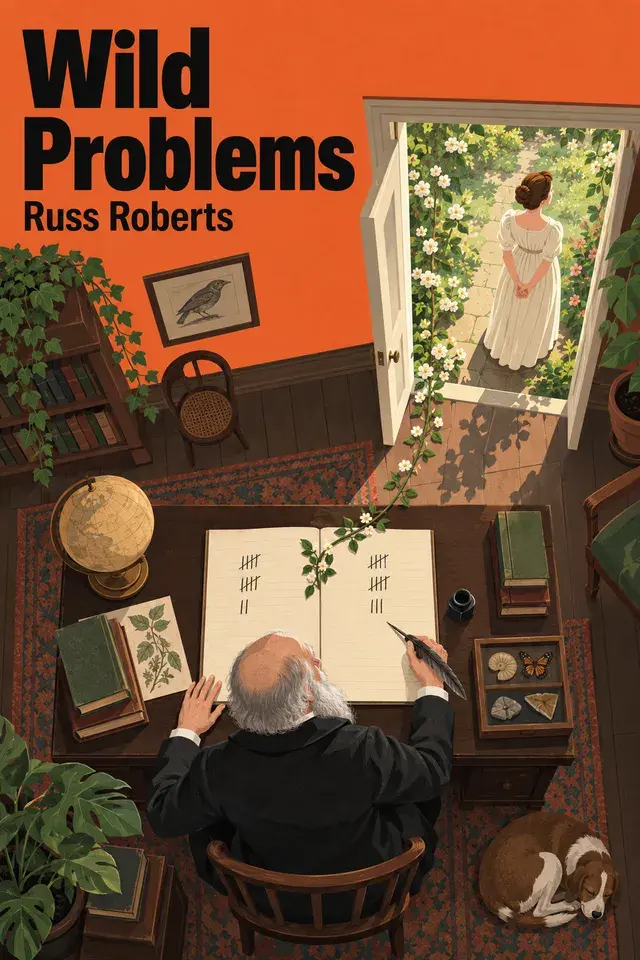
Wild Problems, by Russ Roberts.
Some problems are tame. They have a clear goal, an agreed way to tell whether we are succeeding, and methods that can be tested and repeated. Traffic management or vaccine development may be difficult, but data, experiments, and algorithms can steadily improve the answer. A wild problem is different. It is a major choice—marriage, children, career, religion, or how to spend our time—where the goal is partly personal, the path is not repeatable, and the choice may help create the person who must live with it. The uncertainty is not only what will happen. It is what will matter, and to whom, afterward.
Modern life often responds to uncertainty by measuring harder. We count money, hours, sleep, salary, location, and other visible costs. Those facts matter, but they are not the whole decision. A single score can make alternatives easy to compare while concealing the judgments and omissions used to construct it. This is the streetlight problem: we search where the light is strongest because that is where inspection is easiest, not necessarily where the answer lies. Measurement can calm anxiety and produce visible progress without bringing us closer to the part of the problem that cannot yet be seen.
Darwin’s handwritten marriage ledger shows both the usefulness and the limits of this approach. In 1838, he framed marriage as a momentous question and tried to compare its likely effects with the effects of remaining single. The exercise resembles expected-well-being reasoning. He was not being careless or sentimental. He was trying to take a consequential decision seriously by making its trade-offs explicit.
His imagined reasons for marriage included companionship, conversation, music, a household, care in old age, possible health benefits, and children. But the negatives were more concrete. Marriage might mean moving from London, losing autonomy, giving up some club conversation and reading, accepting obligations toward a wife’s relatives, spending money on children, enduring anxiety and quarrels, and perhaps taking a conventional job. Children could bring responsibility, less time and money for books, and pressure to earn more. Darwin also worried that excessive work, undertaken to meet those obligations, could damage his health.
Remaining single had its own costs in Darwin’s account, including childlessness and the absence of family care and sympathy in old age. Its benefits were freedom of movement, selective company, independence from relatives, and more control over time. These are real considerations. The point is not that marriage erases financial, physical, career, or autonomy costs, or that every person should want it. The ledger is valuable because it takes those burdens seriously, including burdens that can fall unequally. Yet it also reveals more about unmarried Darwin than about marriage itself.
What Darwin could imagine most easily was what commitment would take away. His list barely captures devotion, the pleasure of making another person happy, soothing another’s sorrow, or discovering how mutual presence might change him. It also cannot show the inward life of marriage. Outsiders may observe compatibility in formal encounters, but they cannot see every private conflict, adjustment, or change in self-conception. Nor does this hidden value cancel the possibility of a deeply bad marriage, with restrictions and regret that can affect every part of experience.
Benjamin Franklin offered a more disciplined way to organize attention. Advising Joseph Priestley about a possible career move, Franklin recommended listing the advantages and disadvantages over several days, estimating their relative weights, and canceling considerations that were roughly equivalent. The method protects against focusing on one group of consequences while forgetting another. It can slow rashness and make neglected reasons visible. For a wild problem, that is a genuine service even when it cannot produce certainty.
Franklin did not claim that reasons could be weighed with algebraic precision. The weights still express judgment. The same limitation appears whenever complex information is compressed into one number. A hiring score may reduce the influence of charm or first impressions, and square footage may help compare irregular houses. But the score depends on which attributes were selected, how they were weighted, and what was left out. A formula can organize thought without replacing the judgment that gave the formula meaning.
The deeper difficulty is that some choices alter the chooser’s preferences. Philosopher L. A. Paul’s vampire thought experiment makes this vivid. Before becoming a vampire, a person cannot imagine what it would be like to live on blood and sleep in a coffin. Experienced vampires may report happiness, but that does not answer whether this particular person would value the transformed life. The future self may care about different things, and even traits that seem repellent now might appear attractive after the transformation. The question is not simply which outcome is better. It is which self should supply the standards of judgment.
Marriage, parenthood, and religious conversion have a less fantastical version of the same structure. Their costs can be described from the outside, but the experience may change what produces joy, sorrow, fear, or attachment. Parenthood also involves substantial practical burdens: travel, spending, lost sleep, altered work choices, and reduced freedom. In the culture Roberts describes, pregnancy can add dietary restrictions, health complications, the risk of death in childbirth, and a more difficult work-home trade-off for women. Katja Grace’s robot-baby experiment tries to simulate crying, nighttime waking, feeding, diapers, and sleep loss. It can reproduce selected hardships, but not the emotional exposure of having a real child—the sense, in Elizabeth Stone’s phrase, that one’s heart is outside one’s body.
Testimony remains useful, but it is evidence rather than prediction. Married friends can reveal something about how a relationship works, just as parents can describe parts of parenthood. Yet people may conceal conflict, lack complete self-awareness, or struggle to articulate complex feelings. Even sincere reports from happy parents cannot establish that another person will have the same experience, and people may misread their own happiness. Roberts’s enthusiasm for parenthood is personal, not universal. Some people do not want it, cannot undertake it, or are not able to do so.
Roberts’s meditation retreat shows why participation and duration can disclose value that no description conveys. Before going, he expected silence, emotional strain, no email, unfamiliar meditation, and prolonged stillness to be difficult. The retreat also prohibited conversation, comfort, eye contact, and ordinary gestures. Yet the five-day experience became extraordinary, emotionally overwhelming, liberating, and enduringly softening. He returned twice. Reports from previous participants helped him decide, but none could transmit what those five days would feel like. An hour of silence was not a small version of the whole experience; duration changed its intensity and effect. The example is not a recommendation for everyone. It shows that some value becomes accessible only through sustained participation.
Wild decisions therefore require reasoning, but they defeat the fantasy of complete calculation. Darwin could list visible costs, seek testimony, and weigh competing considerations. He could not know how much uncertainty remained, imagine the inward experience of marriage, or decide whether the standards of single Darwin or married Darwin should control the choice. A wild decision cannot be fully calculated in advance because the experience can change both the chooser and the standards by which the choice will later be judged.
Chapter 2 of 8 · 10 min · Audio & textIn the app
Flourishing Beyond Pleasant Moments
When a decision can change the person who later evaluates it, predicted pleasure and pain are not the whole object of evaluation. Roberts’s positive response is to distinguish two ideas that are often collapsed: narrow utility and flourishing.
Chapter 3 of 8 · 6 min · Audio & textIn the app
Different Lives Can Hold Meaning
Flourishing becomes more useful when it stops sounding like a verdict about one approved life. It asks not only whether a choice adds pleasure or removes burdens, but what role, identity, purpose, or relationship to others it makes possible.
Chapter 4 of 8 · 9 min · Audio & textIn the app
Choosing Without a Best Option
Penelope’s dilemma starts with a crowd of suitors occupying Odysseus’s palace, consuming his resources, and waiting for her to choose. The exact number is unclear, but one count gives one hundred and eight.
Chapter 5 of 8 · 7 min · Audio & textIn the app
Relationships Beyond the Leading Role
Choosing a relationship is not the same as receiving its benefits. A friendship, marriage, family tie, or working partnership becomes meaningful through repeated conduct: where attention goes, how time is shared, and how people respond when moments are inconvenient.
Chapter 6 of 8 · 8 min · Audio & textIn the app
Principles Shape the Person Becoming
Wild moral choices expose a limit in ordinary cost-benefit reasoning. A rational-choice model can ask what is desirable, what is feasible, and which feasible option is most desirable.
Chapter 7 of 8 · 7 min · Audio & textIn the app
Learn Before You Overcommit
Wild problems are difficult not only because outcomes are hidden. They can hide the fit between a choice and the person making it.
Chapter 8 of 8 · 6 min · Audio & textIn the app
Create a Life Through Revision
Many projects begin with a destination that can be described before the work starts. You can set the objective, choose a method, and judge whether the result matches the plan.
Chapter 1 of 8 · 9 min · Audio & text: When Decisions Change the Decider
Wiseley supports reading and listening to summaries in the app.
Continue in WiseleyWhat Wild Problems is about
How do you choose when a decision may change who you become? In Wild Problems, Russ Roberts examines marriage, careers, relationships, and moral choices to explain the limits of calculation. He explores how flourishing, principles, commitment, and experimentation can guide decisions whose deepest consequences cannot be known in advance.
About Russ Roberts

Russ Roberts is an American economist. “Wild Problems” explores how to choose when a decision may change who a person becomes.
Explore more books by Russ Roberts