What you'll learn
Key ideas from Where the Crawdads Sing
These ideas compress the book's argument without treating the author's view as settled fact. Use them as an orientation before reading the full work or listening in Wiseley.
Ma’s departure and her siblings’ exits leave Kya without dependable family care, while Pa’s violence teaches her to hide.
Jumpin’ buys Kya’s mussels for cash and fuel; Mabel arranges a family exchange for smoked fish, facilitated by Jumpin’, while his quota limits Kya’s income.
Tate connects Kya’s field knowledge to books and gives her words for the ecological patterns she already observes.
Chase’s private tenderness and marriage talk coexist with his exclusion of Kya from town life, and his engagement exposes their unequal expectations.
The shell guide turns years of observation into published work and a possible continuing livelihood, though future royalties remain projected.
Kya refuses a manslaughter plea requiring an admission of guilt; Tate, Jumpin’, Mabel, and Sunday Justice offer care without undoing her guardedness.
Tom links Kya’s outsider status to the town’s failure to help her and asks jurors to consider that history alongside the evidence.
Kya’s poems and Chase’s necklace lead Tate to infer her involvement, but his reconstruction remains private and unproven.
Inside Where the Crawdads Sing
Read the first chapter in full here. The other 9 continue in the Wiseley app.
Chapter 1 of 10 · 7 min · Audio & text
A Child Left to the Marsh
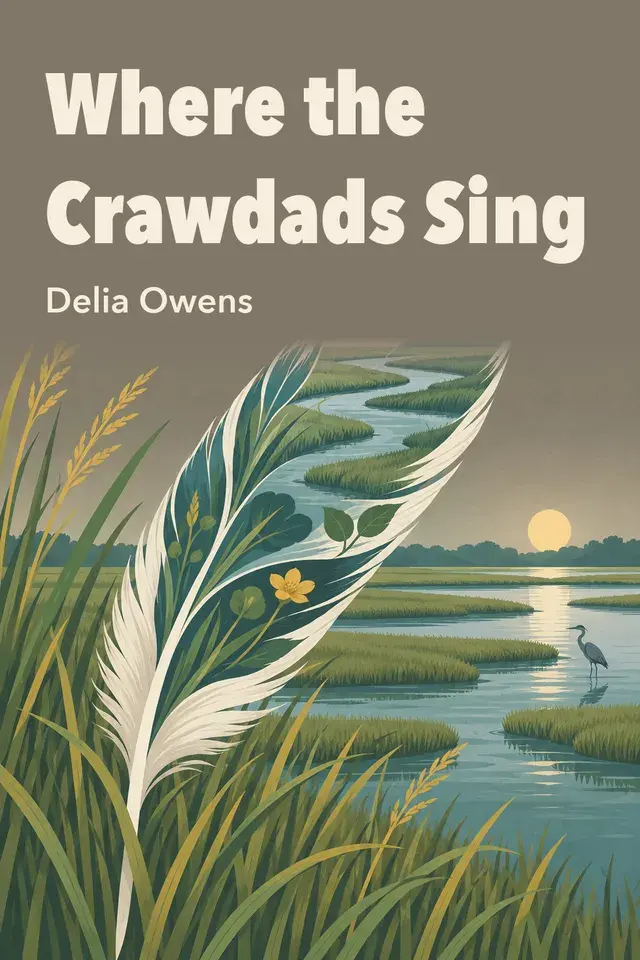
Where the Crawdads Sing, by Delia Owens.
Where the Crawdads Sing begins by separating the marsh from the swamp. The marsh is open to light, grass, birds, and moving water. The swamp is darker and stiller, a place where decay returns to the ground and becomes part of renewal. That cycle frames the opening image: Chase Andrews lies dead beneath an old fire tower, in a place that might have concealed him. On October thirtieth, nineteen sixty-nine, two village boys find him there. The book introduces death as both a mystery and part of the swamp’s natural order.
The narrative then turns to nineteen fifty-two. Kya is six, the youngest of five children, when she watches her mother leave through the screen door. Ma wears high heels and carries a train case. Kya has seen her mother leave before and return, but this departure feels different. That morning, Ma is quiet, red-eyed, and partly hiding a bruise. The signs suggest distress, but Kya does not know where her mother is going or why. She waits for her to come back, while the family says little about the departure.
In the weeks that follow, Kya’s older siblings leave too. Her brother Jodie has been the closest to her. He cooks with her and tries to distract her, but after Pa hits him, Jodie says he cannot keep living there. Kya wants him to take her along, yet she cannot ask. He tells her to run into the marsh and hide if Pa or anyone else threatens her. Kya understands that Pa’s violence is driving her siblings away, but she cannot understand why no one takes her with them. The account gives no answer to that question.
Pa is often absent. When he is home, he may be silent or shout, and Kya learns to stay out of his way. Once, when he raises a hand, she stands her ground and he turns away. But she cannot depend on that moment of restraint. She spends her days in the woods and water, where she can avoid him. Pa’s weekly disability checks are the household’s only income, and the money he gives Kya for food depends on her doing chores. She cleans the shack partly in the hope that Ma might return. Care at home has become something Kya must manage around Pa’s moods and absences.
Hunger eventually pushes Kya into town to buy grits, even though she is anxious around people and avoids speaking. Miss Pansy calls her “swamp trash.” Kya chooses a one-pound bag of coarse-ground yellow grits because it is the weekly special, as Ma had taught her. Mrs. Singletary counts out the change, helping Kya complete a transaction she finds difficult. At home, Kya does not know how to cook the grits properly at first. She tries again and improves. She also learns to stretch food with turnip greens, backbones, and collards. The episode shows a child improvising through trial and error because no steady adult is teaching her how to manage a household.
Before returning to Kya’s school experience, the novel cuts back to the 1969 case. The sheriff asks the boys where they stopped. Their tracks end short of Chase, and there are no other fresh prints leading to the body or the tower. The missing tracks leave an unanswered question: how did Chase reach the tower without leaving footprints?
The narrative returns to Kya in 1952. She does want to learn at school. She wants to read and count beyond twenty-nine, but she is wary when visitors come to take her. Hunger, and the promise of chicken pie and a free hot lunch, persuade her to go. The school keeps separate facilities for white and Black children. With no birth date for Kya in the county records, officials place her in second grade despite her never having attended school. They say first grade is crowded and assume marsh children will not stay in school. The placement takes little account of what she knows or has missed.
In class, Kya gives her full name and is asked to spell “dog.” She answers “God,” and the other children laugh. The teacher tells them to stop, and Kya stays interested in the lesson. But a moment of correction does not make the classroom welcoming. At lunch, the other children ignore her. Though hungry, she eats only a little and hides a pie and roll for later. On the bus, classmates mock her as a marsh hen and swamp rat. She gives the saved food to gulls. Their company lets her laugh, then cry; she fears that they, too, might leave.
When the school visitors return, Kya avoids them by laying misleading tracks through the marsh and leaving no trace on hard ground. After several weeks, the searches stop, and she never attends school again. She returns to watching herons and collecting shells. The marsh has already become more than a place to hide: its familiar sounds comfort her, its food helps sustain her, and the living things around her give her something to observe and learn from. Over time, she imagines the land as a mother who catches her when she stumbles.
Later, the investigation reaches the tower platform. The searchers find no sign that anyone brushed away the footprints, and one grate stands open above the outline of Chase’s body in the mud. The sheriff considers whether someone left it open to make a push look like an accident; his deputy questions that explanation. The sheriff says it is too early to call the death foul play. The open grate and absent tracks make the death suspicious, but do not explain what happened.
The opening places two unresolved absences alongside each other. Chase’s death remains unexplained, just as Kya does not know why her family left her behind. Her first education comes through necessity, attention, and the marsh’s rhythms, while family and school offer little dependable care. The marsh shelters and sustains her, but it cannot answer the questions left by the people who have gone.
Chapter 2 of 10 · 9 min · Audio & textIn the app
Survival Through Attention and Exchange
When Kya is seven, Pa leaves for Asheville, expecting to be gone only a few days. His departure renews her fear that her family will leave one by one.
Chapter 3 of 10 · 7 min · Audio & textIn the app
Learning the Living World
Kya’s practical knowledge does not depend on print. She can read tides, recognize wildlife, and find her way through the marsh, yet books remain beyond her reach.
Chapter 4 of 10 · 10 min · Audio & textIn the app
Longing, Courtship, and Betrayal
At nineteen, Kya watches a group of young women whose friendship has endured for years. Their laughter and embraces show her a kind of belonging she wants but does not know how to enter.
Chapter 5 of 10 · 8 min · Audio & textIn the app
Knowledge Becomes a Home
By 1967, Kya is trying to survive another abandonment. Chase’s rejection revives a larger fear: that people will always leave her.
Chapter 6 of 10 · 7 min · Audio & textIn the app
From Clue to Arrest
The case against Kya takes shape by accumulation. Each new clue seems to answer one question while leaving another open.
Chapter 7 of 10 · 9 min · Audio & textIn the app
The Cost of Being Accused
The murder trial opens on February 25, 1970, after Kya has spent two months in a county jail cell without bail. The courtroom’s brightness, the crowded gallery, and the attention overwhelm her.
Chapter 8 of 10 · 10 min · Audio & textIn the app
Testing the Case
At trial, the prosecution links several clues into a possible account of Chase’s death. The defense tests each link: who observed it, what it can establish, and what else might explain it.
Chapter 9 of 10 · 6 min · Audio & textIn the app
Acquittal and Return
The last defense witness, shrimp-boat captain Tim O’Neal, returns the trial to a question of recognition. He has worked the waters near Barkley Cove for decades.
Chapter 10 of 10 · 6 min · Audio & textIn the app
The Secret Beneath the Legend
After the acquittal, Kya and Tate build a life together in the marsh, her lasting home. Tate moves into her shack, and their days settle around breakfasts, collecting trips, boat rides, and evenings together.
Chapter 1 of 10 · 7 min · Audio & text: A Child Left to the Marsh
Wiseley supports reading and listening to summaries in the app.
Continue in WiseleyWhat Where the Crawdads Sing is about
Delia Owens’s novel follows Kya, abandoned as a child in a coastal marsh, and the investigation into Chase Andrews’s death. It asks how isolation, prejudice, and survival shape belonging and judgment. Kya’s study of wildlife becomes an education and a livelihood, while the trial tests what ambiguous evidence can establish about someone the town has already judged.
About Delia Owens

Delia Owens is an American author and zoologist. “Where the Crawdads Sing” explores how isolation, prejudice, and survival shape belonging through the story of Kya, a girl raised alone in a coastal marsh.
Explore more books by Delia Owens