What you'll learn
Key ideas from When McKinsey Comes to Town
These ideas compress the book's argument without treating the author's view as settled fact. Use them as an orientation before reading the full work or listening in Wiseley.
McKinsey’s prestige and client-first ethic could make a client’s efficiency priorities appear to be neutral expert recommendations.
The chapter’s distribution test asks who gains, who bears displacement or lower pay, and whether promised gains reach affected workers.
An efficiency metric can be assessed by whose needs it counts, what implementation followed, and whether service quality matched claimed savings.
FDA, tobacco, and PMI-funded foundation work overlapped; former officials lacked disclosure, and Pulido sidestepped how team rules were enforced.
McKinsey helped Purdue pursue sales, while prescribers, pharmacies, regulators, lawmakers, and broader economic conditions also shaped the crisis.
Climate claims become easier to assess when dated targets are compared with named services, demonstrated results, and disclosure about client emissions.
Confidentiality makes consulting work difficult to examine, so evaluation must track outcomes, access, administrative costs, and contractor incentives.
Inside When McKinsey Comes to Town
Read the first chapter in full here. The other 13 continue in the Wiseley app.
Chapter 1 of 14 · 8 min · Audio & text
The Consultant’s Promise and Power
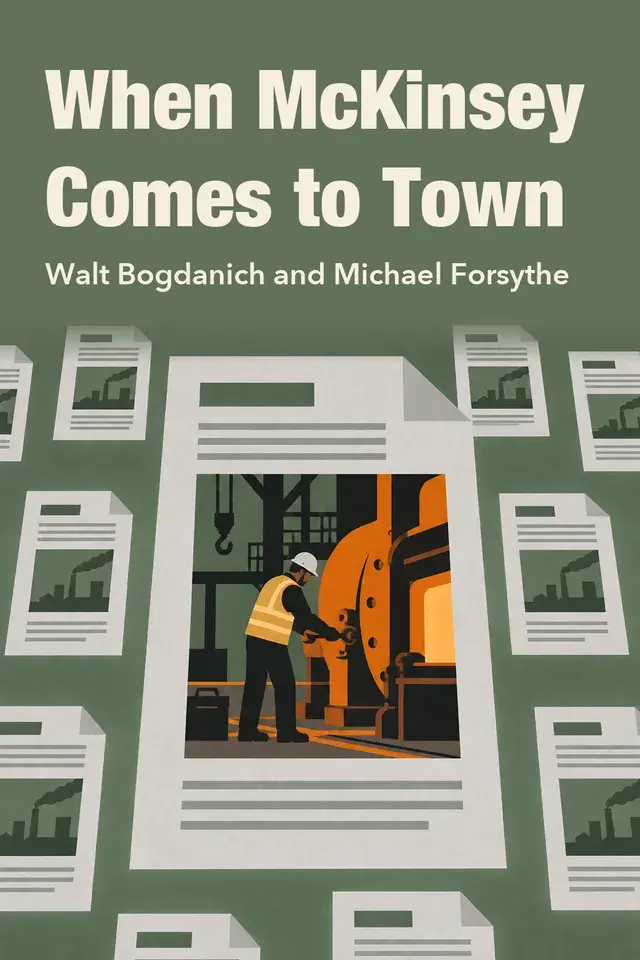
When McKinsey Comes to Town, by Walt Bogdanich and Michael Forsythe.
Management consultants sell a way to make complicated decisions look measurable. McKinsey promised scientific management: analyze an organization, identify inefficiency, and turn priorities into a plan. The firm built a marquee practice serving major companies and government agencies. For recruits, its appeal combined prestige and career opportunity with the promise of improving lives. That mixture matters: a cost-reduction plan could arrive not simply as a client’s preference, but as a disciplined answer from an admired expert.
Marvin Bower shaped a professional model in which McKinsey put client interests first. The firm called its work a practice and its assignments engagements, presenting consulting as a profession. Confidentiality protected clients and their advice from public view, but also made it harder for outsiders to see where McKinsey worked or what it recommended. The client-first principle raises a question the cases explore: how far should service to a client go when its priorities affect workers or safety?
The firm remained a commercial enterprise. Advancement depended partly on relationships and bringing in client work, and a McKinsey engagement could bring substantial fees. At U.S. Steel, the firm’s compensation was partly tied to the company’s financial performance. Those incentives do not by themselves prove that advice was wrong or self-serving. They do help explain why it matters to ask who set the goal, how the work was rewarded, and who carried out the recommendations.
In 2014, U.S. Steel chief executive Mario Longhi brought McKinsey in to help turn around a company facing competition, aging methods, and years without an annual profit. The resulting Carnegie Way emphasized economic profit, cost structure, customers, and innovation. It also treated maintenance costs as an area to rationalize. Once efficiency is measured through cost, maintenance budgets and staffing can become central operating choices, with consequences beyond the spreadsheet.
The early results gave the effort a mixed record. U.S. Steel’s stock rose, and in 2014 it reported its first annual profit in six years. The company then reported a $75 million loss in the first quarter of 2015. Nine thousand employees received notices of possible layoffs; separately, dozens of maintenance workers lost their jobs, and about two hundred were moved to lower-paid roving crews in unfamiliar areas. Union members warned that the changes threatened safety.
Safety concerns became more concrete after maintenance workers died. Following Charles Kremke’s electrocution, Indiana cited U.S. Steel for serious violations involving de-energizing equipment, training, testing, and protective gear. Jonathan Arrizola told his wife, Whitney, that he had recently received an electrical shock at work. Whitney said he was constantly complaining about McKinsey’s worker cuts and that there was always some kind of close call involving someone he worked with. Arrizola died after contacting 480 volts in 2016. A union official said a McKinsey-related reassignment may have moved him from work he knew to an area where he was less proficient. A former maintenance director said McKinsey contributed to repair-budget cuts. McKinsey and U.S. Steel responded that consultants could not approve parts purchases. The account shows both a possible path of influence and limits on the firm’s formal authority; it does not establish that McKinsey’s advice caused either death.
At Disneyland, McKinsey examined park operations after Paul Pressler hired the firm in 1994. Its maintenance recommendations aimed to improve efficiency and profits. They included reducing maintenance jobs and pay for some workers, using outside contractors, moving most staff to overnight shifts, and eventually cutting the daytime response team. The firm also proposed performance measures tied to overhead costs. These recommendations made staffing and maintenance practices part of a broader efficiency plan.
Disney maintenance supervisors argued that daily inspections helped prevent failures. They warned that staffing levels and the distribution of labor were undermining preventive maintenance; one said his warning received no response. Serious accidents followed. In 1998, a moving riverboat tore loose a cleat, killing passenger Luan Dawson and severely injuring his wife. In 2003, a Big Thunder Mountain train failed after unusual noises and mechanical problems, killing Marcelo Torres and injuring ten passengers. State inspectors found maintenance and training deficiencies, including faulty repair procedures and poor use of safety tags.
The families’ lawyers connected the accidents to Disney’s maintenance practices and McKinsey’s recommendations. The Dawson family’s attorney pointed to the removal of ride leads, slow responses to mechanics’ calls, and experienced staff moved to overnight work. The Torres family’s lawsuit also alleged that cost pressures encouraged keeping rides running. Disney settled with the families. McKinsey said its work was unrelated to the incidents, and the firm was not sued or accused of wrongdoing by a government agency in these cases. The sequence and inspection findings warrant scrutiny, but they do not prove that the recommendations caused the accidents.
McKinsey’s stated obligation to dissent offered employees a way to challenge a client’s direction. Former consultant Manish Chopra described resisting a layoffs-focused assignment and proposing revenue growth through pricing instead. His supervisor repeatedly argued that he was not doing the assigned work. Chopra thought his career was doomed, but later said he was surprised it was not. He also said consultants had an obligation to dissent when they believed something was wrong. Other former consultants described pressure on junior staff and possible career costs for refusing work. Dissent was available within the firm’s stated values, though these accounts suggest it did not remove the pressures to satisfy clients and win assignments.
A careful assessment of consulting influence follows the advice into the organization: what was recommended, what the client adopted, which operating practices changed, and what independent findings later recorded. It then weighs company and consultant defenses, other possible causes, and who had authority over implementation. At U.S. Steel and Disneyland, McKinsey’s advice could give client priorities the force of expert management while clients retained formal decision power. That gap leaves responsibility for consequences contested, and it is the book’s central question.
Chapter 2 of 14 · 9 min · Audio & textIn the app
Who Wins From Efficiency
To assess a promise of efficiency, follow both the savings and the costs. The authors place executive-pay advice, shareholder returns, offshoring, and labor-cost reductions in one frame.
Chapter 3 of 14 · 12 min · Audio & textIn the app
Public Contracts and Federal Oversight
Public contracts can turn a consultancy’s access and expertise into continuing work inside government. The questions raised here concern how contracts were awarded, what the state received, and whether private client ties could affect public confidence.
Chapter 4 of 14 · 7 min · Audio & textIn the app
When Execution Becomes Policy
McKinsey’s work for ICE tests the line between helping an agency operate and helping it carry out policy. The contract was signed during Obama’s final year, and the team was embedded at ICE as Trump took office.
Chapter 5 of 14 · 8 min · Audio & textIn the app
China, Access, and Strategic Risk
McKinsey first helped Western companies navigate China’s expanding market. As its local practice grew, the firm also pursued Chinese companies and government bodies.
Chapter 6 of 14 · 8 min · Audio & textIn the app
Tobacco, Vaping, and Conflicted Advice
McKinsey’s tobacco work began decades before vaping put nicotine back at the center of public debate. By the time cigarette-company executives faced a 1994 congressional hearing over nicotine and addiction, the firm had already advised Philip Morris on operations and research.
Chapter 7 of 14 · 8 min · Audio & textIn the app
Selling OxyContin Through Crisis
McKinsey’s OxyContin work shows how sales advice can turn information into pressure on a market. To understand its effects, follow the chain: what data shaped the intervention, who stood to benefit, which safeguards were treated as barriers, and what evidence shows whether the plan changed prescribing or caused harm.
Chapter 8 of 14 · 9 min · Audio & textIn the app
Climate Commitments, Coal Clients
McKinsey’s climate record in this account has to be read in two columns: what it said publicly about decarbonization, and what its confidential client work helped organizations do. Its climate advocacy was substantial, but so was its business with fossil-fuel and mining companies.
Chapter 9 of 14 · 8 min · Audio & textIn the app
Financial Engineering and Systemic Risk
Matrix management and securitization promised to make banks more efficient. One decentralized decisions inside a bank; the other turned loans into assets that could be sold to investors.
Chapter 10 of 14 · 6 min · Audio & textIn the app
Optimizing Claims Against Claimants
Insurance is meant to make a serious loss manageable. But that promise is tested in the claims process: who assesses the loss, how quickly, and what happens when a claimant rejects the first offer?
Chapter 11 of 14 · 7 min · Audio & textIn the app
Analytics Without Ethical Guardrails
Enron and the Houston Astros reveal two ways innovation can outrun oversight. At Enron, complex financial arrangements helped hide losses.
Chapter 12 of 14 · 10 min · Audio & textIn the app
South Africa and Accountability Failure
In South Africa, the public contracts that brought McKinsey revenue also exposed how little scrutiny could accompany its influence. The book describes state capture as private interests taking over public agencies to divert resources and weaken safeguards.
Chapter 13 of 14 · 8 min · Audio & textIn the app
Saudi Access and Surveillance
McKinsey’s Saudi relationship grew from oil-era development advice into close work with ministries and national leaders. Early consultant Sandy Apgar advised Aramco’s expansion and helped the kingdom plan an urban economy.
Chapter 14 of 14 · 9 min · Audio & textIn the app
Public Services and the Accountability Test
The NHS began as a promise that people should receive care according to need, not ability to pay. It was tax-funded and free at the point of care.
Chapter 1 of 14 · 8 min · Audio & text: The Consultant’s Promise and Power
Wiseley supports reading and listening to summaries in the app.
Continue in WiseleyAbout Walt Bogdanich & Michael Forsythe
Walt Bogdanich
Walt Bogdanich is an American journalist. “When McKinsey Comes to Town” explores how McKinsey’s advice shaped corporate and government decisions and where client service ends and responsibility begins.
Explore more books by Walt Bogdanich
Michael Forsythe
Michael Forsythe is an American journalist. “When McKinsey Comes to Town” explores how McKinsey’s advice shaped corporate and government decisions and where client service ends and responsibility begins.
Explore more books by Michael Forsythe