What you'll learn
Key ideas from What Your ADHD Child Wishes You Knew
These ideas compress the book's argument without treating the author's view as settled fact. Use them as an orientation before reading the full work or listening in Wiseley.
The Five C’s frame parenting as a connected practice of self-control, compassion, collaboration, consistency, and celebration.
ADHD is biologically based and developmental, but each child has an individual pattern of strengths and challenges.
Acceptance begins with parents examining their reactions and listening to how the child experiences ADHD.
Self-advocacy develops as adults help children understand their learning needs, practice respectful requests, and accept useful support.
Stop, Think, Act gives children and adults a practiced path from pausing, to understanding, to choosing and trying a response.
ADHD-related procrastination can reflect difficulty starting and sizing a task; breaking work into smaller steps can make the beginning clearer.
Bullying calls for a coordinated response with the child and school; reducing harassment does not automatically create belonging.
Screens can offer focus, achievement, learning, relief, and connection, while online life can intensify comparison and social pressure.
Inside What Your ADHD Child Wishes You Knew
Read the first chapter in full here. The other 8 continue in the Wiseley app.
Chapter 1 of 9 · 8 min · Audio & text
The Five C’s as Parenting Practice
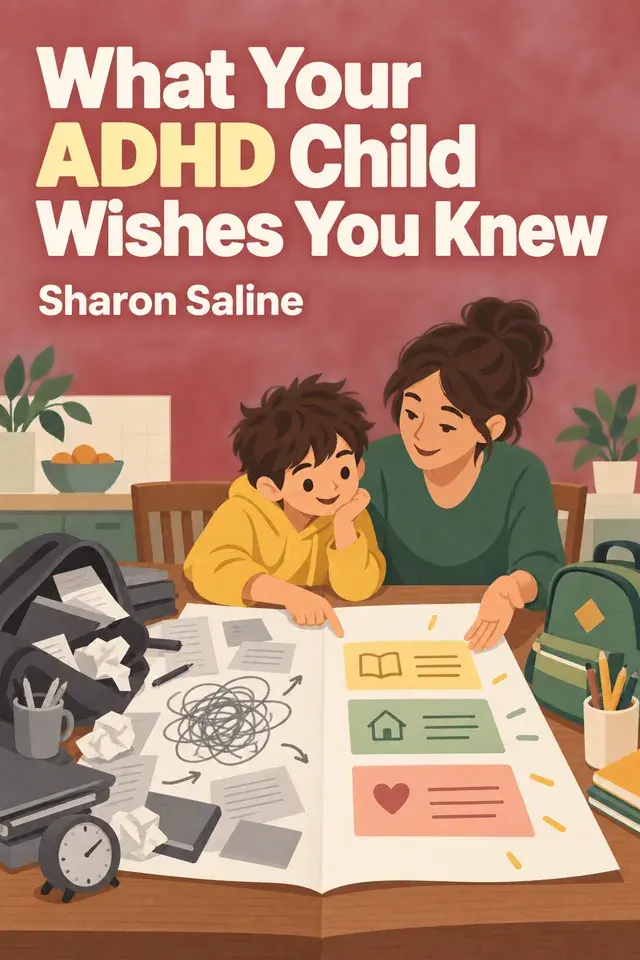
What Your ADHD Child Wishes You Knew, by Sharon Saline.
Sharon Saline’s guiding method is built around five connected practices: self-Control, Compassion, Collaboration, Consistency, and Celebration. Together, they offer parents a way to handle everyday difficulty while protecting the relationship. The aim is not simply to stop a behavior. It is to understand what is happening for the child, respond thoughtfully, and make room for learning and cooperation. Connection and skill-building become more likely when a parent can meet a child’s experience with steadiness and respect.
The foreword notes that the work of parenting can become harder as children grow. They face more tasks, greater independence, and more complex demands from school and peers, often without a parent beside them at every moment. Parents remain important allies and teachers, helping children build the skills they will need. That makes the way a parent responds during a difficult moment part of the teaching itself.
Saline asks parents to consider that a child’s repeated difficulty may reflect a skill the child cannot reliably use in that moment. Forgetting, impulsive actions, or losing focus do not automatically mean the child does not care or is choosing to make life harder. This perspective does not excuse every action. It encourages a parent to look for the concern or barrier underneath it before deciding what response will help.
Drew’s school-route conversation shows what can happen when that concern gets lost. Drew and his father had agreed to work out a route between classes. His father went further and began investigating Drew’s locker and belongings, criticizing what he found. The original concern about getting from class to class remained unanswered. The exchange escalated into shouting and a physical outburst, and Drew walked away angry that his concern had been ignored. The example shows how a parent can intend to help and still miss the child’s actual problem. Once the conversation turns into criticism, it is harder for either person to hear the other.
Self-Control is the parent’s effort to notice strong feelings before acting on them. Frustration, worry, and exhaustion can build through repeated reminders and setbacks. Saline suggests pausing, breathing, and checking what is happening inside before responding. This gives the parent a chance to choose words and actions instead of letting the first surge of emotion decide them. It can also show a child what it looks like to manage intense feelings.
That pause does not require a parent to be calm all the time. Saline treats self-control as an ongoing practice: parents will still become upset, and they can return to a more thoughtful response without berating themselves. Acknowledging a child’s feelings also does not mean giving up a necessary limit. The parent can recognize what the child is communicating, state what they observe, and keep the boundary while making space for a better conversation.
Compassion means trying to see the child as they are in that moment, including their feelings, abilities, and struggles. It asks the parent to resist reducing a difficult episode to a judgment about the child’s character. Compassion can be hard when behavior is frustrating, but it helps the parent look for what the child may need before moving straight to correction.
The panicked math-project example puts this into practice. A teen who has forgotten a project is overwhelmed and worried. The immediate response is to acknowledge that worry and help her slow down. Saline’s point is that calming and understanding the feeling can make later problem-solving possible. The parent and teen can discuss a plan after the panic has eased. Trying to solve everything while the child is flooded may add pressure when the child cannot yet take in suggestions.
Collaboration means treating a problem as something the parent and child can examine together. The parent listens to the child’s account, shares relevant observations, and invites ideas for a workable response. Being included can help a child feel respected and make it easier to take part in a plan. The parent does not have to ask endless questions or accept every suggestion; too much talking can feel like pressure, especially when the child has no answer yet.
The parent also keeps responsibility for necessary decisions. Collaboration does not mean that children set every household rule or that adults avoid direction. A parent may decide that a change is needed and retain the final say, while still hearing the child’s perspective and explaining the decision. The shared work is finding a way to handle the problem, not handing over the adult role.
Consistency is reliable follow-through on clear agreements. Children benefit when expectations and responses are predictable, but consistency does not mean that a family will carry out a plan perfectly every time. Setbacks are expected. The family can regroup and return to the agreed plan instead of treating one difficult day as proof that the effort has failed. That return to the plan is more useful than demanding flawless performance from either parent or child.
Flexibility can fit within consistency when an unexpected circumstance calls for a temporary exception. The parent can explain why the exception is being made and that it does not replace the usual agreement. By contrast, changing a limit simply because a child keeps pressing can make the agreement harder to trust. Saline’s approach pairs empathy for disappointment with follow-through on the boundary.
Celebration means noticing genuine effort and naming what went well. Saline favors feedback that is specific and tied to something the child actually did, rather than exaggerated or generic praise. For example, telling a child that getting ready for bed took only two reminders makes the success clear. This kind of attention helps balance the corrections children may hear repeatedly. The author also argues that positive experiences can take repetition and time to stick, so noticing progress is an ongoing part of the relationship.
The Five C’s work as a connected practice. A parent steadies themself, listens for the child’s experience, works with the child where possible, follows through on a realistic agreement, and recognizes sincere effort. None promises that conflict will disappear or that progress will be smooth. The framework gives parents a way to return to connection and useful problem-solving when a difficult moment interrupts both.
Chapter 2 of 9 · 11 min · Audio & textIn the app
Understanding the ADHD Profile
ADHD is a biologically based developmental condition, not the result of poor parenting. It involves persistent inattention, hyperactivity, or both when these interfere with a child’s functioning or development.
Chapter 3 of 9 · 9 min · Audio & textIn the app
Acceptance Through Listening and Partnership
Acceptance does not arrive automatically with a diagnosis. It develops as family members make sense of what ADHD means and find ways to live with it together.
Chapter 4 of 9 · 13 min · Audio & textIn the app
Making School Challenges Workable
School asks children to plan, organize, persist, and control impulses while doing work that may feel difficult or dull right now. A distant grade or future benefit may not be enough to make an unpleasant task feel manageable.
Chapter 5 of 9 · 9 min · Audio & textIn the app
Turning School Support into Independence
Once a learning difficulty has been identified, a useful next step is a plan that turns that understanding into repeatable actions. A child’s account matters because the same assignment can be manageable for one student and draining for another.
Chapter 6 of 9 · 10 min · Audio & textIn the app
Helping Big Feelings Become Manageable
Big feelings can arrive faster than a child can use what they know. The chapter describes perceived danger setting off the body’s fight-or-flight response before a child has time to think through the situation.
Chapter 7 of 9 · 8 min · Audio & textIn the app
Building Everyday Executive Skills
A household responsibility can become difficult before a child even begins. A task may seem too large, its steps may be hard to hold in mind, or the time needed may be unclear.
Chapter 8 of 9 · 8 min · Audio & textIn the app
Belonging, Boundaries, and Teen Choices
Friendship can be a source of comfort and confidence, but children with ADHD do not all experience it the same way. Some connect easily and have rewarding friendships; others feel awkward, lonely, or excluded.
Chapter 9 of 9 · 9 min · Audio & textIn the app
Screens, Transitions, and Lasting Hope
Technology is not simply a distraction to remove. For many young people with ADHD, screens offer stimulation, choice, and quick rewards.
Chapter 1 of 9 · 8 min · Audio & text: The Five C’s as Parenting Practice
Wiseley supports reading and listening to summaries in the app.
Continue in WiseleyAbout Sharon Saline

Sharon Saline is a clinical psychologist and author. “What Your ADHD Child Wishes You Knew” explores how parents can understand a child’s experience of ADHD and turn that understanding into practical support.
Explore more books by Sharon Saline