What you'll learn
Key ideas from What If? 2
These ideas compress the book's argument without treating the author's view as settled fact. Use them as an orientation before reading the full work or listening in Wiseley.
Playful questions can lead through serious science, even when their answers are not useful for anything.
Useful estimates state their assumptions and compare quantities in compatible units.
Structural scale adds loads, wind exposure, elevator space, and cost that a floor-counting exercise cannot capture.
Passive lenses can redirect light but cannot concentrate moonlight enough to exceed the source-temperature limit.
Written laws alone do not settle who a rule covers or how it applies at the edges.
Tire wear is dispersed through air, soil, water, and lungs; its footprint follows particle pathways rather than an even strip left on the road.
The proton-Earth and electron-Moon scenario pushes calculations far beyond tested physics, leaving its wider consequences uncertain.
Inside What If? 2
Read the first chapter in full here. The other 10 continue in the Wiseley app.
Chapter 1 of 11 · 3 min · Audio & text
Treat Absurd Questions Seriously
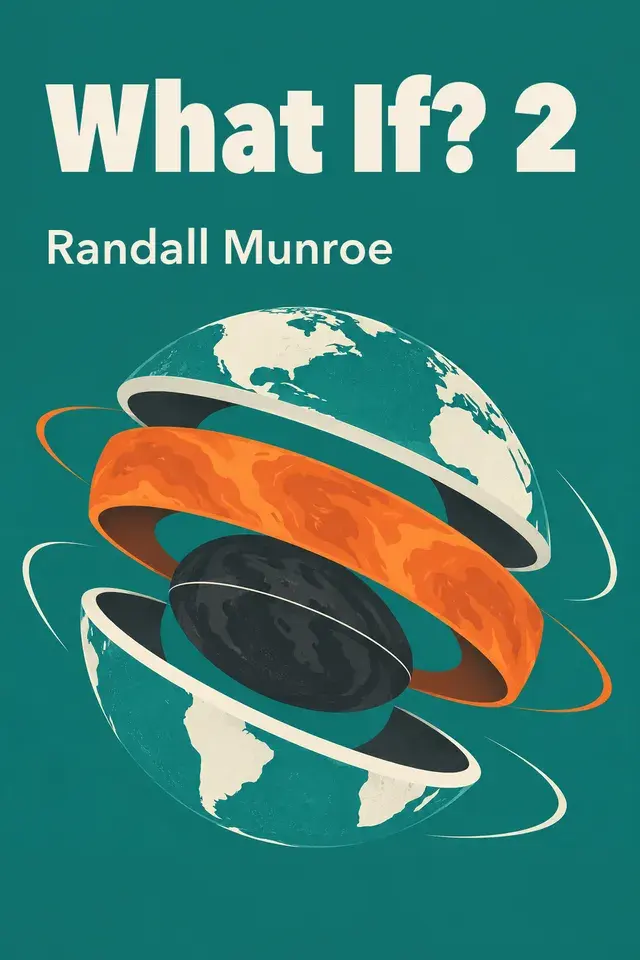
What If? 2, by Randall Munroe.
Some questions are strange enough that nobody is expected to know the answer. Randall Munroe says that is part of their appeal. When a question does not have an obvious answer, it is easier to admit confusion, take time to investigate, and enjoy the process instead of feeling that you should already know a basic fact.
He contrasts the pressure of being asked for an electron’s mass with the freedom of wondering how much all the electrons in a bottlenose dolphin weigh. The second question sounds ridiculous, but it can still be approached seriously: the answer is about half a pound. The point is not that every odd question hides an important discovery. It is that curiosity does not have to begin with a practical purpose, and not knowing the answer is a reasonable place to begin.
A familiar example shows both the reach and the limits of an explanation. After someone rubs a balloon on their hair, the hairs stand up. The usual account is that electrons move from the hair to the balloon, leaving the hairs with similar charges that repel one another. But the broader question of why electrons move from one material to another, rather than another, does not have a good general theory. The effect is studied, yet an explanation of one familiar result does not settle every question behind it.
That gap matters to the book’s way of thinking. A scientific answer can explain part of what happens while leaving another part unresolved. Uncertainty is not a reason to pretend the question has no answer, nor a license to make one up. It is a boundary to state clearly. Even a playful question can reveal where a familiar explanation works and where understanding remains incomplete.
The same science can connect seemingly silly questions with serious subjects. Triboelectric charging, the transfer of electrons between materials, matters to questions about how lightning forms. Counting the subatomic particles in an organism is also used in modeling radiation hazards. Even if the answers are not useful for anything, trying to answer silly questions can take you through some serious science.
Munroe compares the book’s weight with the combined electrons in two dolphins: information that probably isn’t useful for anything, but is fun to know. The pleasure comes from following a question far enough to see what can be worked out, what remains uncertain, and how the result changes one’s view of something familiar.
The questions in the book are thought experiments, not instructions to try anything described. Munroe explicitly warns readers not to try the scenarios at home and says he is not a health or safety expert. That qualification matters: exploring an idea on the page does not establish that acting it out would be safe.
The invitation, then, is to take an absurd question seriously without taking every answer—or every scenario—as settled or safe. Careful inquiry can make an outlandish question approachable, while honest limits keep curiosity from turning into false certainty.
Chapter 2 of 11 · 7 min · Audio & textIn the app
Follow the Forces and Energy
First impressions can be misleading when a hypothetical involves extreme size or temperature. The way through is to follow what interacts, what changes, and which effect takes over.
Chapter 3 of 11 · 9 min · Audio & textIn the app
Count Rates, Mass, and Time
An estimate becomes useful when it makes its assumptions visible. Start by choosing a quantity and units, then ask what rate creates or consumes it.
Chapter 4 of 11 · 8 min · Audio & textIn the app
Motion Has Its Own Limits
Motion can seem like a question of speed or strength. These examples show why the timing of a force, the moving air around an object, and the bodies that must withstand the motion all matter.
Chapter 5 of 11 · 10 min · Audio & textIn the app
Changing a World Changes Everything
At planetary scale, changing one property can make a different mechanism dominate. Removing Earth’s mass does not steadily make someone lighter.
Chapter 6 of 11 · 10 min · Audio & textIn the app
Engineering Meets Physical Boundaries
A billion-story building begins as a floor-counting exercise, but its first hard limit is the weight carried by each level. Every floor must support itself and all the floors above it.
Chapter 7 of 11 · 11 min · Audio & textIn the app
Bodies and Populations at Scale
Biological estimates change when we move from one body to a population or from a short span to many generations. Ancestors show why a family tree cannot be calculated by simply doubling the number of people in each generation.
Chapter 8 of 11 · 10 min · Audio & textIn the app
Light, Heat, and Seeing
Light can bend, spread, carry different kinds of energy, and arrive for different lengths of time. Those are separate questions.
Chapter 9 of 11 · 8 min · Audio & textIn the app
Rules, Ownership, and Value
Questions about laws, ownership, or money can look like counting problems: How large is a claim? How many stars lie above a country?
Chapter 10 of 11 · 9 min · Audio & textIn the app
Earth’s Systems Carry Consequences
A material rarely stays where it first appears. Tire rubber leaves a road, snow changes as it settles, and a change in rainfall can reach from rooftops to the atmosphere.
Chapter 11 of 11 · 10 min · Audio & textIn the app
Find the Edge of the Model
A strange question can still support careful reasoning, but not every calculation earns a prediction. Sometimes a familiar mechanism gives a useful estimate.
Chapter 1 of 11 · 3 min · Audio & text: Treat Absurd Questions Seriously
Wiseley supports reading and listening to summaries in the app.
Continue in WiseleyWhat What If? 2 is about
Randall Munroe tests absurd questions against physics, biology, engineering, and rough arithmetic. What happens when Earth spins once per second, Rome is built in a day, or candy replaces rain? The answers show how to state assumptions, estimate scale, follow consequences, and recognize when a scenario is uncertain or impossible.
About Randall Munroe
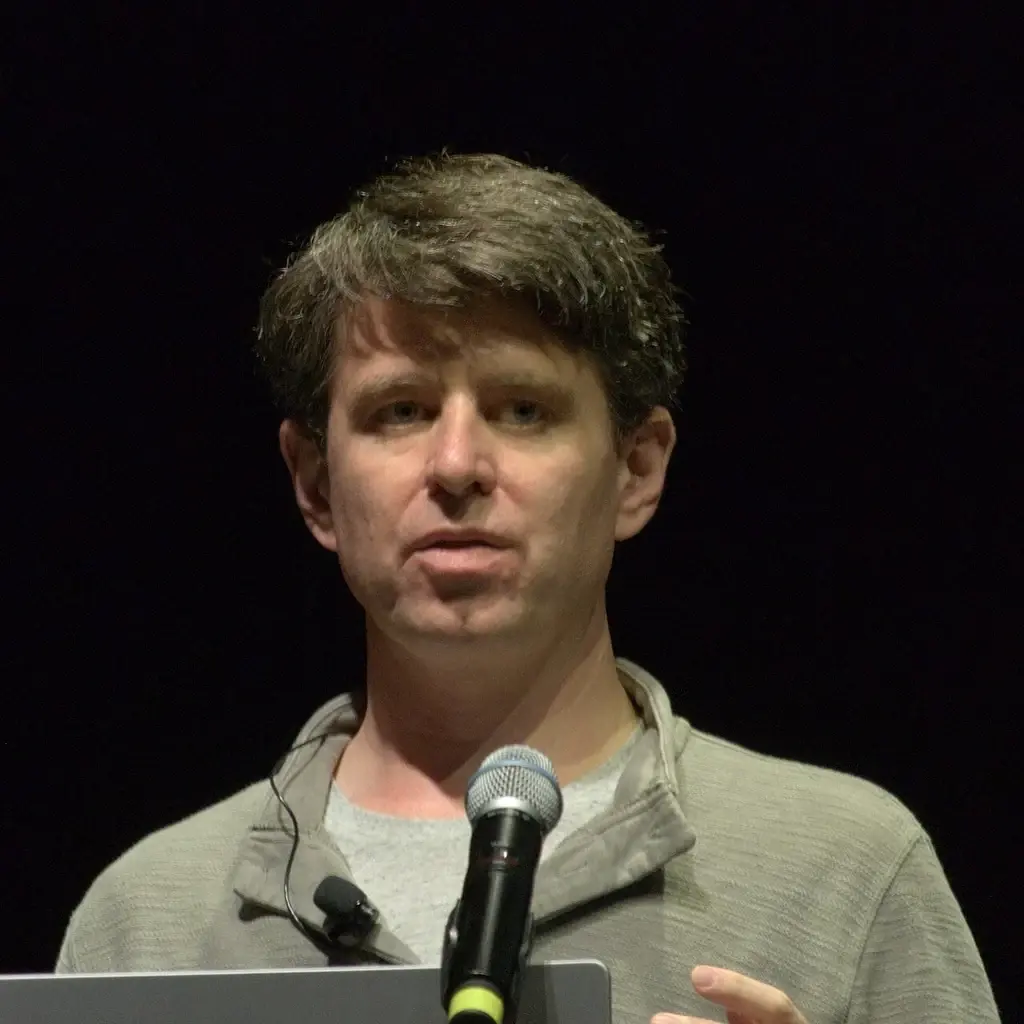
Randall Munroe is an American cartoonist and author. “What If? 2” explores absurd hypothetical questions tested against physics, biology, engineering, and rough arithmetic.
Explore more books by Randall Munroe