What you'll learn
Key ideas from What Happened to You?
These ideas compress the book's argument without treating the author's view as settled fact. Use them as an orientation before reading the full work or listening in Wiseley.
Rising threat shifts influence toward reactive systems, making cortical reflection harder to access.
Extreme, prolonged, or unpredictable activation can sensitize stress responses and raise developmental risks without determining outcomes.
The ACE score counts affirmative adversity categories, but it does not describe each experience’s pattern or meaning.
Connectedness is presented as a developmental influence that changes probabilities of health outcomes rather than determining any individual’s future.
The reward-bucket metaphor links daily regulation with the amount and variety of reward obtained from personally different sources.
The sequence places regulation and relational safety before reasoning when stress may limit access to cortical processing.
Inside What Happened to You?
Read the first chapter in full here. The other 3 continue in the Wiseley app.
Chapter 1 of 4 · 7 min · Audio & text
Why Stress Changes Our Responses
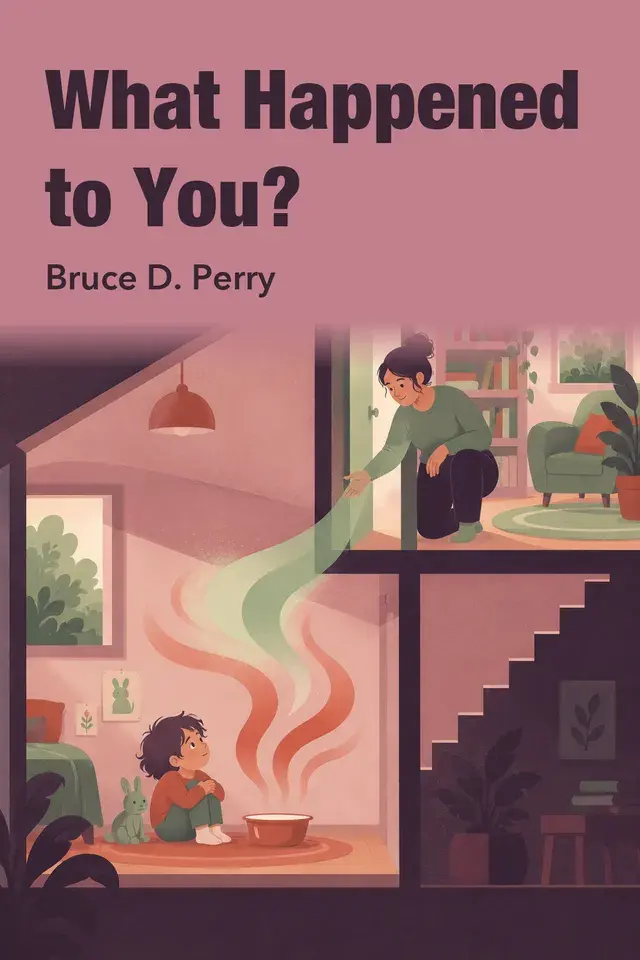
What Happened to You?, by Bruce D. Perry.
Perry starts with the moment a challenge arrives. A stressor pushes the system out of balance and activates an internal response aimed at restoring balance. When there are no significant stressors, basic needs such as hunger and thirst are met, and there is no external complexity or threat, the state is calm. As challenges and stress rise, the internal state shifts from alert toward terror. The sequence shown across the figures is calm, alert, alarm, fear, and terror. It describes changes in current functioning as stress changes. That makes the brain’s organization relevant: the question is not only what challenge occurred, but what internal state it produced.
The brain model underneath this sequence has four interconnected areas: the brainstem, diencephalon, limbic system, and cortex. Structural and functional complexity increases from the lower, simpler brainstem toward the cortex. This hierarchy does not describe four independent units; the areas are connected. It helps show which parts become dominant in a given state. The accompanying figure locates bodily functions such as respiration, cardiac activity, movement, temperature, sleep, and appetite lower in the organization, with functions such as emotion, memory, bonding, language, abstract thought, and reflection represented higher up.
The cortex supports speech and language, abstract cognition, reflecting on the past, and envisioning the future. When calm, a person can use these more complex functions to reflect and create. Under threat, the cortex becomes less dominant and more reactive parts begin to take over. This is a shift in relative control across connected systems, with changing access to functions. Fear shuts down many cortical systems. The figure also traces cognition from abstract and creative, through concrete and routine, toward emotional, reactive, and reflexive. Problem-solving capacity and a person’s sphere of concern shift along with that change.
Figure 5 compares the degree of stress with the resulting internal state. In someone with neurotypical stress-response systems, there is a linear relationship: as stress rises, the state shifts proportionally. A moderate stressor produces proportional activation and active alertness. The person is more activated than in calm, but this example is active alert, not fear. The figure draws a different, steeper curve for a sensitized stress response and attributes it to a history of trauma. Under that sensitized condition, even the most basic daily challenges will induce fear. A person with this response will respond to moderate stress with terror.
Consider two people meeting comparable demands. The neurotypical pattern predicts proportionate activation; at a moderate stress level, the internal state is active alert. With sensitization, the mapping changes sharply: a basic daily challenge will induce fear, and moderate stress will produce terror. The external category of demand is only one part of the comparison. The same level of stress does not guarantee the same internal state when the response curves differ. The figure shows a different relationship between challenge and response in each system, not merely different labels for the same degree of distress.
Keeping demand and response separate clarifies the contrast. Moderate stress describes the challenge, while active alert and terror name internal states that follow from the response pattern. One person can remain in active alert at a level of stress that brings another into a more threatened state. That difference affects thinking. At active alert, cortical systems supporting language, abstract thought, reflection, and imagining what comes next have greater influence. As perceived threat rises, the diencephalon and brainstem gain greater control; fear shuts down many cortical systems. Thinking may become more concrete and then emotional, reactive, or reflexive, with problem-solving capacity and sphere of concern shifting as well. The figures tie these differences in access to current state.
The state model also applies within one person. In calm, the cortex is more available for reflection and creation. As the state moves toward fear, the cortex becomes less dominant, and reflective functions are harder to access. This does not mean reflection has permanently disappeared. The source describes state-dependent functioning: all brain functioning depends on the state a person is in, and functions can shift as the state changes.
The behavior table adds two broad adaptive patterns, arousal and dissociation. It says adaptive behaviors differ depending on which pattern dominates for an individual during a stressful or traumatic event. The model connects current state not only to cognition, but also to different adaptive options. A person’s behavior can therefore be understood in relation to the state and response pattern active at that moment, while the same person may function differently in another state.
The source attributes the sensitized response to a history of trauma. As an editorial limit on applying this comparison to an individual, a strong reaction alone does not establish that person’s trauma history. That is a caution about inference, not a rule stated by the figure. The figures’ focus here is the relationship between challenge, internal state, and access to brain functions.
Chapter 2 of 4 · 10 min · Audio & textIn the app
How Experience Shapes Stress Systems
Experience shapes stress systems through pattern, not merely through presence. Stress, in this account, is a demand on one or more physiological systems.
Chapter 3 of 4 · 7 min · Audio & textIn the app
Connection and Everyday Sources of Reward
Support appears here in two related but distinct forms. Connectedness helps shape developmental risk over time.
Chapter 4 of 4 · 9 min · Audio & textIn the app
Regulate, Relate, Then Reason
When a person is frightened or overwhelmed, a request for an explanation can be reasonable but mistimed. The practical sequence offered here is regulate, relate, then reason.
Chapter 1 of 4 · 7 min · Audio & text: Why Stress Changes Our Responses
Wiseley supports reading and listening to summaries in the app.
Continue in WiseleyWhat What Happened to You? is about
How do stress and relationships shape our responses to everyday life? This summary explores how adversity affects regulation, why connectedness matters, and how calming the body and establishing connection can make reasoning and learning more accessible. It offers a framework for understanding reactions in the context of experience.