What you'll learn
Key ideas from We Need to Talk
These ideas compress the book's argument without treating the author's view as settled fact. Use them as an orientation before reading the full work or listening in Wiseley.
Improvement begins when people examine their own contribution instead of explaining every failed exchange through the other person’s behavior.
Curiosity seeks the context behind another person’s beliefs; agreement is not the measure of a useful exchange.
A distracted person can put devices away and recommit, or explain the constraint and defer the conversation.
Shift responses center the listener; supportive responses acknowledge the speaker and give them room to continue.
Constructive disagreement addresses tensions early, focuses on solutions, and does not require a declared winner.
Open questions let people describe their experience in their own terms, while closed questions efficiently establish quick facts.
Active listening combines understanding, response, retention, attention to verbal and nonverbal cues, clarification, and mental summaries.
Inside We Need to Talk
Read the first chapter in full here. The other 9 continue in the Wiseley app.
Chapter 1 of 10 · 8 min · Audio & text
Conversation as Human Infrastructure
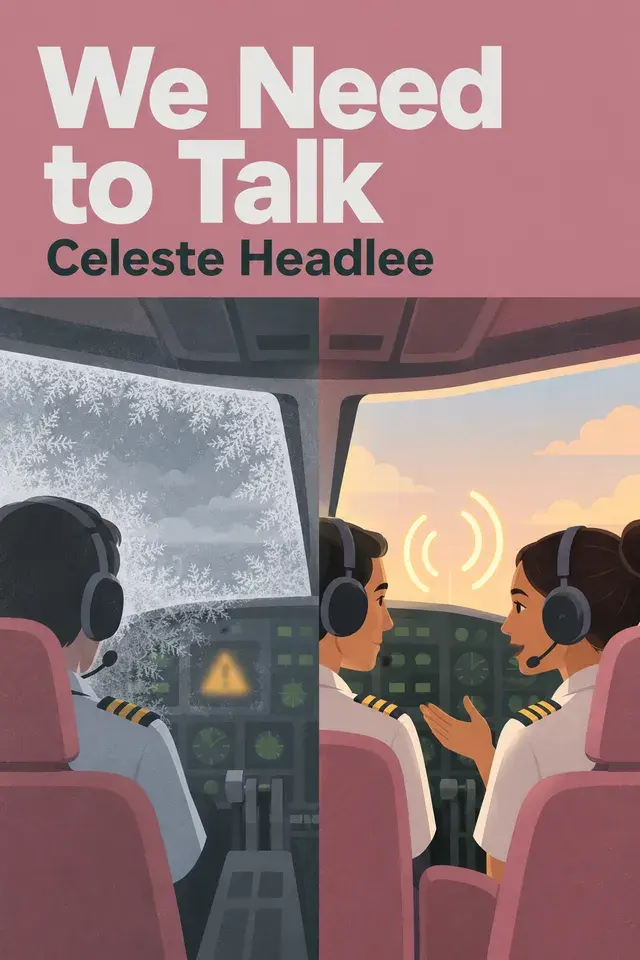
We Need to Talk, by Celeste Headlee.
Conversation can seem like an ordinary part of the day: something people do between more important tasks. Celeste Headlee asks us to see it at a more basic scale. People depend on language to coordinate, share what they know, build trust, and make plans together. When an exchange breaks down, the consequences can reach far beyond awkwardness. They can affect safety, care, and the ability to work together.
Language lets people describe more than what is happening in front of them. They can explain what happened earlier, what might happen next, what caused a problem, or how to carry out a task. People can share practical knowledge across time and distance, negotiate terms, and make trade possible by explaining what they can offer and what they expect in return. Trade depends on goods, but it also depends on people being able to establish enough trust to agree on the exchange.
Headlee connects these abilities to human survival and cooperation. Conversation gives people a way to pool knowledge and coordinate action beyond what one person could manage alone. It also lets them express an experience with precision: not just that something hurts, for example, but how, when, and how badly. Those distinctions can matter when others need to understand a situation and respond.
The origins of language remain uncertain. The book describes several theories, including the idea that language helped people trade and establish trust, and the possibility that it evolved as part of mating. Headlee is especially drawn to Shigeru Miyagawa’s theory, which combines meaningful units associated with animal gestures and the expressive quality of birdsong. On this account, humans may have sung before they spoke. It is an intriguing explanation, not a settled account of how language began. The exact chronology is debated, too.
The larger point does not depend on choosing one origin story. Whatever path language took, it now allows people to pass along experience, explain dangers, and decide what to do together. Those abilities can support daily cooperation, but they also matter in settings where a mistake can be irreversible. Headlee turns to a cockpit recording to show what such a failure can look like.
Air Florida Flight 90 was delayed in winter weather. The captain had to choose whether to de-ice again or depart, and the plane took off forty-nine minutes after de-icing. During the exchange, the first officer repeatedly noticed or questioned ice and the aircraft’s performance. His concerns came through hesitantly, without producing a clear decision to stop or correct course. The pilots did not realize that ice had made their instrument readings unreliable, and the captain had not turned on the engine heaters.
Flight 90 struck the Fourteenth Street Bridge and fell into the Potomac River. Seventy-eight people died; five survived. The crash raised concrete questions about de-icing, cold-weather equipment, and instrument readings. Investigators and safety experts also studied the cockpit conversation. Many communication experts concluded that the copilot needed to be more direct. Headlee emphasizes the other side of the exchange: the captain needed to listen better. Her point is not that conversation alone explains the crash. Rather, the recording shows how a warning can be present without becoming a shared understanding that changes what people do.
The same dependence appears in Headlee’s own radio work, in a very different situation. Two days after the massive earthquake in Haiti, she spoke on air with Mallery Thurlow, who was in Michigan and had been trying for two days to reach her fiancé, France Neptune, in Port-au-Prince. The production staff tracked him down and brought them both on air; the couple heard each other for the first time since the earthquake. Headlee focused on the segment she had planned and the story she intended to tell. During the broadcast, France told Mallery that her young godchild had died in the collapse of a school building. Headlee did not respond to the moment as a disclosure that called for care; she stayed oriented toward the planned program. The broadcast drew complaints. Looking back, she believes she should have ended the segment and allowed the couple privacy.
The error was not simply a poorly chosen sentence. Headlee had mistaken the prepared topic for the whole conversation. The situation had changed, but her attention remained with her plan. Her account shows how a host can continue speaking while missing what the other people in the exchange are experiencing. In this case, the human cost was immediate and personal: news of a death became part of a live broadcast instead of being met with privacy.
In hospitals, the stakes can also involve how people pass along information. Headlee cites a count of 1,744 deaths linked to communication failures in the United States from 2009 to 2013. Those cases involved problems such as shift handoffs, chart review, and communication with patients and families. The count is limited: it covers cases tracked through malpractice suits, not every instance in which communication may have contributed to harm. Even with that qualification, it illustrates why clear exchanges and reliable handoffs are part of patient safety.
Headlee also makes an economic case. She cites an estimate that poor communication costs businesses about thirty-seven billion dollars a year, or more than twenty-six thousand dollars per worker in the calculation. That estimate covers companies with more than one hundred employees, so it should not be treated as a universal total for every employer. For hospitals, the book cites research estimating about twelve billion dollars in annual communication inefficiencies, with more than half attributed to extra patient days when information is not shared clearly or promptly. These figures are estimates drawn from particular research and scopes, rather than exact prices for each misunderstanding.
The examples point to the same underlying dependence. Organizations rely on people to communicate what they see, understand what others report, and coordinate what happens next. A missed warning can put lives at risk; a missed disclosure can expose someone’s grief; information that fails to reach the right person can waste time and money. Conversation is human infrastructure because so much of people’s shared work rests on exchanging knowledge and responding to one another. Before considering particular ways to improve an exchange, it helps to recognize how much depends on that exchange working at all.
Chapter 2 of 10 · 5 min · Audio & textIn the app
Connection Needs More Than Communication
When people say they have communicated, they may mean that information has moved from one person to another. Celeste Headlee draws a sharper line between that exchange and conversation.
Chapter 3 of 10 · 8 min · Audio & textIn the app
Own Your Part and Prepare
When a conversation goes badly, it is easy to focus on what the other person did: they talked too much, went quiet, repeated themselves, or seemed dull. Headlee asks readers to look at their own contribution as well.
Chapter 4 of 10 · 10 min · Audio & textIn the app
Enter Difficult Conversations Curiously
Hard conversations can feel risky. Race, politics, religion, death, and other sensitive subjects can bring anger or hurt.
Chapter 5 of 10 · 9 min · Audio & textIn the app
Train Attention, Choose to Engage
The habits Headlee proposes are skills to practice, not lines to memorize. Changing longstanding habits takes time, so she advises patience and starting with one manageable skill.
Chapter 6 of 10 · 8 min · Audio & textIn the app
Let Another Experience Stay Theirs
Empathy can begin with a sincere wish to say, “I know how that feels.” But when we answer someone’s story with our own, the conversation can quietly turn toward us.
Chapter 7 of 10 · 7 min · Audio & textIn the app
Disagree Without Taking the Soapbox
Headlee's counsel about disagreement begins with resisting the urge to use a conversation as a platform for a lesson. Personal experience does not automatically make someone qualified to advise another person.
Chapter 8 of 10 · 11 min · Audio & textIn the app
Use Words with Care
Careful conversation depends partly on what we say and partly on how much we say it. A clear point can lose force when it is buried in extra words, and a sound point can become harder to hear when it is repeated without adding anything.
Chapter 9 of 10 · 8 min · Audio & textIn the app
Ask, Admit, and Stay Relevant
A useful conversation depends on three habits working together: asking questions that let people explain what they know, admitting where your own knowledge ends, and keeping details connected to the point. Each habit makes it easier for the exchange to move somewhere meaningful.
Chapter 10 of 10 · 9 min · Audio & textIn the app
Listen Deeply and Restore Attention
Listening is more than hearing words. It means staying with another person’s meaning instead of answering a different question in your own mind.
Chapter 1 of 10 · 8 min · Audio & text: Conversation as Human Infrastructure
Wiseley supports reading and listening to summaries in the app.
Continue in WiseleyAbout Celeste Headlee

Celeste Headlee is an American journalist. “We Need to Talk” explores conversation as a learnable skill that distraction and self-focus can erode.
Explore more books by Celeste Headlee