What you'll learn
Key ideas from We Are the Weather
These ideas compress the book's argument without treating the author's view as settled fact. Use them as an orientation before reading the full work or listening in Wiseley.
Accepting evidence intellectually does not ensure that its implications feel real enough to guide action.
Collective participation can begin before enthusiasm and may strengthen the identity and feelings connected to an activity.
A shift in social norms can make participation ordinary, while organized pressure can turn shared demands into institutional policy.
Foer’s before-dinner rule is a partial daily dietary change that belongs alongside wider emissions cuts.
Ecological footprints vary with consumption patterns, so humanity’s resource demand cannot be understood as evenly shared.
Protecting Earth needs engineering and law, alongside less food waste, girls’ education, family planning, reproductive healthcare, and plant-rich eating.
Hope is an unreliable prerequisite for action; effort and continued conversation can persist amid uncertainty.
Personal behavior helps reproduce or shift norms, even though individual choices alone cannot dismantle powerful systems.
Inside We Are the Weather
Read the first chapter in full here. The other 10 continue in the Wiseley app.
Chapter 1 of 11 · 7 min · Audio & text
Why Knowledge Fails to Become Belief
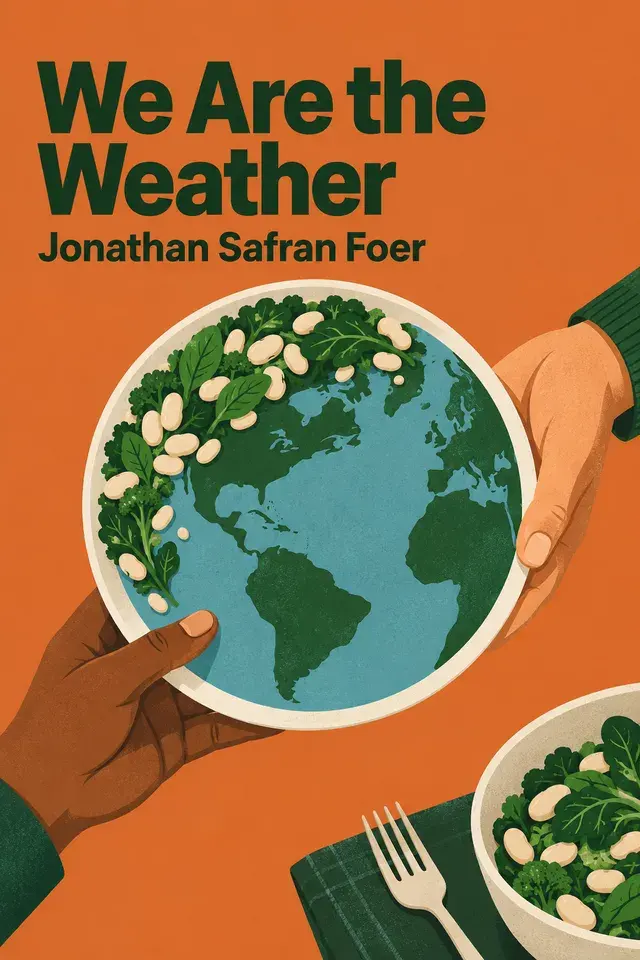
We Are the Weather, by Jonathan Safran Foer.
Foer begins with the strange confidence of memory. As a child, he imagined that every breath carried molecules from Julius Caesar’s last exhalation, joining ordinary life to distant history. Later, he learned that the book he remembered, The Book of Endings, did not exist. He found instead Panati’s Extraordinary Endings of Practically Everything and Everybody, which contained some details he recalled but not Caesar’s final breath or the “Dispute with the Soul” account; he must have learned those elsewhere. The memory had become a story of its own. What feels vivid and coherent can shape us, but a fact’s presence in memory does not ensure that its meaning has reached us.
That gap matters when the danger is real but hard to feel. Climate change brings stronger storms, rising seas, drought, fires, and losses of forests and species. Yet these harms unfold across different places and times. People can know about them and still experience them as remote, disconnected events. Foer calls this a crisis of belief: the distance between accepting that a threat exists and feeling involved enough to respond.
Stories help close that distance by giving events a shape. Many memorable stories have clear protagonists, conflict, turning points, and conclusions. Climate change resists that form. It is incremental and complex, with many causes and consequences rather than one villain or one decisive moment. Apocalyptic tales may make it more dramatic, but they can misrepresent how the crisis develops. The trouble is not that climate impacts are always invisible. A particular fire or flood can be vivid. The difficulty is that many separate impacts may not add up, emotionally, to one worsening story.
Foer contrasts this difficulty with the shared story of the Second World War home front. Civilians accepted rationing, higher taxes, speed limits, blackouts, and other constraints. Factories changed production, new groups entered the workforce, and people gathered materials. President Roosevelt described daily work and self-denial as part of a common front, supporting those who fought and the country’s security. A sacrifice that might otherwise feel like an arbitrary inconvenience could make sense as solidarity in a struggle to save lives and a way of life. Foer does not claim that civilian sacrifice alone won the war. It was one part of a much larger effort.
The civil-rights movement shows another side of storytelling: a memorable public story can help people act, while leaving some people outside its frame. The familiar account centers on Rosa Parks, who refused to give up her bus seat. Claudette Colvin had done so nine months earlier. Parks was an experienced activist who helped strategize. Colvin was fifteen, poor, and pregnant by an older married man. Movement leaders judged her biography and character unsuitable for the public role they wanted.
The resulting story was not simply false. Parks’s act was real, and she was heroic as both a participant and someone who understood how a story could shape history. But the popular account simplified a more complicated event into a clear scene of refusal. Its famous photograph was staged. That crafted public image made the episode easier to remember and helped give it force. It also shows the cost of a heroic plot: people whose lives do not fit the preferred image can be excluded, even when their actions matter.
Climate offers fewer such handles. It has no single central character whose decision stands for the whole crisis. Our attention also favors nearby, immediate concerns and suffering that is identifiable or visibly worsening. Even when each climate disaster is concrete, their accumulated pattern can feel abstract. The mind can register the evidence without feeling the pull that comes from a clear, local story. Waiting for that feeling to arrive on its own may mean waiting too long.
Jan Karski’s testimony makes the difference between hearing and believing stark. During the war, he traveled from occupied Poland to alert leaders in the West to Nazi persecution and extermination, carrying accounts gathered from resistance groups. In 1943, after hearing him, Felix Frankfurter said he could not believe the account. He did not accuse Karski of lying or dispute his truthfulness. He was describing a limit in his own capacity to accept what he had heard. The testimony reached him as information, but it did not become a conviction that shook his conscience into action.
Foer’s grandmother’s escape gives the same problem a family scale. At twenty, in 1941, she fled her Polish village as Nazi forces approached, leaving close family behind. Her mother knew what she knew, yet stayed. Her younger sister followed and gave her shoes, saying she was lucky to be leaving. Foer resists turning that difference into a verdict on courage. Those who remained may have believed that the coming danger would resemble dangers they had already survived. Chance and circumstance also shaped who left.
Foer sees the uncomfortable resemblance to his own response to climate change. He could imagine rebuking those who stayed, then recognize that he too can accept evidence without letting it govern his life. His grandmother’s story does not prove that a better argument can force belief into existence. Instead, it shows how hearing, believing, and acting can separate, even when the stakes are grave. Climate knowledge often remains emotionally remote because a slow, distributed crisis is difficult to hold in one story. Until it becomes more than an acknowledged fact, understanding alone may leave people feeling untouched by what they know.
Chapter 2 of 11 · 7 min · Audio & textIn the app
When Action Comes Before Feeling
An action plan that depends on everyone first feeling alarm is fragile. Foer turns from the gap between knowing and feeling to a practical question: how can people act when concern is weak?
Chapter 3 of 11 · 7 min · Audio & textIn the app
How Many Actions Change Norms
Foer shifts from what one person does to how contributions reinforce one another, changing what a community expects and what institutions allow. No one explains a movement’s outcome alone, but each contribution can matter as part of the chain.
Chapter 4 of 11 · 7 min · Audio & textIn the app
Food Choices in a Warming World
The climate argument about food begins with more than one source of warming. Greenhouse gases trap some of the heat that would otherwise escape from Earth.
Chapter 5 of 11 · 7 min · Audio & textIn the app
Learning to See Our Home
Percival Lowell mapped canals across Mars and defended his observations, though other astronomers could not see the same features. The word Schiaparelli had used for Martian channels meant natural waterways, but it was translated into English as canals.
Chapter 6 of 11 · 6 min · Audio & textIn the app
No Escape from Earthly Responsibility
A second home beyond Earth can sound like a way to protect humanity’s future. Stephen Hawking and Elon Musk have argued for colonizing space, and Foer allows that another Earth might someday be necessary.
Chapter 7 of 11 · 9 min · Audio & textIn the app
Acting Without Hope or Certainty
Climate conversations often end with a question about whether anyone is hopeful. Foer thinks that question can let the subject disappear, whichever answer a person gives.
Chapter 8 of 11 · 6 min · Audio & textIn the app
Finite Resources, Fragile Memory
Foer begins with a family story that makes resourcefulness look both extraordinary and finite. His grandfather was warned that his family had been murdered and urged to flee.
Chapter 9 of 11 · 5 min · Audio & textIn the app
Agency Within Shared Systems
Foer takes seriously the argument that one person’s choices cannot dismantle industries or change public policy. But he rejects the conclusion that personal behavior is therefore irrelevant.
Chapter 10 of 11 · 7 min · Audio & textIn the app
Choosing Life Across Generations
At the close, Foer turns from trying to persuade strangers to speaking to his sons. The shift brings the climate argument into family life: the question is not only what will happen to the world, but who will be able to live in it and what they will inherit.
Chapter 11 of 11 · 7 min · Audio & textIn the app
What Livestock Emissions Count
A single percentage can make a complex climate argument easy to grasp, but it can also hide how the number was built. In the appendix, Foer treats livestock’s share of emissions as a kind of super-statistic: a compact figure standing in for many questions about land, gases, and what belongs in the account.
Chapter 1 of 11 · 7 min · Audio & text: Why Knowledge Fails to Become Belief
Wiseley supports reading and listening to summaries in the app.
Continue in WiseleyAbout Jonathan Safran Foer

Jonathan Safran Foer is an American novelist. “We Are the Weather” explores why climate knowledge so often fails to change behavior and what food choices have to do with it.
Explore more books by Jonathan Safran Foer