What you'll learn
Key ideas from We Are All Weird
These ideas compress the book's argument without treating the author's view as settled fact. Use them as an orientation before reading the full work or listening in Wiseley.
Mass systems targeted average demand, then helped turn a statistical middle into a cultural expectation.
Godin defines weird as a chosen departure from mass expectations, often seeking acceptance from a chosen group; unchosen traits are not the same.
Niche markets and connected communities reinforce specialized interests through creation, products, discussion, and feedback.
Abundant supply lets specialized goods reach beyond tiny circles and influence what mainstream producers offer.
Institutions gain predictability by turning an average into a standard, and compliance can reinforce the power that standard supports.
Organizations become relevant by fitting a particular community with genuine value and earning its trust.
Inside We Are All Weird
Read the first chapter in full here. The other 4 continue in the Wiseley app.
Chapter 1 of 5 · 6 min · Audio & text
How Mass Made Normal
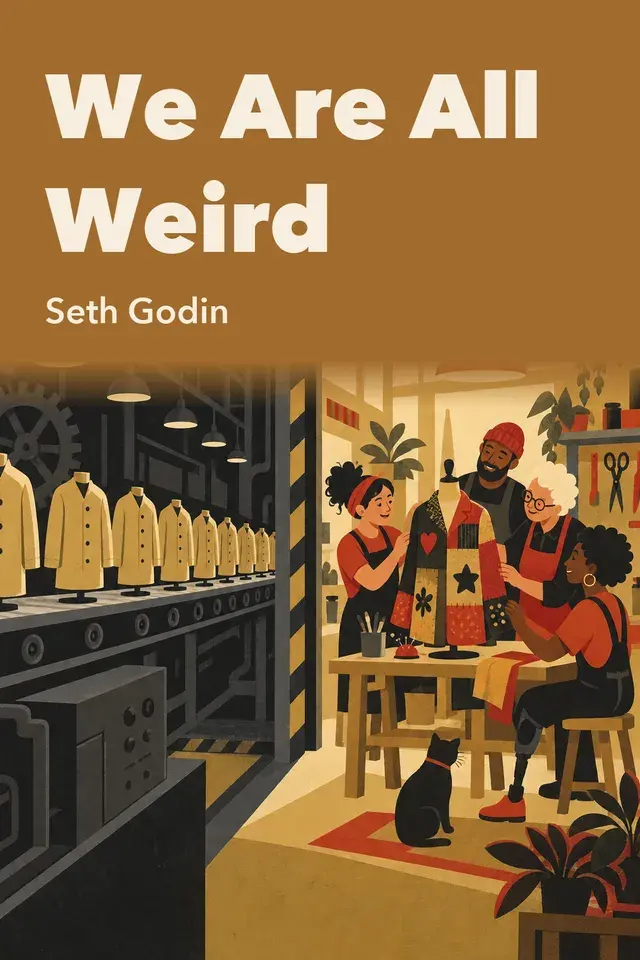
We Are All Weird, by Seth Godin.
In Godin’s account, mass became more than many buyers purchasing at once. It began with organizations seeking efficient systems. Factories and institutions were designed for repeatable operation before a mass market was fully in place. Once production was organized around repetition, a standard offer could reach many more people than a separate design for each customer. Most organizations could not afford to make a distinct product for every user, so they planned around average demand. Marketing then encouraged people to want what those systems already made. Mass did not simply discover a natural common preference; it also shaped demand toward what could be produced in bulk. A practical business choice came to feel like a description of everybody.
Mass media extended this pattern by addressing a broad public as if it were a shared audience. A statistical average can summarize a distribution, but it does not describe every person in it. Godin argues that marketers helped turn “normal” from a statistical description into a cultural expectation. The middle began to look like the standard everyone should meet. Yet normality depends on context. What feels ordinary in one neighborhood or community may be unusual somewhere else. The word can name a local expectation, but it cannot serve as a timeless account of what all people are like.
The contrast between Manhattan’s East Village and Fifth Avenue makes that difference concrete. The East Village appears as a meeting place for varied religious, culinary, artistic, and social identities, with businesses serving particular interests. Its ordinary life is shaped by that mix. Fifth Avenue presents another kind of audience. Tourist-oriented chains, including Abercrombie and Tiffany’s, offer familiar products, but their appeal can include the experience of shopping there, taking home a souvenir, or associating oneself with elite status. Standardized goods can draw broad demand even when the reasons people want them are not identical. These streets show that a city can contain different versions of normal at once. The statistical middle does not erase local variety.
The Belgian zoo’s pregnant elephant shows both the pull of mass attention and its limits. The ad agency put a sonogram of the baby elephant on YouTube and ran polls and contests about whether it would be a girl or a boy. Attention followed, and the zoo’s attendance climbed. For a time, an unusual story gave a wide public something to follow together. But the event depended on being unusual. It was an exceptional burst of attention, not a dependable formula that could be repeated whenever the zoo needed a crowd. Mass reach remained possible; what became less predictable was the ability to summon the public around an ordinary offer. A large crowd could still gather without proving that mass had regained its former organizing power.
Godin uses “weird” to mean a chosen departure from mass expectations. A person chooses what to believe or do instead of automatically following the checklist marketers want people to follow. This definition matters because not every difference is a choice. A trait present from birth, or a difference rooted in someone’s physical nature, is not the chosen stance he is describing. Seeing a difference does not tell us whether someone chose it. Weirdness, in this account, is about the decision, not simply about standing apart.
Choosing differently does not mean wanting no acceptance or belonging. People may still want recognition, but from a group whose judgment matters to them rather than from everyone. They give up some of the comfort and efficiency of fitting the mass in exchange for belonging where their difference is understood. So weird does not mean lonely, and it is not a label for every person outside an average. It names a deliberate choice to depart from what mass culture presents as normal.
Mass also brought real gains. Standardized systems made production more efficient and productive, made some people rich, and gave powerful people and organizations considerable reach and influence. They helped large societies operate. When many people can use the same product, making it in bulk can serve shared needs efficiently. These benefits explain why mass remains attractive. Its limit is the assumption that people are alike enough for one common offer to fit them all. An average can be useful for planning, but it cannot stand in for every person’s needs or preferences. When the average becomes a universal standard, variation starts to look like a defect, and the pressure shifts toward making people conform to the offer instead of respecting their differences.
Godin says mass as the engine of our culture is gone forever. That does not mean broad products, large audiences, or exceptional mass-market successes disappear. Fifth Avenue’s stores still attract buyers, and the elephant’s unusual story drew a crowd. Success like the zoo’s is rare, though; it does not mark a return to mass as culture’s organizing engine. Mass once made the statistical middle seem universal; weird names the deliberate choice to step away from that expectation.
Chapter 2 of 5 · 7 min · Audio & textIn the app
Four Forces That Reinforce Difference
Four forces reinforce one another: more people can create and publish; greater security gives some people room to choose; niche marketing helps specialized interests find an audience; and connected groups make those interests easier to sustain. Together, they help culture move in many directions instead of organizing around one central taste.
Chapter 3 of 5 · 7 min · Audio & textIn the app
Markets Move Toward the Edges
Once mass no longer organizes culture, the change appears in what can be made, offered, and communicated. Fishing shows how a market can grow around new kinds of choice.
Chapter 4 of 5 · 9 min · Audio & textIn the app
The Power Behind Normal
An average describes where many people fall in a distribution. It does not, by itself, say how anyone ought to behave.
Chapter 5 of 5 · 6 min · Audio & textIn the app
Serve a Chosen Tribe
The practical question is: who is this for, and what would genuinely matter to them? People tend to dislike communication that has no relevance to their lives.
Chapter 1 of 5 · 6 min · Audio & text: How Mass Made Normal
Wiseley supports reading and listening to summaries in the app.
Continue in WiseleyWhat We Are All Weird is about
How did industrial society make one version of “normal” seem universal, and what changes when people can choose differently? Seth Godin traces the shift from mass production and media toward online creation, specialized markets, and connected tribes, then examines the power that enforces conformity. The book offers a framework for serving particular communities while preserving choice and meaningful difference.
About Seth Godin

Seth Godin is an American author and entrepreneur who writes about marketing, creativity, and work. His books include Purple Cow, Linchpin, and This Is Marketing.
Explore more books by Seth Godin