What you'll learn
Key ideas from Visual Thinking
These ideas compress the book's argument without treating the author's view as settled fact. Use them as an orientation before reading the full work or listening in Wiseley.
People think in pictures of objects, spatial patterns, or words; object and spatial visualization are visual modes, while verbal thought is distinct.
Hands-on and contextual learning can reveal abilities that a narrow, test-led curriculum may leave unseen.
Labels can clarify support needs or narrow expectations, so a diagnosis alone does not establish a person’s abilities.
Innovation connects imagining, calculation, prototyping, testing, construction, and maintenance.
Genetic influence interacts with development, experience, and training; inherited traits do not dictate a person’s abilities or future.
Failure analysis gains clarity by tracing how design, records, maintenance, environmental conditions, and operator information interact.
Animal minds can be studied through species-specific senses, natural observation, and flexible behavior, even without verbal reports.
Communities rely on people who notice infrastructure problems and support inspection, repair, and continuing maintenance.
Inside Visual Thinking
Read the first chapter in full here. The other 7 continue in the Wiseley app.
Chapter 1 of 8 · 6 min · Audio & text
Three Ways of Seeing
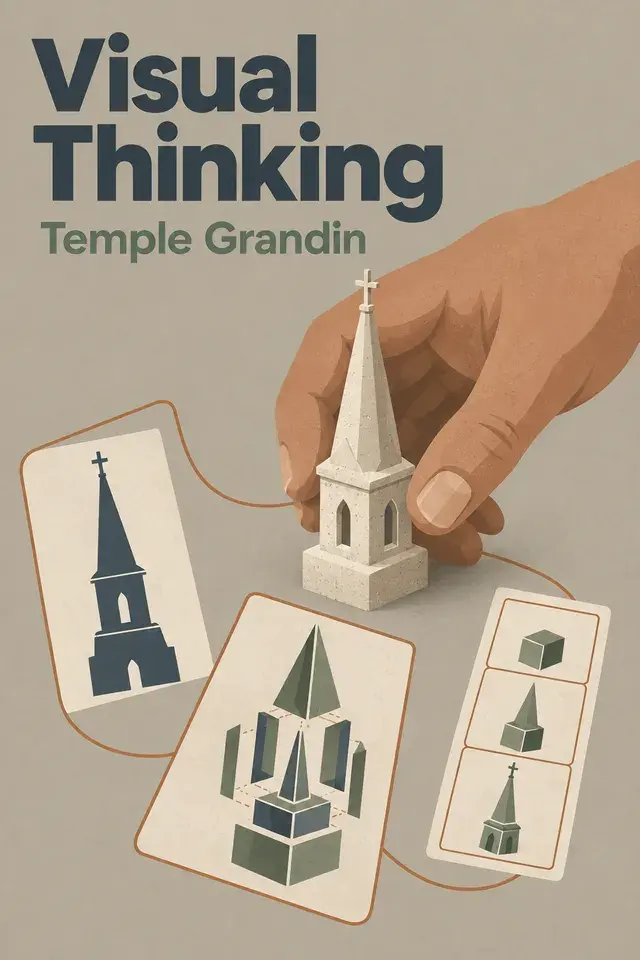
Visual Thinking, by Temple Grandin.
People do not all think in the same format. Temple Grandin makes a distinction that can be easy to miss: visual thinking describes how someone processes information, not how well their eyes see. Her experience as an autistic person led her to ask whether others also thought in pictures. But autism does not dictate a single thinking style. Grandin later corrects her early assumption that all autistic people are visual thinkers; some are highly verbal.
She describes three broad ways of organizing thought. Object visualizers retrieve concrete, often detailed pictures of things. Spatial visualizers notice patterns, relationships, and abstract arrangements among objects or numbers. Verbal thinkers rely more on words and sequence, building explanations in an ordered line. These are useful tendencies rather than sealed categories: a person can use all three, though one route may come more naturally. Grandin presents object and spatial visualization as different strengths, not a scale from less to more intelligent. One thinker may picture a train’s parts; another may grasp the relationships that make it run, while language helps explain and sequence what is known.
Grandin explores these differences by asking people to imagine a church steeple. She had first asked about familiar homes and pets, but vivid recall might come from familiarity alone. The less familiar steeple brought a wider range of responses. Some people reported a particular building in photographic detail; others had only a faint inverted-V outline; still others assembled a generic steeple from remembered features. The responses suggest differences in mental imagery, but they are not a simple two-choice test.
Another example shows how the same image can direct attention toward different information. In a slide of a steer looking toward a sunbeam, about half the children noticed the beam. Almost none of the school administrators did; they focused instead on the caption. Grandin uses the contrast to show that image and language can guide attention differently. It does not mean every child attends visually or every administrator verbally. One picture cannot assign people a fixed thinking style.
Grandin’s first practical application is her cattle-chute perspective exercise. Cattle sometimes stopped at shadows, sunlight, dangling chains, or ropes. By physically entering the chute and considering what the setting presented from the animals’ position, she could notice cues that might seem minor to a person standing outside. Their balking became understandable as a response to features in their surroundings, rather than an inexplicable refusal. The exercise turns perspective-taking into a concrete question: what might the animal be perceiving here?
Imagery itself also varies. At one end is aphantasia, little or no mental visual imagery; at the other is hyperphantasia, imagery so vivid and detailed it can resemble a dream. Many people fall between these extremes. A case Grandin discusses helps separate imagery from remembered information: patient MX could no longer picture friends, family, and places, yet could answer from memory which was greener, a leaf or a pine needle, without seeing the difference in his mind’s eye. Aphantasia is not automatically a disorder, and having a vivid inner picture is not the only way to know something.
Questionnaires and surveys offer clues about this range, but their results need care. One study of 750 schoolchildren reported roughly one-third as strongly visual-spatial, one-quarter as strongly auditory-sequential, and 45 percent as mixed. Grandin notes that reliable population estimates are scarce, so those results describe that sample rather than everyone. The Vividness of Visual Imagery Questionnaire asks sixteen questions about imagery and related abilities, rating how vivid an image feels. In a study of nearly 700 people, about two percent were classified as having aphantasia. Grandin also discusses an eighteen-question Visual-Spatial Identifier as an indicator of tendencies. These measures can prompt self-understanding, but they are not diagnoses or definitive classifications.
Brain research adds another kind of evidence. In a recall task, researchers found that visual thinkers generated images while verbal thinkers relied more on self-talk. Brain imaging can also compare activity during perception and imagination, but the two processes are related rather than identical. A scan may show activity without explaining how an entire network produces thought. These findings therefore offer pieces of the picture, not a final map of any individual’s mind.
Together, the examples establish a vocabulary for concrete imagery, spatial relationships, and language-based thought. They show how people may represent the same world differently and take different information from it. Grandin’s framework makes room for complementary strengths without ranking them, and prepares the ground for the book’s later questions about learning, work, and safety.
Chapter 2 of 8 · 8 min · Audio & textIn the app
Schools That Reveal Ability
Schools can hide what students know when a narrow curriculum treats one kind of classroom performance as the measure of ability. Grandin recalls shop, art, home economics, and drama classes where students learned by making, measuring, sewing, cooking, and building sets.
Chapter 3 of 8 · 8 min · Audio & textIn the app
From Making to Meaningful Work
Grandin opens with a visit to the United States Patent and Trademark Office, which she experiences as a museum of human ingenuity. For decades, inventors had to submit working models or prototypes with their patent applications.
Chapter 4 of 8 · 8 min · Audio & textIn the app
Innovation Through Cognitive Partnerships
A useful design passes through several kinds of work. Someone may picture what should exist; someone else calculates loads, dimensions, or forces.
Chapter 5 of 8 · 6 min · Audio & textIn the app
Neurodiversity, Creativity, and Genius
Neurodiversity names neurological differences without reducing a person to a diagnosis. It can make room to recognize strengths, but that does not erase disability, distress, or the need for support.
Chapter 6 of 8 · 9 min · Audio & textIn the app
Seeing Systems Before Failure
A risk estimate can tell us how likely a failure appears to be. It cannot, by itself, show how a real object might break, or how one failure could trigger another.
Chapter 7 of 8 · 7 min · Audio & textIn the app
Animal Minds Beyond Language
Language is one way to report thought, but it is not the only evidence of cognition. Animals can learn and remember through the senses their species relies on.
Chapter 8 of 8 · 4 min · Audio & textIn the app
Maintenance Begins With Attention
The book closes by bringing its account of different ways of thinking back to a shared responsibility: keeping public systems working. Bridges depend on people who notice, understand, and act on their condition.
Chapter 1 of 8 · 6 min · Audio & text: Three Ways of Seeing
Wiseley supports reading and listening to summaries in the app.
Continue in WiseleyAbout Temple Grandin
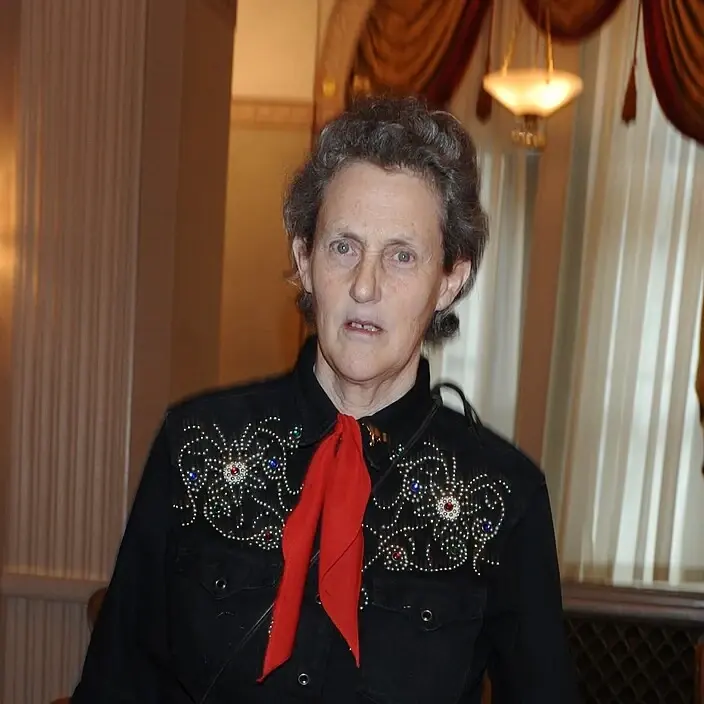
Temple Grandin is an American academic and autism activist. “Visual Thinking” explores how people who think in pictures, patterns, and words differ and how schools and workplaces can recognize those differences.
Explore more books by Temple Grandin