What you'll learn
Key ideas from Utopia for Realists
These ideas compress the book's argument without treating the author's view as settled fact. Use them as an orientation before reading the full work or listening in Wiseley.
Utopia serves as an open-ended guidepost for questioning accepted limits and debating different visions of a better society.
Sharing productivity through time, income, taxation, and ownership is a political choice that education alone cannot settle.
Market pay and demand reveal purchasing power under current arrangements, not a job’s full social contribution.
A guaranteed income frames basic security as a social right and gives recipients room to choose how to meet their needs.
Scarcity can sharpen attention to immediate needs while draining the mental bandwidth needed for planning, self-control, and decisions beyond the present.
A useful progress dashboard keeps economic statistics alongside material conditions, work, knowledge, cohesion, service, and time.
Bregman argues that border militarization raised crossing risks, reduced return migration, and coincided with a much larger undocumented Mexican population.
Crises can open space for change or reinforce old convictions; ideas already available help shape what follows.
Inside Utopia for Realists
Read the first chapter in full here. The other 8 continue in the Wiseley app.
Chapter 1 of 9 · 7 min · Audio & text
Recovering the Future
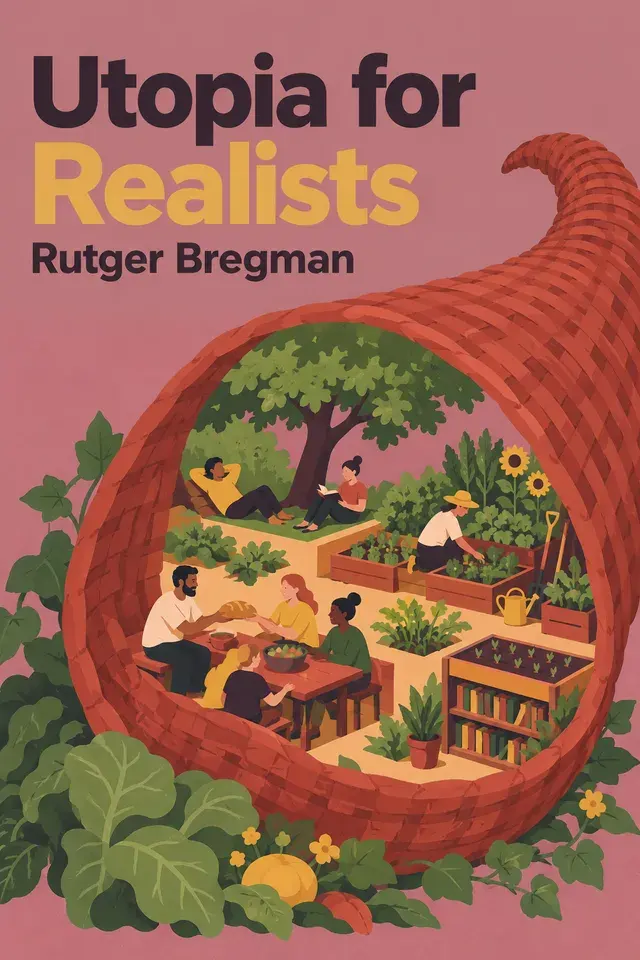
Utopia for Realists, by Rutger Bregman.
Bregman opens with Oscar Wilde’s image of humanity reaching one country and then setting sail for a better one. The image treats progress as more than improving what already exists. It depends on being able to imagine somewhere better to go. Bregman sees a striking modern paradox: people have gained wealth, health, safety, and knowledge on a scale that would once have seemed impossible, yet they struggle to picture a shared future worth pursuing.
To show how unusual this change is, he asks us to imagine a peasant in Tuscany. By his estimate, average Italian income was about sixteen hundred dollars in both 1300 and around 1900. For centuries, daily life changed so slowly that someone could move between those periods and notice little difference. Then, from around 1880, new inventions and rapid economic growth changed the pace of life. Bregman estimates that the average Italian became fifteen times as wealthy as in 1880. He also cites a steep decline in extreme poverty worldwide, from 94 percent in 1820 to under 10 percent by the time of his account. These figures frame a real transformation, not a promise that progress will continue automatically.
Nor have the gains reached everyone alike. Bregman notes that income in Congo had hardly changed over two centuries, even as other places grew much richer. The contrast matters: progress can be immense and still leave people excluded, and richer societies have unfinished responsibilities to others.
Bregman uses Cockaigne, a medieval dream of plenty, to explore what abundance once meant. In this imagined country, roast geese fly ready to eat, wine flows in rivers, and people have leisure instead of endless labor. The dream answers the pain of scarcity with food, comfort, and freedom from hard work. By comparison, modern Western Europe might look like Cockaigne to someone from the Middle Ages: food is plentiful, homes can be heated or cooled, leisure is more available, and social assistance exists. Bregman qualifies the comparison: access to an impressive social safety net depends partly on having the right passport.
Even where the old dream seems fulfilled, abundance cannot answer every question. The pursuit of ever more consumption has brought costs such as pollution, obesity, and surveillance. More fundamentally, material comfort does not tell people what to live for. The question changes from how to escape hunger and insecurity to what might give life purpose once some of those needs are met. Cockaigne can describe a destination for material desire, but it does not say what makes a good life.
That gap is the crisis of purpose Bregman wants readers to notice. He argues that politics has grown comfortable with administering current problems and targets, while leaving less room to debate shared ideals. When parties seem to differ mainly over small adjustments, it becomes harder to imagine a different society. Many people in wealthy countries, he says, expect their children to fare worse. His concern is not simply that progress might stall; it is that people have lost confidence in their ability to envision something better.
He connects this loss of imagination to the tendency to treat shared troubles as private failures. Unemployment, illness, or unhappiness can be framed as evidence that an individual made poor choices or did not try hard enough. Meanwhile, older collective affiliations have weakened. If common problems are understood only as personal ones, people have fewer ways to discuss their causes together or to build a shared response. Bregman calls for new collectives that can make those conversations and efforts possible.
For him, utopia is a way to reopen the argument about what society could become. The word carries a tension between a good place and a place that does not exist. A utopia should therefore act as a guidepost: it can direct attention toward better possibilities without pretending to provide a complete answer. It can make familiar arrangements look questionable and keep questions alive about what counts as progress and what people value. Different visions can compete in public debate; no single ideal needs to settle the matter for everyone.
This open-ended approach also separates a guidepost from a fixed blueprint. Bregman points to Tommaso Campanella’s City of the Sun, where an ideal society prohibits individual ownership, controls private life, prescribes relationships, and watches citizens under rules that tolerate no dissent. Fighting is punishable by death, and someone who commits a transgression is browbeaten until they submit to being stoned. A detailed design like this can subordinate real people to the ideal it claims to serve. Thomas More’s Utopia, by contrast, can be read as an indictment of greed and poverty rather than a literal plan to impose. The distinction is not between having ideals and having none. It is between using an ideal to question society and enforcing it as a finished design.
Bregman’s method is to imagine alternatives, build them on solid foundations, and experiment cautiously. That requires people to gather around possibilities and learn from attempts to put them into practice. An experiment may help reveal what works and what needs to change, without claiming to settle the question of how everyone should live. For Bregman, history is shaped by human choices and ideas; it is not determined by machines or trends alone.
The aim, then, is not to arrive at a perfect society and stop asking questions. It is to recover the capacity to imagine directions worth exploring, while remaining open to disagreement and correction. Material progress can give people more possibilities, but a vision of better lives helps give those possibilities direction. Utopia matters as an invitation to think and act together, not as a final destination.
Chapter 2 of 9 · 9 min · Audio & textIn the app
Who Gains from Machines?
A machine can help society make more while requiring fewer people to make it. That simple arithmetic opens a political question: when output rises, whose income rises with it?
Chapter 3 of 9 · 9 min · Audio & textIn the app
Work Time as a Shared Dividend
In 1930, economist John Maynard Keynes imagined that rising prosperity might eventually leave people working only about fifteen hours a week. He treated this as a distant prospect, not a schedule for the near future.
Chapter 4 of 9 · 10 min · Audio & textIn the app
What Counts as Valuable Work?
A job’s price does not settle its value to society. Pay and market demand show where employers and customers are willing to spend money under current rules.
Chapter 5 of 9 · 12 min · Audio & textIn the app
Income as a Social Right
A guaranteed income begins with a different idea of what public assistance is for. Rather than treating money as a prize for the deserving or help reserved for people who pass a test, Bregman argues that everyone should have a secure minimum as a right.
Chapter 6 of 9 · 11 min · Audio & textIn the app
Poverty's Cognitive Tax
Poverty is often treated as evidence that someone lacks discipline or makes poor choices. But the same behavior can look different when we consider the conditions under which decisions are made.
Chapter 7 of 9 · 8 min · Audio & textIn the app
Measuring What Matters
A statistic’s original job matters. Before gross domestic product became familiar, governments estimated national wealth for changing purposes, including taxes, war, and harvests.
Chapter 8 of 9 · 9 min · Audio & textIn the app
Testing Aid, Rethinking Borders
Good intentions do not tell us whether a policy reduces poverty. Rutger Bregman turns to randomized controlled trials, or RCTs, as a way to test development claims.
Chapter 9 of 9 · 7 min · Audio & textIn the app
How Ideas Become Possible
The policies discussed in this book do not become public choices simply because someone has made a persuasive case for them. Bregman closes by asking how ideas once treated as impossible can gain influence.
Chapter 1 of 9 · 7 min · Audio & text: Recovering the Future
Wiseley supports reading and listening to summaries in the app.
Continue in WiseleyAbout Rutger Bregman

Rutger Bregman is a Dutch historian and author. “Utopia for Realists” explores why material progress has not supplied a shared vision of a better future.
Explore more books by Rutger Bregman