What you'll learn
Key ideas from Until the End of Time
These ideas compress the book's argument without treating the author's view as settled fact. Use them as an orientation before reading the full work or listening in Wiseley.
The second law describes an overwhelming statistical tendency toward higher entropy, not an absolute ban on decreases.
Cells sustain local organization through ongoing energy flow and entropy release to their surroundings.
Evolution changes populations through inherited variation and differences in reproductive success, without a planned direction.
Brain mechanisms and behavior can be measured, while the first-person feel of experience remains a distinct explanatory question.
Practical freedom describes the broad, flexible responses that a person’s organization supports, compared with a rock’s limited responses.
Language lets people pass on knowledge, coordinate action, and share plans beyond direct experience.
Extraordinary claims call for carefully designed, repeatable tests that can distinguish results from chance.
Human life is contingent and finite, but impermanence can make relationships, inquiry, and expression more precious.
Inside Until the End of Time
Read the first chapter in full here. The other 14 continue in the Wiseley app.
Chapter 1 of 15 · 6 min · Audio & text
One Universe, Many Explanations
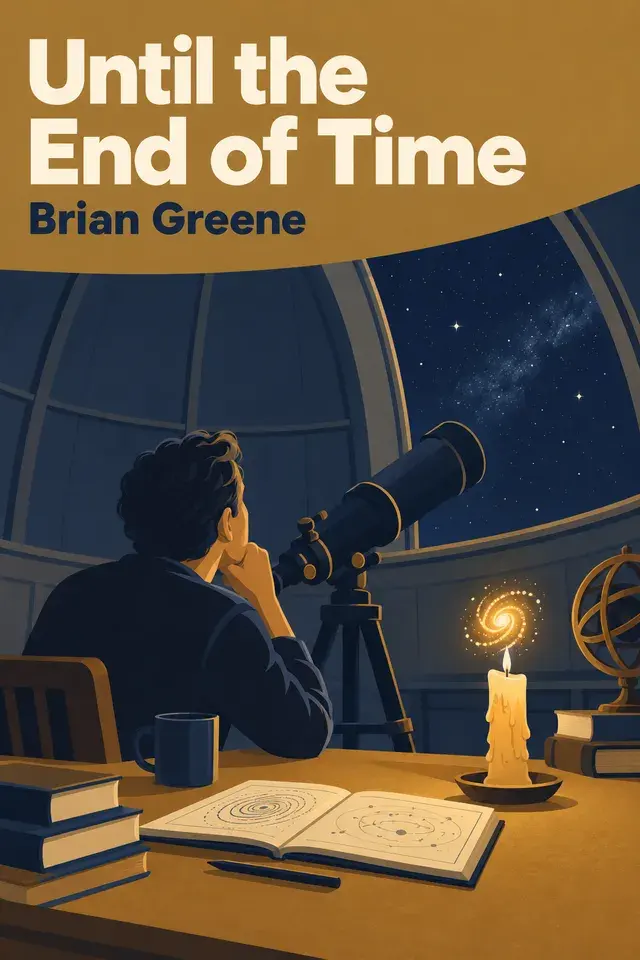
Until the End of Time, by Brian Greene.
Brian Greene begins with a large itinerary: follow the universe from its earliest history through the formation of stars and planets, the emergence of life, and the arrival of minds that can ask how the story ends. This is not a claim that physics alone contains every answer. It is a way to trace how increasingly complex forms arise within one physical world, while asking what each kind of explanation can tell us. Entropy and evolution will recur as guides through that history; for now, they mark themes, not complete explanations.
That approach depends on recognizing that a question’s scale changes the explanation that serves it. Physics describes particles and forces; biology describes living organization, inheritance, and adaptation; accounts of thought and culture ask how people interpret, create, and share. These descriptions are connected: living things are physical, and human minds depend on living brains. But a connection is not a reason to replace one vocabulary with another. Each level selects features that matter for a different question, and no single account currently makes every other account unnecessary.
The Pythagorean theorem offers a small model of both the power and limits of explanation. In the geometry where its assumptions hold, a proof establishes a precise relation among the sides of every right-angled triangle. Once the starting rules and definitions are fixed, a correct proof is not merely a useful guess; its conclusion follows necessarily. That security belongs to the relation as stated within that framework.
Change the geometry, and the conclusion need not carry over unchanged. Triangles on a curved surface can yield a different result from the familiar case. This does not make the original proof defective; it means the proof answered a conditional question. The assumptions determine which mathematical world is being described, and within that world the reasoning can be exact.
That leaves a further question. Does mathematics describe a structure that reality possesses independently of us, with human beings discovering its truths? Or is mathematics a language people made, exceptionally powerful because the world contains regularities and our minds are good at finding patterns? Greene is drawn to the first possibility, but he does not settle the issue. Equations can describe nature with striking precision without proving that the universe is, in itself, mathematical. We know the language works; what that success says about the world’s deepest nature remains open.
The distinction between a description and what it helps us understand appears again when Greene turns from equations to literature. A physical account could trace the atoms in Cervantes’s body and the activity of his brain as he wrote Don Quixote. Such an account might illuminate the material process of writing. It would not, by itself, tell us what an interpretation of the novel can reveal about human nature. For that, we attend to the story as a work of literature, using concepts and judgments from another level of inquiry. The literary account does not deny the physical one; it answers another question.
The same principle cautions against treating the disciplines as rival candidates for the one proper description. Reduction to simpler ingredients is a powerful scientific strategy; it helps explain how a larger system is made and behaves. Yet details that matter at one scale can obscure a question posed at another. A description of matter does not automatically tell us what an organism is doing, how a person understands an experience, or what a literary work reveals about people. Good explanations fit their subject and remain compatible with what is known at other levels.
Greene’s route through physics, life, consciousness, and culture therefore moves by linked but distinct stories. A unified account of all phenomena may be possible, but it is not already in hand. Even a unified physical foundation would not automatically replace explanations that work at the scale of organisms or human experience. The task is to follow the connections without pretending that a particle description and a human interpretation perform identical work.
This explanatory project also opens an existential question. Greene wonders whether awareness of death helps explain people’s attraction to what seems lasting: mathematical proofs, natural laws, philosophies, religions, works of art, or legacies. Seeking permanence may be one response to knowing that our time is limited. Greene treats this as a plausible influence, not a universal key. Daily circumstances, social life, deliberation, and many other motives also shape what people do; mortality cannot explain everything.
Cosmic history and mathematical description can show how minds entered a universe governed by physical processes. They do not, by themselves, settle what human life means. The journey ahead follows the links from physical conditions to life and mind, then to the stories people make. Its starting point is that one world can sustain several explanations, each revealing something the others leave in shadow.
Chapter 2 of 15 · 5 min · Audio & textIn the app
Counting Entropy and Time
Thermodynamics began with a practical problem: how could steam engines turn more of their fuel into useful work? A heated steam engine pushed a piston, but mid-nineteenth-century engines wasted much of the heat they received.
Chapter 3 of 15 · 7 min · Audio & textIn the app
Order in an Expanding Cosmos
The second law describes a statistical pull toward higher total entropy, but it does not require every region to become less structured. A subsystem can lose entropy if its surroundings gain more.
Chapter 4 of 15 · 6 min · Audio & textIn the app
Stars Forge the Elements
Gravity can do more than gather matter into clumps. In a sufficiently massive cloud of gas, it can make the cloud less uniform.
Chapter 5 of 15 · 6 min · Audio & textIn the app
Life’s Shared Molecular Machinery
The elements that can make familiar life are not enough by themselves. Life appears when ordinary matter is arranged into cells whose many parts coordinate.
Chapter 6 of 15 · 8 min · Audio & textIn the app
Evolution and Life’s Open Origin
Life’s history brings two questions that are easy to confuse. How do populations change once heredity and reproduction exist?
Chapter 7 of 15 · 7 min · Audio & textIn the app
The Puzzle of Experience
A brain can be studied from the outside. Researchers can record its activity, relate patterns to behavior, and investigate which regions process different kinds of information.
Chapter 8 of 15 · 5 min · Audio & textIn the app
Choice Within Physical Law
Quantum theory presents an unmeasured particle as a mixture of possible outcomes. This is more than saying that the particle has one definite position we do not yet know.
Chapter 9 of 15 · 6 min · Audio & textIn the app
Language, Stories, and Social Imagination
Human language lets people share more than a signal about what is happening now. A small set of sounds can be combined into sentences, and sentences into descriptions of events that never occurred.
Chapter 10 of 15 · 6 min · Audio & textIn the app
Myths, Mortality, and Religion
Myths give cultures stories about origins, rituals, and how the world is ordered. In Greene’s working definition, they are culturally important stories that invoke supernatural agents to explore culture’s grand concerns.
Chapter 11 of 15 · 5 min · Audio & textIn the app
Belief, Evidence, and Science
We rely on patterns to make sense of the world. Recognizing a familiar face, anticipating what an animal may do, or understanding how a thrown object moves can help us act.
Chapter 12 of 15 · 6 min · Audio & textIn the app
Art as Felt Knowledge
Art is ancient and widespread, yet its evolutionary purpose is not obvious. People spend time and energy making music, images, and performances, though these activities do not serve a clear survival need like finding food.
Chapter 13 of 15 · 8 min · Audio & textIn the app
The Universe’s Conditional Endings
The universe’s distant future is best read as a set of conditional routes, not one certain calendar. Greene’s broad forecast assumes that known physical laws continue to hold and that future intelligence does not take control of stars or galaxies.
Chapter 14 of 15 · 9 min · Audio & textIn the app
Thought at the Cosmic Limit
The possibility of thought lasting as long as the cosmos turns on a practical thermodynamic question: can a thinker keep getting usable energy and releasing its waste? Any Thinker, whatever its physical design, must take in concentrated energy, change its internal state as it processes information, and release heat.
Chapter 15 of 15 · 5 min · Audio & textIn the app
Meaning in Finite Lives
The book ends by returning from the universe’s history to the question of what makes a human life matter. Physics can describe how matter became life and mind, and what limits may face them.
Chapter 1 of 15 · 6 min · Audio & text: One Universe, Many Explanations
Wiseley supports reading and listening to summaries in the app.
Continue in WiseleyAbout Brian Greene
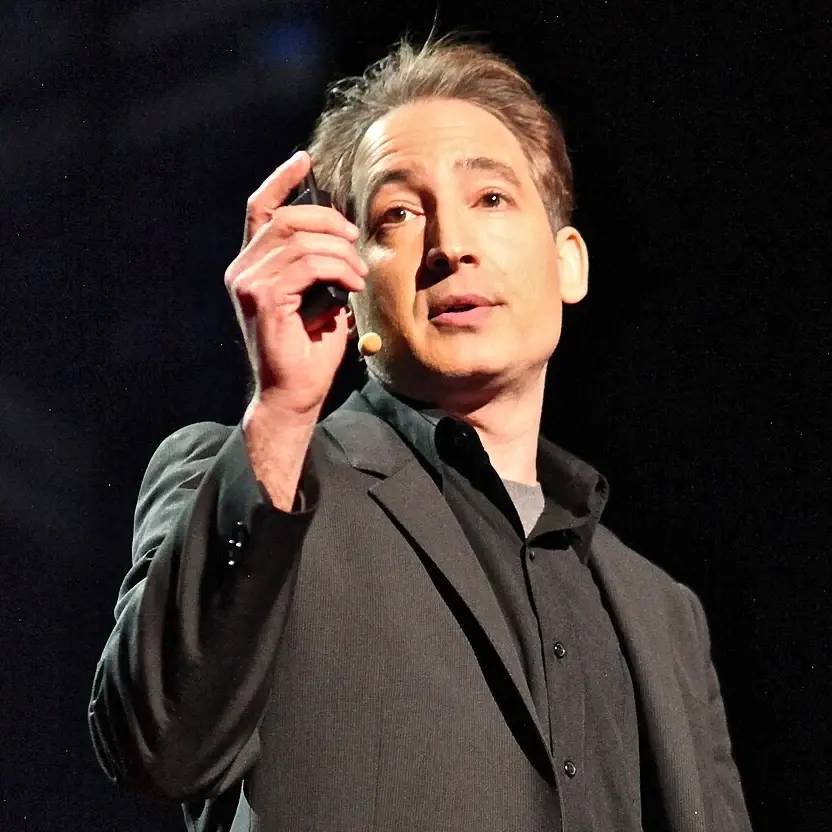
Brian Greene is an American theoretical physicist. “The Elegant Universe” explores string theory and the search for a unified description of the physical universe.
Explore more books by Brian Greene