What you'll learn
Key ideas from Unstoppable
These ideas compress the book's argument without treating the author's view as settled fact. Use them as an orientation before reading the full work or listening in Wiseley.
At Bollettieri’s, early starts, drills, lessons, and matches turned the family’s decision into a demanding daily routine.
Sharapova learned to build points by anticipating how one placement could shape the opponent’s reply and the shot after it.
Her method for using defeat was to diagnose what failed, keep the lesson, and release the fear that could make her play too safely.
Sharapova attributed her 2005–2006 consistency chiefly to knowing her strengths and limits, not to a sudden physical upgrade.
She believed Grigor’s pursuit of beautiful, perfect tennis hindered his progress; great players also win when depleted with an imperfect game.
Her 2012 French Open title showed that she had returned from shoulder surgery by changing how she won.
Sharapova accepted the positive test and her failure to check the updated list while disputing how clearly the change was communicated.
Inside Unstoppable
Read the first chapter in full here. The other 11 continue in the Wiseley app.
Chapter 1 of 12 · 6 min · Audio & text
Persistence Starts in the Present
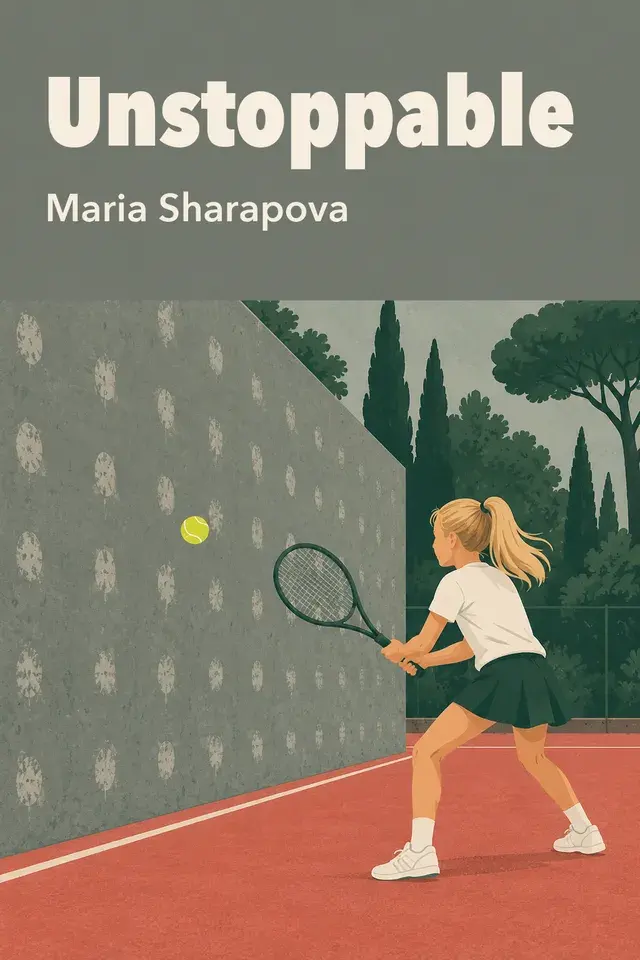
Unstoppable, by Maria Sharapova.
Unstoppable opens at the 2016 Australian Open, where Sharapova takes what she describes as a routine urine test. The meldonium finding that follows disrupts the career story. To approach the question of how she responds, the memoir turns back to her childhood and asks a more basic question: what keeps her going? Its first answer is not a theory of toughness, but the pleasure of paying attention to a ball and its return.
Sharapova says hitting a tennis ball had delighted her since she was four. In her account, hitting can also bring her attention back to the present when distress or frightening news takes over. The earliest scene she recalls is in a Sochi park. She takes a racket and ball from her father’s bag, then hits against a fence or wall and watches the ball come back. She is unsure whether this is a direct memory or one shaped by old photographs. Either way, the scene presents tennis first as an absorbing, immediate task: make contact, follow the ball, and do it again.
Her father brought her to Riviera Park, where she could hit against a wall for hours. People who noticed her there were struck more by her concentration and persistence than by her skill. Her father eventually enrolled her in a children’s tennis clinic. The coach, Yuri Yudkin, noticed how her eyes followed the ball and how long she stayed with the activity. He saw promise, but believed her development would depend on whether she could sustain that effort over time.
That early absorption did not remain only a pleasure. As tennis became lessons, matches, and tournaments, Sharapova’s focus turned toward beating opponents. At first she wanted to beat her father and his skilled friends. She says trophies were not the point; she wanted to win, and she hated losing. Loss stayed with her, and fear of defeat became one source of her competitive drive. Her account holds both sides together: a love of hitting and a growing desire to come out ahead.
Yudkin offered a practical description of toughness. It meant locking into repetitive work and enduring the boredom that made other children restless. He believed early promise alone could not show whether a player would keep working day after day, or whether the grind would eventually become unbearable. Sharapova says she liked repetition and believed tedious practice could help her win. She describes continuing in difficult conditions, and after others stopped, as a gift more important than strength or speed.
Still, she cannot explain where that quality came from. She wonders whether wanting approval from her father or coach played a part, but does not claim to know. She has even suggested that examining toughness too closely might damage it. Persistence, then, is neither a fully explained trait nor simply a decision made once. In these early years, it appears through repeated returns to the task, even as its deeper source remains uncertain.
Circumstance also helped determine whether tennis could become that task. Sharapova’s family left Gomel after the Chernobyl disaster and first went north to Siberia. After Maria was born there, her father chose Sochi rather than staying or returning to Gomel. Sharapova says she would not have taken up tennis without that move: tennis was part of Sochi’s resort life and more accessible there than in much of Russia. The disaster did not make a tennis career inevitable. In her account, it set off a chain of moves that placed tennis within reach.
Some parts of this childhood story remain open questions. Along with her uncertainty about the park memory, Sharapova wonders whether her mother’s exposure to local food and water around the time of Chernobyl might have had something to do with her height. She offers no answer and does not present this as an established cause. These qualifications matter because the memoir looks back to make sense of a life, while acknowledging that memory and explanation do not always provide certainty.
When Yudkin later judged that Sochi offered too few opportunities for her development, he stressed that her potential did not guarantee she could keep going. The effort would require her father to commit himself to the work. Sharapova says Yuri decided instinctively to take on that responsibility. Though he knew little about tennis, he believed he could learn, gave up his job and plans, and made her development his goal. His decision turned a child’s absorbed play into a family project, but it could not settle how far that project would go.
Her parents’ accounts of the decision differ. Yuri says her mother supported the plan from the start. Sharapova remembers her mother as not believing in tennis, but trusting and loving her husband and coming around because of his certainty. The difference shows that family commitment was not a single, identical conviction shared by everyone. It took shape through different kinds of trust and willingness.
The beginnings of Sharapova’s persistence therefore resist a simple explanation. Tennis started as pleasure, became a way to concentrate on what was in front of her, and grew into a drive to beat others. Her path also depended on where her family moved, what her coach believed was possible, and the commitment her father chose to make. The question of what made her keep going remains partly unanswered. What the childhood story does establish is that persistence was built from returns to the present, inside circumstances no single quality could control.
Chapter 2 of 12 · 6 min · Audio & textIn the app
A Family Bets on Tennis
When Maria Sharapova was six, her father acted on a conviction that her tennis could grow beyond the opportunities available to them. A youth clinic in Moscow put that belief before a much larger audience.
Chapter 3 of 12 · 7 min · Audio & textIn the app
Sacrifice, Boundaries, and Support
At Bollettieri’s, access to tennis had never meant that the family’s other needs were covered. The academy paid for Maria’s lessons, tournament arrangements, and two meals a day, but Yuri still had to find money for rent, spending money, and other costs.
Chapter 4 of 12 · 7 min · Audio & textIn the app
Recognition Changes the Stakes
At a Florida tournament, Sharapova was probably the youngest player there, facing opponents who were older and often bigger. She remembers surprise at the applause she received as she advanced.
Chapter 5 of 12 · 7 min · Audio & textIn the app
Building a Competitive Game
Sharapova’s competitive game began to take shape as a way to solve a point, not just to strike a ball hard. She describes learning to read angles and think several shots ahead.
Chapter 6 of 12 · 6 min · Audio & textIn the app
Learning the Tour’s Demands
By sixteen, Sharapova was moving from junior training into a professional year shaped by travel, fatigue, and opponents with more experience. She says she needed to build strength and coordination, because stamina could determine whether she held up in difficult matches.
Chapter 7 of 12 · 9 min · Audio & textIn the app
Winning by Staying in the Point
Sharapova’s 2004 Wimbledon title was not a smooth climb fueled by uninterrupted confidence. In her account, it came as she learned to keep attention on the play in front of her, drawing on skill and support when her mind or body faltered.
Chapter 8 of 12 · 7 min · Audio & textIn the app
Success Must Be Repeated
Winning Wimbledon changed what Sharapova had to solve. A first major proved she could win the biggest event, but it also made each next tournament a test of whether she could do it again.
Chapter 9 of 12 · 7 min · Audio & textIn the app
Rebuilding After Injury
Sharapova’s account of recovery begins in a year when achievement and loss arrived together. In 2008, she won the Australian Open, her third Grand Slam title, while losing important coaching relationships and confronting a shoulder injury that would unsettle her game.
Chapter 10 of 12 · 4 min · Audio & textIn the app
Intimacy and Imperfect Play
In Sharapova’s account, competition shapes private life as well as public achievement. She says friendship with fellow players is difficult because they are opponents; affection can make it harder to finish a match decisively.
Chapter 11 of 12 · 7 min · Audio & textIn the app
Adapting for a Long Career
By her mid-twenties, Sharapova felt she had reached the middle of her professional career. The early excitement had faded, many goals had been met, and younger players now treated beating her as a major achievement.
Chapter 12 of 12 · 7 min · Audio & textIn the app
Responsibility After the Ban
In winter 2015, Sharapova was thinking about retirement and imagining that 2016 might be her final season. Then a positive test from the Australian Open changed the question from when she might stop playing to whether she could return at all.
Chapter 1 of 12 · 6 min · Audio & text: Persistence Starts in the Present
Wiseley supports reading and listening to summaries in the app.
Continue in WiseleyAbout Maria Sharapova

Maria Sharapova is a Russian former professional tennis player. “Unstoppable” explores a tennis career shaped by childhood migration, family sacrifice, relentless practice, major victories, injury, and a doping suspension.
Explore more books by Maria Sharapova